

1 Franc – Rwanda-Burundi
Context
Years: 1960–1964
Country: Rwanda and Urundi Belgian Congo
Issuer: Rwanda-Burundi
Issuing organization: Bank of Issue of Rwanda and Burundi
Currency:
(1960—1964)
Demonetized: Yes
Total mintage: 21,000,000
Material
References
KM: #Click to copy to clipboard1
Numista: #7256
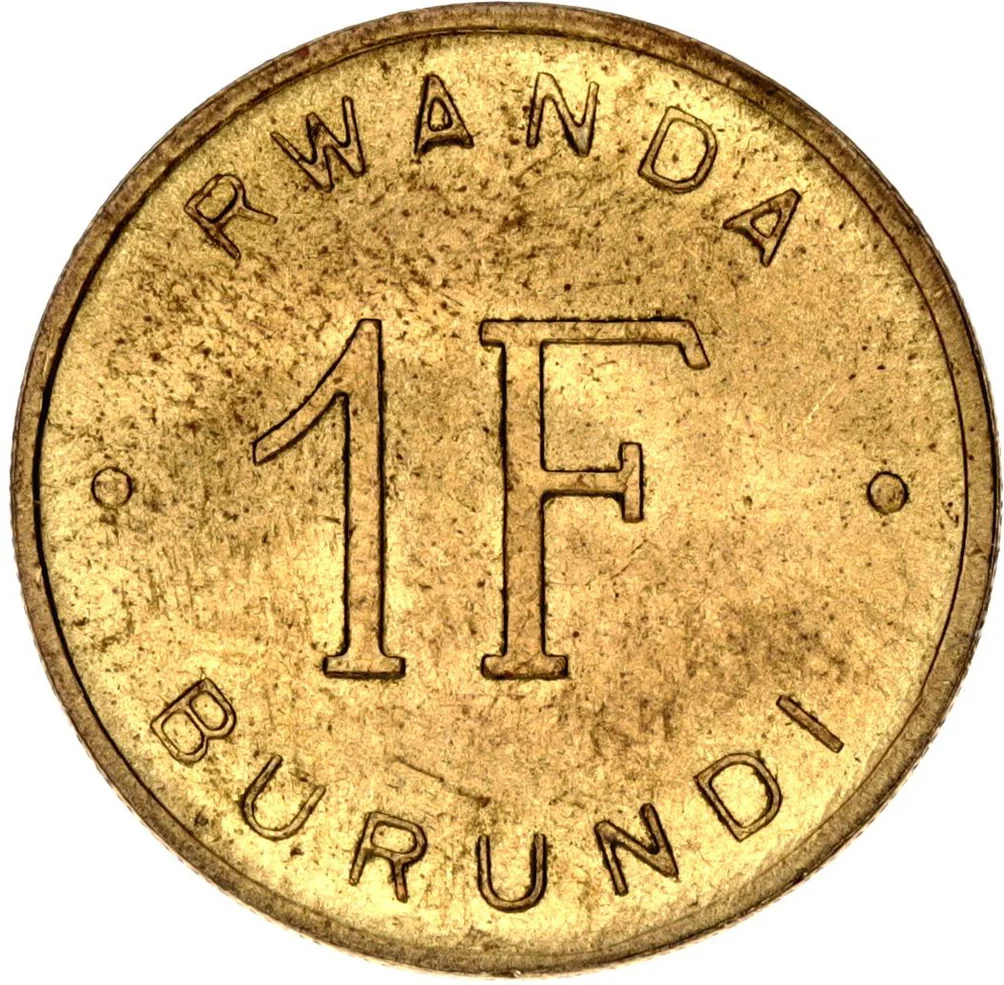
Obverse
Description:
Face value and issuer.
Inscription:
RWANDA
. 1F .
BURUNDI
. 1F .
BURUNDI
Script: Latin
Engraver: Marcel Rau
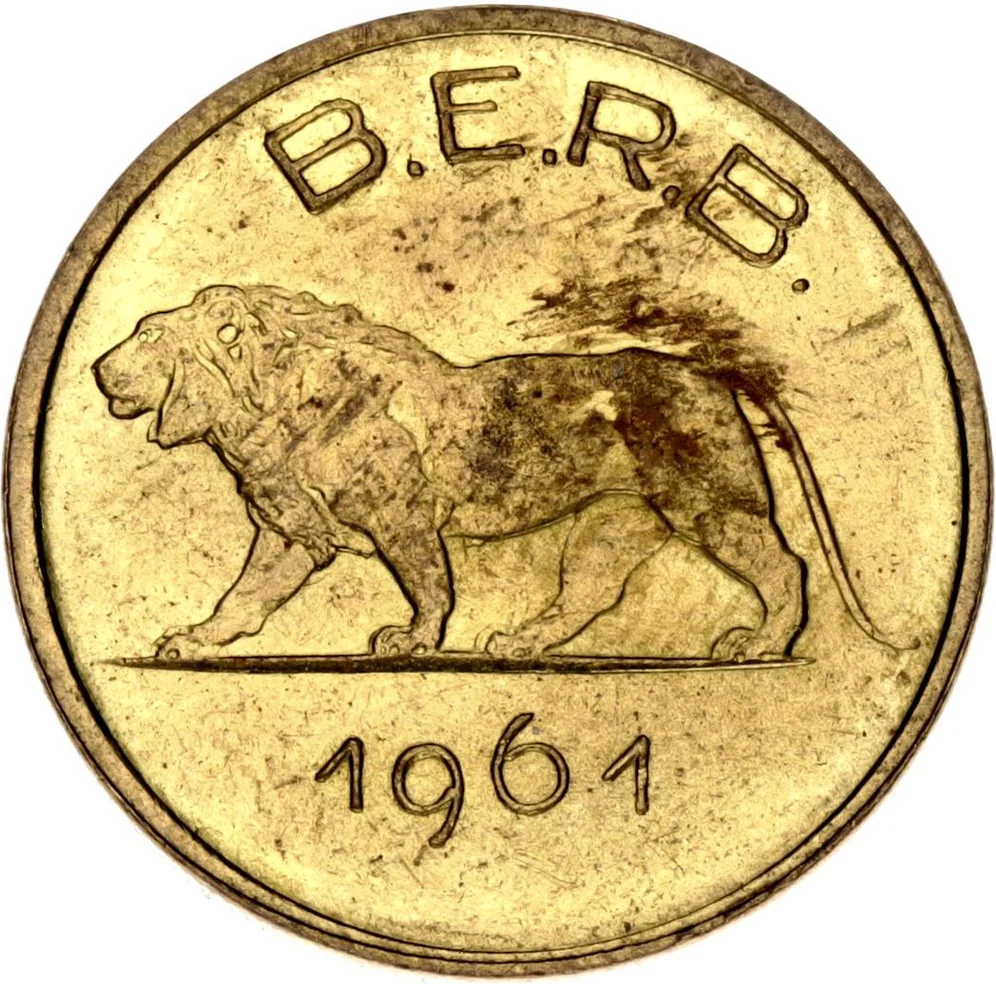
Reverse
Description:
Lion walking left.
Inscription:
B.E.R.B.
1961
1961
Translation:
Banca de Stat a Republicii Populare Române
1961
1961
Script: Latin
Language: Romanian
Engraver: Marcel Rau
Edge
Milled
Mints
| Name | Mark |
|---|---|
| Royal Mint of Belgium | — |
Mintings
| Year | Mint Mark | Mintage | Quality | Collection |
|---|---|---|---|---|
| 1960 | — | 2,000,000 | ||
| 1961 | — | 16,000,000 | ||
| 1964 | — | 3,000,000 |
Historical background
In 1960, Rwanda and Burundi existed as a unified administrative entity under Belgian colonial rule known as Ruanda-Urundi, which was a United Nations Trust Territory. The currency in circulation was the Belgian Congo franc, issued by the Banque Centrale du Congo Belge et du Ruanda-Urundi. This monetary union tied the economies of both territories directly to the Belgian Congo, reflecting the colonial economic structure that prioritized resource extraction and export to the metropole. The system provided monetary stability but was designed to serve broader colonial interests rather than foster independent local economic development.
Politically, 1960 was a year of intense upheaval and transition. The Belgian Congo was hurtling toward independence (achieved in June 1960), plunging into immediate instability. This crisis directly impacted Ruanda-Urundi, as the shared currency and central bank were headquartered in Léopoldville. The sudden disruption raised urgent questions about the future monetary sovereignty of Rwanda and Burundi, as their currency supply and banking system were now tied to a neighboring state in chaos.
Consequently, by late 1960, authorities in Ruanda-Urundi were forced to make emergency arrangements. They introduced a separate issue of francs, still denominated as "Congolese francs" but physically distinct and circulated only within their borders, to insulate themselves from the Congo's collapse. This interim solution was a clear precursor to full monetary independence, setting the stage for the establishment of separate national central banks and currencies—the Rwandan franc and the Burundian franc—following each country's independence in 1962. Thus, the currency situation of 1960 was one of abrupt colonial dissolution and the first pragmatic steps toward distinct national financial systems.
Politically, 1960 was a year of intense upheaval and transition. The Belgian Congo was hurtling toward independence (achieved in June 1960), plunging into immediate instability. This crisis directly impacted Ruanda-Urundi, as the shared currency and central bank were headquartered in Léopoldville. The sudden disruption raised urgent questions about the future monetary sovereignty of Rwanda and Burundi, as their currency supply and banking system were now tied to a neighboring state in chaos.
Consequently, by late 1960, authorities in Ruanda-Urundi were forced to make emergency arrangements. They introduced a separate issue of francs, still denominated as "Congolese francs" but physically distinct and circulated only within their borders, to insulate themselves from the Congo's collapse. This interim solution was a clear precursor to full monetary independence, setting the stage for the establishment of separate national central banks and currencies—the Rwandan franc and the Burundian franc—following each country's independence in 1962. Thus, the currency situation of 1960 was one of abrupt colonial dissolution and the first pragmatic steps toward distinct national financial systems.
🌱 Common