

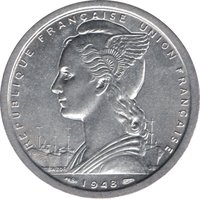
Obverse
Description:
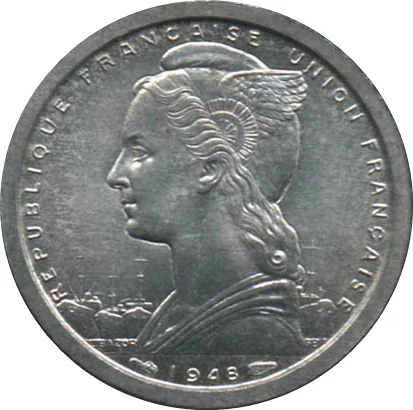
Marianne facing left in a winged Phrygian cap. Date in exergue.
Inscription:
REPUBLIQUE FRANÇAISE UNION FRANÇAISE
L.BAZOR GB
1948
L.BAZOR GB
1948
Translation:
FRENCH REPUBLIC FRENCH UNION
L.BAZOR GB
1948
L.BAZOR GB
1948
Script: Latin
Language: French
Engraver: Lucien Georges Bazor
Reverse
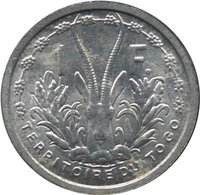
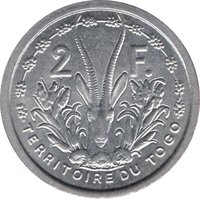
Description:
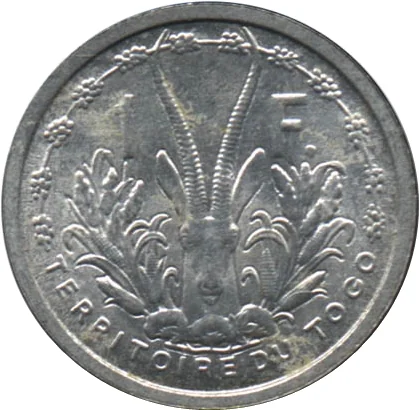
Gazelle head flanked by sprigs.
Inscription:
1 F.
TERRITOIRE DU TOGO
TERRITOIRE DU TOGO
Translation:
Territory of Togo
Script: Latin
Language: French
Engraver: Lucien Georges Bazor
Edge
Plain
Mints
| Name | Mark |
|---|---|
| Monnaie de Paris | — |
Mintings
| Year | Mint Mark | Mintage | Quality | Collection |
|---|---|---|---|---|
| 1948 | — | 5,000,000 |
Historical background
In 1948, Togo's currency situation was intrinsically tied to its status as a United Nations Trust Territory under French administration, following the post-World War I division of the former German colony. The official currency was the CFA franc, specifically the CFA franc of French West Africa (CFA XOF), which had been introduced across France's African colonies just two years prior, in 1945. This currency was created to stabilize the monetary environment and replace the pre-war French African franc, with a fixed parity to the French franc (initially 1.7 metropolitan francs = 1 CFA franc, though this was revalued in 1948 to 2 French francs = 1 CFA franc).
The CFA franc system operated under a strict framework of monetary union with France, guaranteeing unlimited convertibility and a fixed exchange rate. For Togo in 1948, this meant its currency was fully managed by the Banque de l'Afrique Occidentale (BAO), which acted as the central bank for the French West African territories. This arrangement provided monetary stability and facilitated trade within the franc zone, but it also meant Togo had no independent monetary policy; its money supply, credit, and foreign exchange reserves were entirely controlled from Paris and Dakar (the seat of the BAO).
Economically, this system supported Togo's integration into the French commercial sphere, with exports like cocoa, coffee, and phosphates being channeled primarily to France. However, it also reflected and reinforced Togo's colonial economic structure, where the currency served the needs of the export sector and French interests more than fostering diversified local development. The fixed parity and guaranteed convertibility simplified transactions for colonial enterprises but offered little flexibility for the territory to respond to local economic conditions, a characteristic that would define its monetary landscape for decades to come.
The CFA franc system operated under a strict framework of monetary union with France, guaranteeing unlimited convertibility and a fixed exchange rate. For Togo in 1948, this meant its currency was fully managed by the Banque de l'Afrique Occidentale (BAO), which acted as the central bank for the French West African territories. This arrangement provided monetary stability and facilitated trade within the franc zone, but it also meant Togo had no independent monetary policy; its money supply, credit, and foreign exchange reserves were entirely controlled from Paris and Dakar (the seat of the BAO).
Economically, this system supported Togo's integration into the French commercial sphere, with exports like cocoa, coffee, and phosphates being channeled primarily to France. However, it also reflected and reinforced Togo's colonial economic structure, where the currency served the needs of the export sector and French interests more than fostering diversified local development. The fixed parity and guaranteed convertibility simplified transactions for colonial enterprises but offered little flexibility for the territory to respond to local economic conditions, a characteristic that would define its monetary landscape for decades to come.
🌟 Limited