

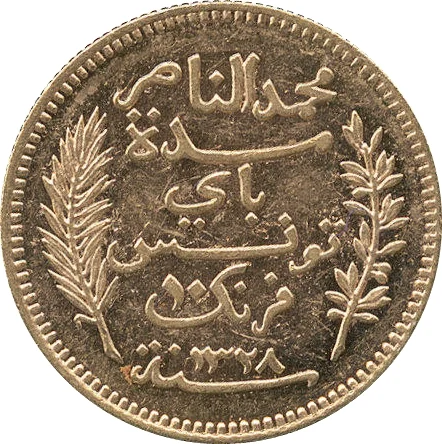
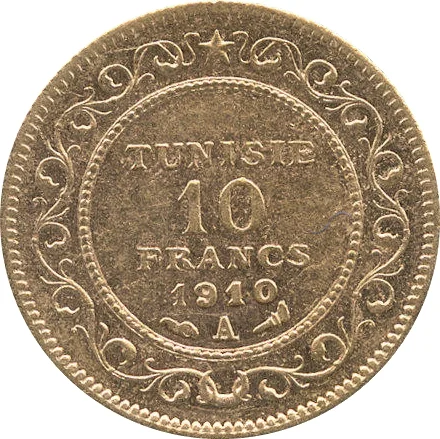

Obverse
Description:
Arabic ruler with value and Hijri date.
Inscription:
محمد الناصر
مدة
باي
تونس
١٠
فرنك
١٣٢٨
سنة
مدة
باي
تونس
١٠
فرنك
١٣٢٨
سنة
Translation:
Muhammad al-Nasir
Medina
Bey
Tunis
10
Francs
1328
Year
Medina
Bey
Tunis
10
Francs
1328
Year
Language: Arabic
Reverse
Edge
Mints
| Name | Mark |
|---|---|
| Monnaie de Paris | (A) |
Mintings
| Year | Mint Mark | Mintage | Quality | Collection |
|---|---|---|---|---|
| 1907 | — | 36 | ||
| 1908 | — | 166 | ||
| 1909 | — | 83 | ||
| 1910 | — | 83 | ||
| 1911 | — | 83 | ||
| 1912 | — | 83 | ||
| 1913 | — | 83 | ||
| 1914 | — | 83 | ||
| 1915 | — | 83 | ||
| 1916 | — | 83 | ||
| 1917 | — | 83 | ||
| 1918 | — | 83 | ||
| 1919 | — | 83 | ||
| 1920 | — | 83 | ||
| 1921 | — | 83 |
Historical background
In 1907, Tunisia operated under a complex and fragmented monetary system, a direct legacy of its pre-colonial economic ties and its new status as a French protectorate, established in 1881. The currency in circulation was a mixture of metallic coins, including the French gold 20-franc piece (the louis), the silver 5-franc piece, and various Spanish, Italian, and Ottoman coins. However, the most widely used currency for everyday transactions was the piastre, a unit of account inherited from the Ottoman era. Critically, the value of the piastre was not fixed to the French franc but was instead determined by the fluctuating market price of the silver coins on which it was based, leading to instability and uncertainty in trade and taxation.
This monetary duality created significant economic problems. The French administration and major commercial enterprises operated in the stable gold-based franc, while the local population and smaller-scale commerce used the volatile silver-based piastre. This led to a persistent exchange rate risk, complicating government budgeting, tax collection (as revenues in piastres had to be converted to francs), and business contracts. The instability discouraged European investment and exacerbated tensions within the protectorate's economy, effectively creating a two-tier system that disadvantaged local Tunisians engaged in the traditional economic sphere.
The situation in 1907 was therefore one of mounting pressure for reform, placing Tunisia on the cusp of a major monetary transition. French authorities viewed the chaotic system as an obstacle to full economic integration and control. Consequently, after years of planning, the reform would be enacted in the following year, 1908, with the decree of July 10. This law officially demonetized the old silver coins and definitively pegged the Tunisian franc to the French franc at par, formally subordinating Tunisia's currency to the French monetary zone and simplifying colonial economic management at the expense of local monetary tradition.
This monetary duality created significant economic problems. The French administration and major commercial enterprises operated in the stable gold-based franc, while the local population and smaller-scale commerce used the volatile silver-based piastre. This led to a persistent exchange rate risk, complicating government budgeting, tax collection (as revenues in piastres had to be converted to francs), and business contracts. The instability discouraged European investment and exacerbated tensions within the protectorate's economy, effectively creating a two-tier system that disadvantaged local Tunisians engaged in the traditional economic sphere.
The situation in 1907 was therefore one of mounting pressure for reform, placing Tunisia on the cusp of a major monetary transition. French authorities viewed the chaotic system as an obstacle to full economic integration and control. Consequently, after years of planning, the reform would be enacted in the following year, 1908, with the decree of July 10. This law officially demonetized the old silver coins and definitively pegged the Tunisian franc to the French franc at par, formally subordinating Tunisia's currency to the French monetary zone and simplifying colonial economic management at the expense of local monetary tradition.

✨ Legendary