

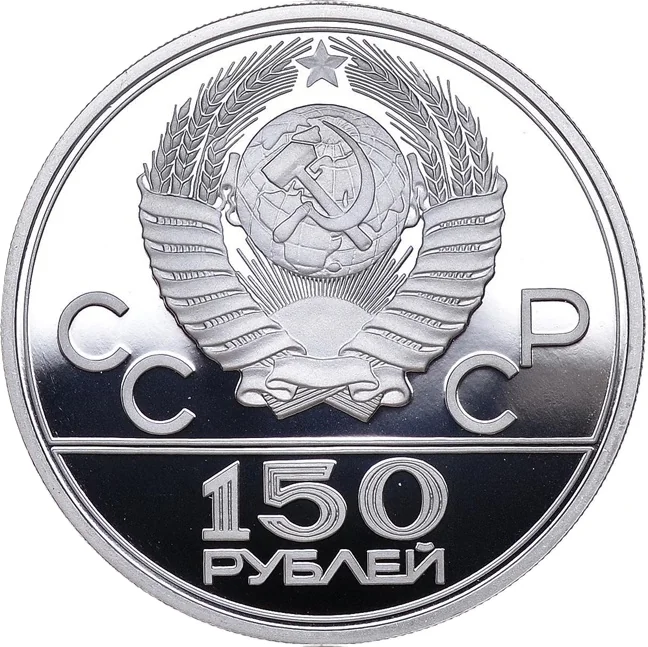
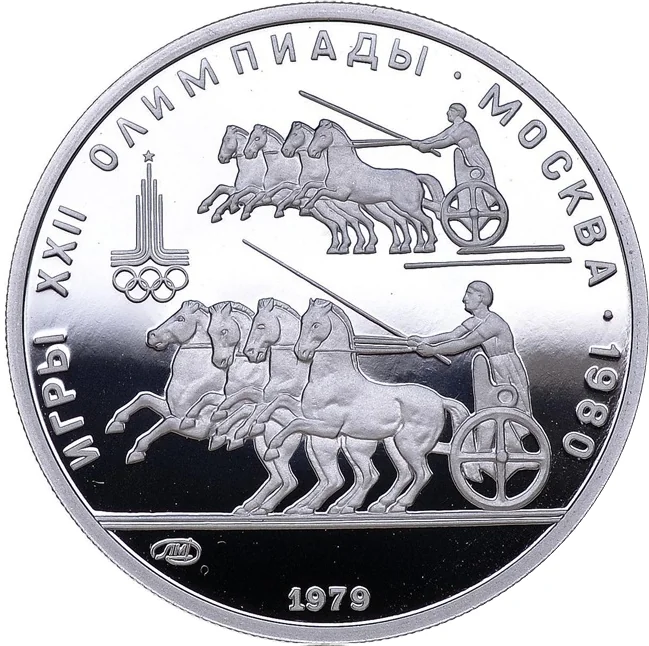
150 Rubles – Soviet Union
Non-circulating coins
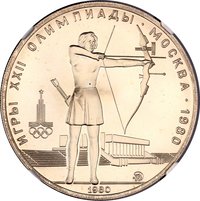
Commemoration: 1980 Summer Olympics, Moscow
Russia
Context
Year: 1979
Country: Russia 
Issuer: Soviet Union 
Period:
(1922—1991)
Currency:
(1961—1991)
Demonetization: 1991
Total mintage: 26,806
Material
Diameter: 28.6 mm
Weight: 15.55 g
Platinum weight: 15.53 g
Thickness: 1.5 mm
Shape: Round
Composition: 99.9% Platinum
Standard: Silver half ounce
Technique: Milled
Alignment: Medal alignment
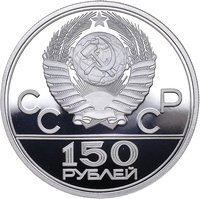
flip
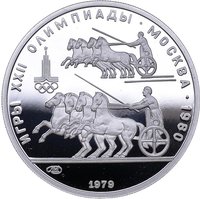
References
Y: #Click to copy to clipboard176
Numista: #71995
Value
Exchange value: 150 SUR
Bullion value: $0.00
Obverse
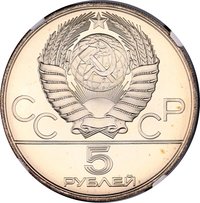
Reverse
Edge
Reeded
Categories
| Animal> Horse |
| Sport> Summer Olympic Games |
Mints
| Name | Mark |
|---|---|
| Saint Petersburg | (ЛМД) |
Mintings
| Year | Mint Mark | Mintage | Quality | Collection |
|---|---|---|---|---|
| 1979 | ЛМД | 9,728 | ||
| 1979 | ЛМД | 17,078 | Proof |
Historical background
In 1979, the Soviet Union operated under a rigid and complex dual-currency system, a hallmark of its centrally planned economy. The official state currency was the ruble (rubl), which was non-convertible, meaning it could not be legally exchanged for foreign currencies on international markets. Its value was set artificially by the state at an official rate (approximately 0.66 rubles to 1 US dollar) that bore no relation to its actual purchasing power or economic reality. Internally, this "clearing ruble" was used for all official salaries, domestic trade, and state accounting, but its stability masked a growing gap between the plentiful goods in propaganda and the empty shelves of state stores.
Beneath this facade, a vast shadow economy thrived, fueled by a second, parallel currency system. For ordinary citizens, access to desirable or even basic goods often required either hard foreign currencies (like US dollars or Deutsche Marks), obtained from abroad or on the black market, or special "certificate rubles." These were a separate script issued through Beryozka stores, which sold high-quality imported and deficit Soviet goods exclusively to foreigners, diplomats, and elite Soviet citizens with access to hard currency. This created a two-tiered society where privilege was measured not just in political status but in access to convertible funds.
The currency situation of 1979 thus reflected the USSR's deeper economic stagnation during the late Brezhnev era, known as the "Era of Stagnation." While the official ruble maintained a facade of stability, the thriving black market for hard currency and the existence of special stores exposed the growing inefficiencies and shortages within the planned economy. The system artificially insulated the Soviet economy from global financial pressures but at the cost of creating glaring inequalities and a crippling lack of consumer goods, planting seeds of discontent that would become more apparent in the following decade.
Beneath this facade, a vast shadow economy thrived, fueled by a second, parallel currency system. For ordinary citizens, access to desirable or even basic goods often required either hard foreign currencies (like US dollars or Deutsche Marks), obtained from abroad or on the black market, or special "certificate rubles." These were a separate script issued through Beryozka stores, which sold high-quality imported and deficit Soviet goods exclusively to foreigners, diplomats, and elite Soviet citizens with access to hard currency. This created a two-tiered society where privilege was measured not just in political status but in access to convertible funds.
The currency situation of 1979 thus reflected the USSR's deeper economic stagnation during the late Brezhnev era, known as the "Era of Stagnation." While the official ruble maintained a facade of stability, the thriving black market for hard currency and the existence of special stores exposed the growing inefficiencies and shortages within the planned economy. The system artificially insulated the Soviet economy from global financial pressures but at the cost of creating glaring inequalities and a crippling lack of consumer goods, planting seeds of discontent that would become more apparent in the following decade.
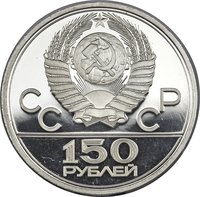
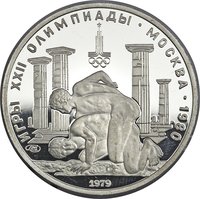
💎 Extremely Rare