

200 lire (Arm of Carabinieri foundation) – Italy
Add to wishlist
Circulating commemorative coins
Commemoration: 180th Anniversary of the foundation of the Arm of Carabinieri
Italy
Context
Material
References
KM: #
Numista: #719
Value
Exchange value: 200 ITL
Inflation-adjusted value: 397.04 ITL
Obverse
Description:
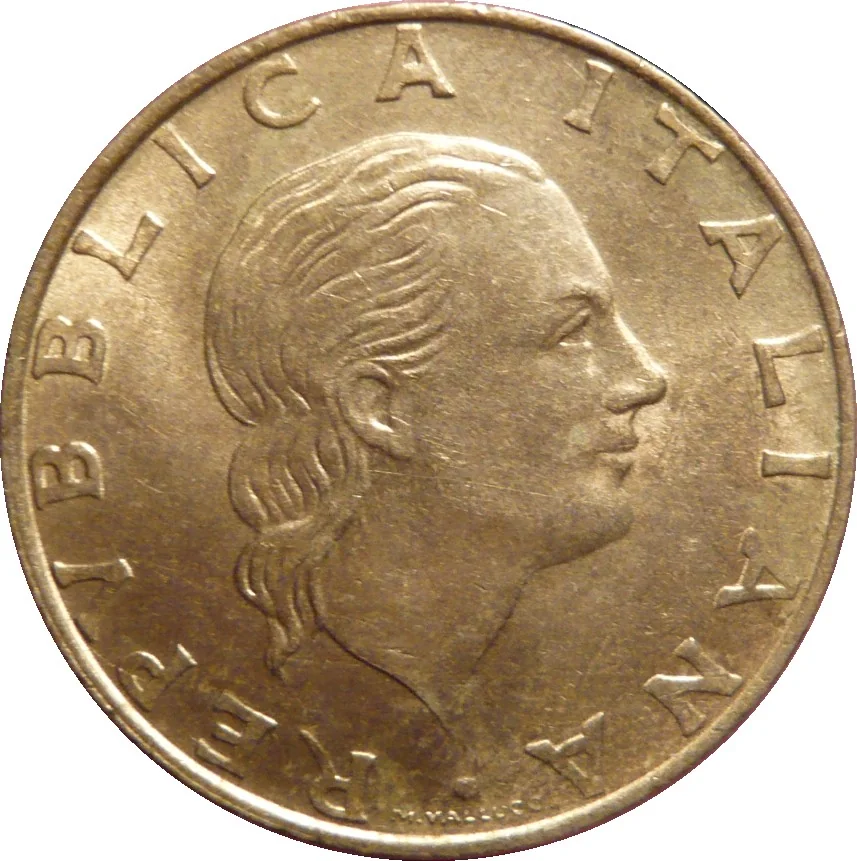
Female head with long curls facing right. Below neck, a large dot and engraver's name.
Inscription:
REPVBBLICA ITALIANA ·
M.VALLUCCI
M.VALLUCCI
Translation:
Italian Republic
M. Vallucci
M. Vallucci
Script: Latin
Engraver: Mario Vallucci
Reverse
Description:
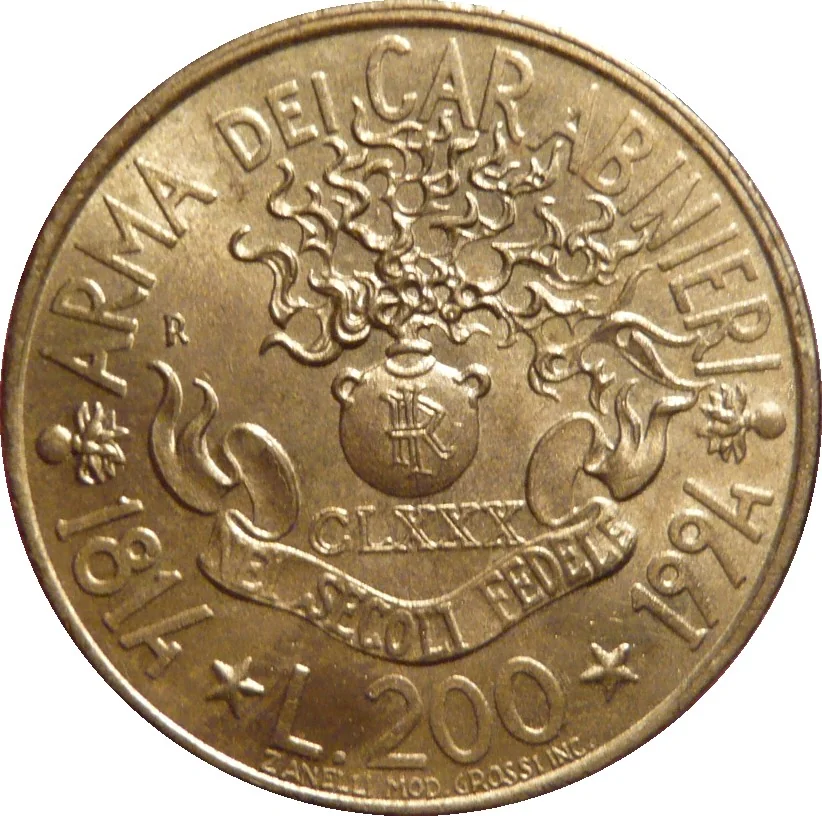
Carabinieri symbol (a grenade with a thirteen-pointed flame) above anniversary years in Roman numerals and a banner. Below, the value between stars and the anniversary dates.
Inscription:
ARMA DEI CARABINIERI
R
IR
CLXXX
NEI SECOLI FEDELE
1814 * L.200 * 1994
ZANELLI MOD. GROSSI INC.
R
IR
CLXXX
NEI SECOLI FEDELE
1814 * L.200 * 1994
ZANELLI MOD. GROSSI INC.
Translation:
ARMS OF GOD CARABINIERE
R
IR
180
THROUGH THE CENTURIES FAITHFUL
1814 * L.200 * 1994
ZANELLI MODEL GROSSI ENGRAVER
R
IR
180
THROUGH THE CENTURIES FAITHFUL
1814 * L.200 * 1994
ZANELLI MODEL GROSSI ENGRAVER
Script: Latin
Engraver: Sergio Grossi
Designer: Luciano Zanelli
Edge
Reeded
Mints
| Name | Mark |
|---|---|
| Rome | R |
Historical background
In 1994, Italy’s currency situation was defined by its turbulent participation in the European Exchange Rate Mechanism (ERM), the system designed to stabilize European currencies ahead of the planned single currency. The year followed the severe crisis of September 1992, when speculative attacks, exacerbated by high Italian public debt and political instability, forced the lira to be devalued and ultimately suspended from the ERM. By 1994, the lira was operating under a "floating" regime outside the formal bands of the mechanism, though the government remained publicly committed to eventually rejoining as a step towards European Monetary Union (EMU).
Domestically, the economic backdrop was challenging. Italy was grappling with a deep recession, high unemployment, and a public debt-to-GDP ratio exceeding 120%, one of the highest in the industrialized world. This fiscal position created persistent pressure on the lira and limited the government's policy options. The political landscape was also in upheaval following the Tangentopoli (Bribesville) corruption scandals, which led to the collapse of the traditional party system and the rise of Silvio Berlusconi's new Forza Italia government in March 1994, adding to economic policy uncertainty.
Despite these pressures, 1994 saw a period of relative stabilization for the lira after the extreme volatility of 1992-93. The currency found a new, lower equilibrium, and inflation, a historic weakness of the Italian economy, was brought under better control. This period of "competitive devaluation" actually boosted exports, aiding a nascent economic recovery. The year was thus a transitional one, marked by managing the consequences of the ERM exit while cautiously laying the groundwork for a future return to European monetary integration, a goal that remained a central pillar of Italy's long-term policy.
Domestically, the economic backdrop was challenging. Italy was grappling with a deep recession, high unemployment, and a public debt-to-GDP ratio exceeding 120%, one of the highest in the industrialized world. This fiscal position created persistent pressure on the lira and limited the government's policy options. The political landscape was also in upheaval following the Tangentopoli (Bribesville) corruption scandals, which led to the collapse of the traditional party system and the rise of Silvio Berlusconi's new Forza Italia government in March 1994, adding to economic policy uncertainty.
Despite these pressures, 1994 saw a period of relative stabilization for the lira after the extreme volatility of 1992-93. The currency found a new, lower equilibrium, and inflation, a historic weakness of the Italian economy, was brought under better control. This period of "competitive devaluation" actually boosted exports, aiding a nascent economic recovery. The year was thus a transitional one, marked by managing the consequences of the ERM exit while cautiously laying the groundwork for a future return to European monetary integration, a goal that remained a central pillar of Italy's long-term policy.
🌱 Very Common