

50 Rubles (Great Theater) – Russian Federation
Non-circulating coins
Commemoration: 225th Anniversary of the Great Theater
Russia
Context
Year: 2001
Country: Russia 
Issuer: Russian Federation
Period:
(since 1991)
Currency:
(since 1998)
Total mintage: 2,000
Material
References
Value
Exchange value: 50 RUB
Bullion value: $1460.38
Inflation-adjusted value: 516.77 RUB
Obverse
Description:
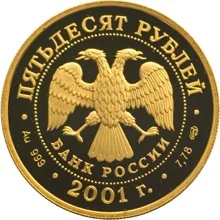
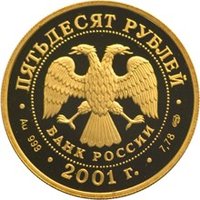
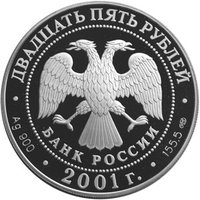
The center features the Bank of Russia emblem (a two-headed eagle with wings down, above the inscription "БАНК РОССИИ") within a dotted circle. The rim inscriptions read: "ПЯТЬДЕСЯТ РУБЛЕЙ" at the top, "2001" at the bottom, with metal specifications on the left and the mint mark on the right.
Inscription:
ПЯТЬДЕСЯТ РУБЛЕЙ
БАНК РОССИИ
• Au 999 • 2001 г. • 7,78 СПМД •
БАНК РОССИИ
• Au 999 • 2001 г. • 7,78 СПМД •
Translation:
FIFTY RUBLES
BANK OF RUSSIA
• Au 999 • 2001 • 7.78 SPMD •
BANK OF RUSSIA
• Au 999 • 2001 • 7.78 SPMD •
Language: Russian
Designer and engraver: Alexander Vasilyevich Baklanov
Reverse
Description:
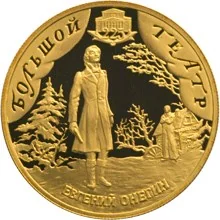
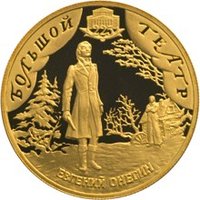
Bolshoi Theater's 225th anniversary, featuring a scene from Act II of Tchaikovsky's *Evgeny Onegin*.
Inscription:
БОЛЬШОЙ ТЕАТР
225
ЕВГЕНИЙ ОНЕГИН
225
ЕВГЕНИЙ ОНЕГИН
Translation:
Bolshoi Theatre
225
Eugene Onegin
225
Eugene Onegin
Script: Cyrillic
Language: Russian
Engraver: Sergey Alexandrovich Kornilov
Designer: Alexander Vasilyevich Baklanov
Edge
134 corrugations
Mints
| Name | Mark |
|---|---|
| Saint Petersburg | (СПМД) |
Mintings
| Year | Mint Mark | Mintage | Quality | Collection |
|---|---|---|---|---|
| 2001 | СПМД | 2,000 | Proof |
Historical background
In 2001, the Russian Federation's currency situation was defined by a fragile but strengthening stability following the devastating 1998 financial crisis. The cornerstone of this stability was a managed floating exchange rate regime, where the Central Bank of Russia (CBR) intervened to smooth out excessive volatility, but generally allowed the ruble's value to be determined by market forces of supply and demand. This represented a significant shift from the pre-crisis fixed exchange rate peg, which had collapsed under pressure. The ruble, redenominated in 1998, was trading at approximately 29-30 RUB/USD by year's end, a modest depreciation from 28 RUB/USD at the start of the year, reflecting a controlled adjustment rather than a panic.
This relative calm was underpinned by a confluence of favorable external conditions. High global prices for oil, gas, and other key Russian exports led to a substantial current account and budget surplus, creating a large inflow of foreign currency. This surge in hard currency earnings allowed for the rapid repayment of IMF debts ahead of schedule and a significant increase in the CBR's foreign exchange reserves, which grew from about $28 billion to over $36 billion during the year. The growing reserves bolstered confidence in the ruble and provided the CBR with a crucial buffer to manage the currency market.
However, underlying vulnerabilities persisted. The economy remained heavily dollarized, with many citizens and businesses still preferring to hold savings and conduct large transactions in US dollars due to lingering memories of hyperinflation and bank failures. Furthermore, the banking sector was weak and restructuring slowly, limiting credit to the real economy. While 2001 was a year of consolidation and recovery for the ruble, the system's health remained acutely dependent on continued high commodity prices, highlighting an unresolved structural dependence in the Russian economy.
This relative calm was underpinned by a confluence of favorable external conditions. High global prices for oil, gas, and other key Russian exports led to a substantial current account and budget surplus, creating a large inflow of foreign currency. This surge in hard currency earnings allowed for the rapid repayment of IMF debts ahead of schedule and a significant increase in the CBR's foreign exchange reserves, which grew from about $28 billion to over $36 billion during the year. The growing reserves bolstered confidence in the ruble and provided the CBR with a crucial buffer to manage the currency market.
However, underlying vulnerabilities persisted. The economy remained heavily dollarized, with many citizens and businesses still preferring to hold savings and conduct large transactions in US dollars due to lingering memories of hyperinflation and bank failures. Furthermore, the banking sector was weak and restructuring slowly, limiting credit to the real economy. While 2001 was a year of consolidation and recovery for the ruble, the system's health remained acutely dependent on continued high commodity prices, highlighting an unresolved structural dependence in the Russian economy.
✨ Legendary