

100 francs – Tunisia
Add to wishlist
Tunisia
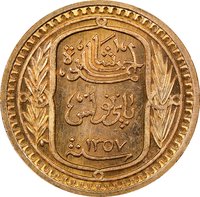
Obverse
Description:
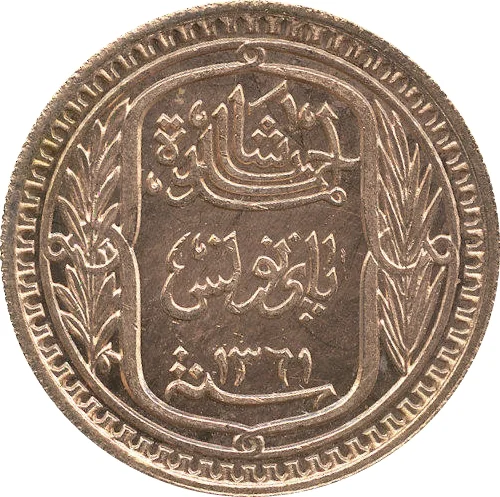
Arabic ruler and date.
Inscription:
باشا
احمد
مدة
باي تونس
١٣٦١
سنة
احمد
مدة
باي تونس
١٣٦١
سنة
Translation:
Pasha
Ahmad
Muddat
Bey of Tunis
1361
Year
Ahmad
Muddat
Bey of Tunis
1361
Year
Language: Arabic
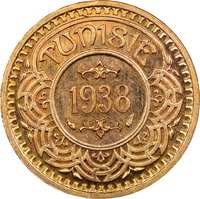
Reverse
Edge
Reeded
Mints
| Name | Mark |
|---|---|
| Monnaie de Paris | — |
Mintings
| Year | Mint Mark | Mintage | Quality | Collection |
|---|---|---|---|---|
| 1941 | — | 33 | ||
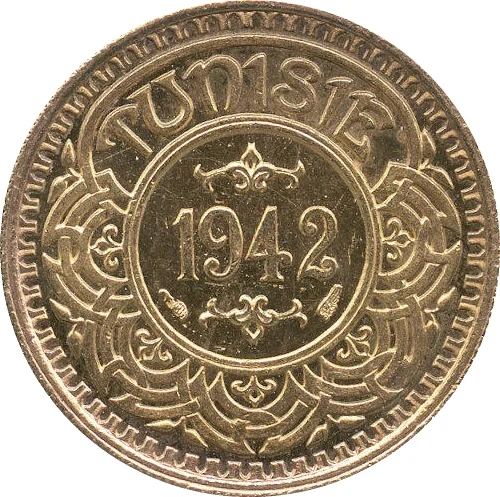
| 1942 | — | 33 |
Historical background
In 1941, Tunisia's currency situation was complex and directly shaped by the geopolitical pressures of World War II. Although officially a French protectorate, the country was under the control of the Vichy French government, which was collaborating with Nazi Germany. The primary legal tender remained the Tunisian franc, which was pegged to and interchangeable with the French franc. However, the war severely disrupted normal economic channels, leading to shortages, inflation, and a growing black market for goods and currency.
The Axis and Allied powers both exerted significant monetary influence. Following the Allied landings in North Africa in late 1942 (Operation Torch), Tunisia became a battleground, and by early 1943, it was under Allied control. During this period, both British military authorities and the American forces introduced their own occupation currency. Notably, the British issued "British Military Authority" banknotes denominated in francs, while the Americans circulated "Allied Military Currency" notes. These currencies circulated alongside, and sometimes in competition with, the existing Tunisian franc, creating a multi-layered and unstable monetary environment.
This period of occupation currency highlighted Tunisia's lack of monetary sovereignty and the severe strain on its economy. The influx of military scrip, coupled with wartime scarcity and the demands of sustaining large armies, fueled inflation and economic dislocation. The situation only began to stabilize after the complete liberation of Tunisia in 1943, when efforts were made to unify the currency under the returning Free French administration, though the Tunisian franc remained tied to the French franc and the economy required significant post-war reconstruction.
The Axis and Allied powers both exerted significant monetary influence. Following the Allied landings in North Africa in late 1942 (Operation Torch), Tunisia became a battleground, and by early 1943, it was under Allied control. During this period, both British military authorities and the American forces introduced their own occupation currency. Notably, the British issued "British Military Authority" banknotes denominated in francs, while the Americans circulated "Allied Military Currency" notes. These currencies circulated alongside, and sometimes in competition with, the existing Tunisian franc, creating a multi-layered and unstable monetary environment.
This period of occupation currency highlighted Tunisia's lack of monetary sovereignty and the severe strain on its economy. The influx of military scrip, coupled with wartime scarcity and the demands of sustaining large armies, fueled inflation and economic dislocation. The situation only began to stabilize after the complete liberation of Tunisia in 1943, when efforts were made to unify the currency under the returning Free French administration, though the Tunisian franc remained tied to the French franc and the economy required significant post-war reconstruction.
✨ Legendary