

Obverse
Description:
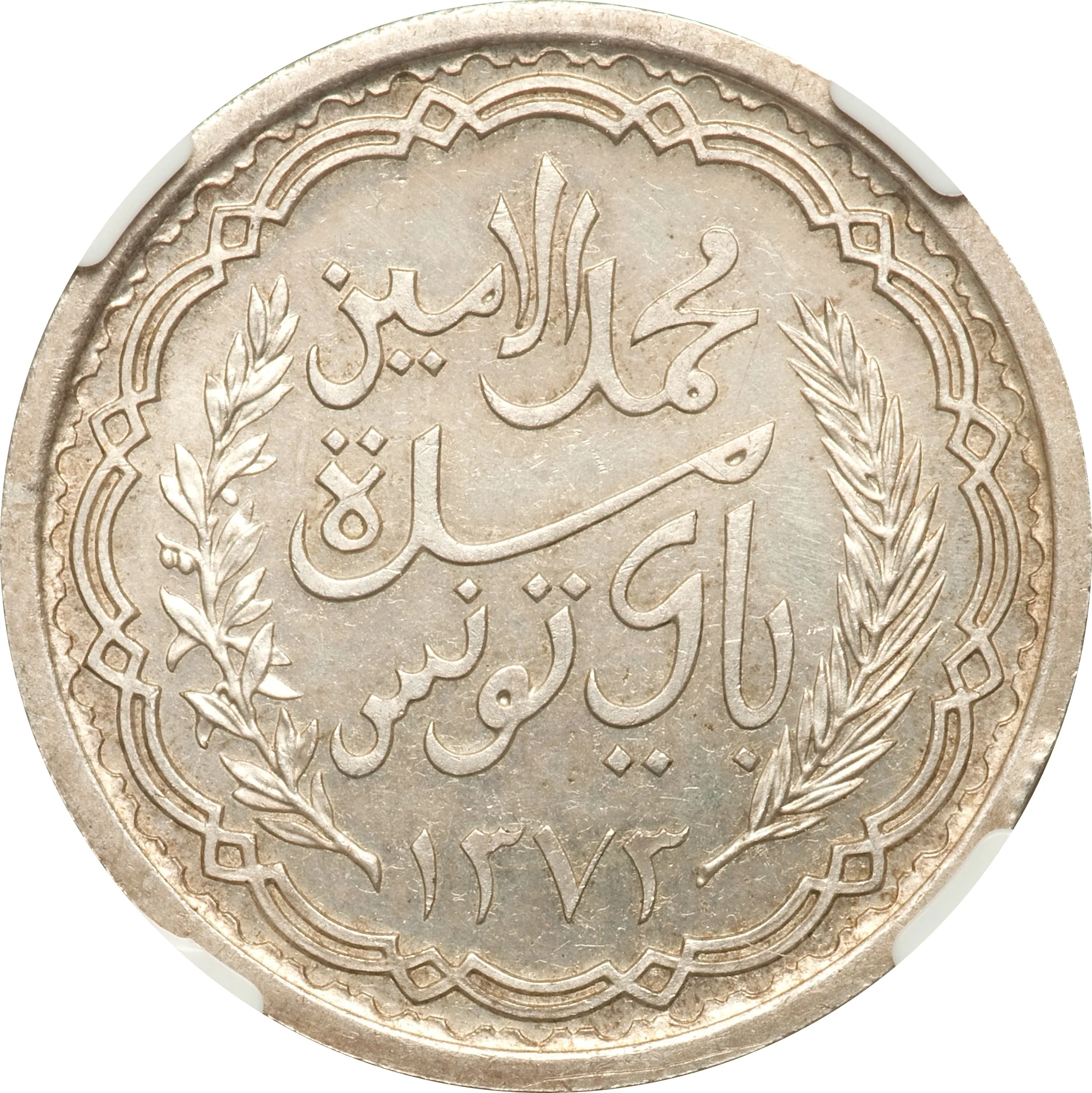
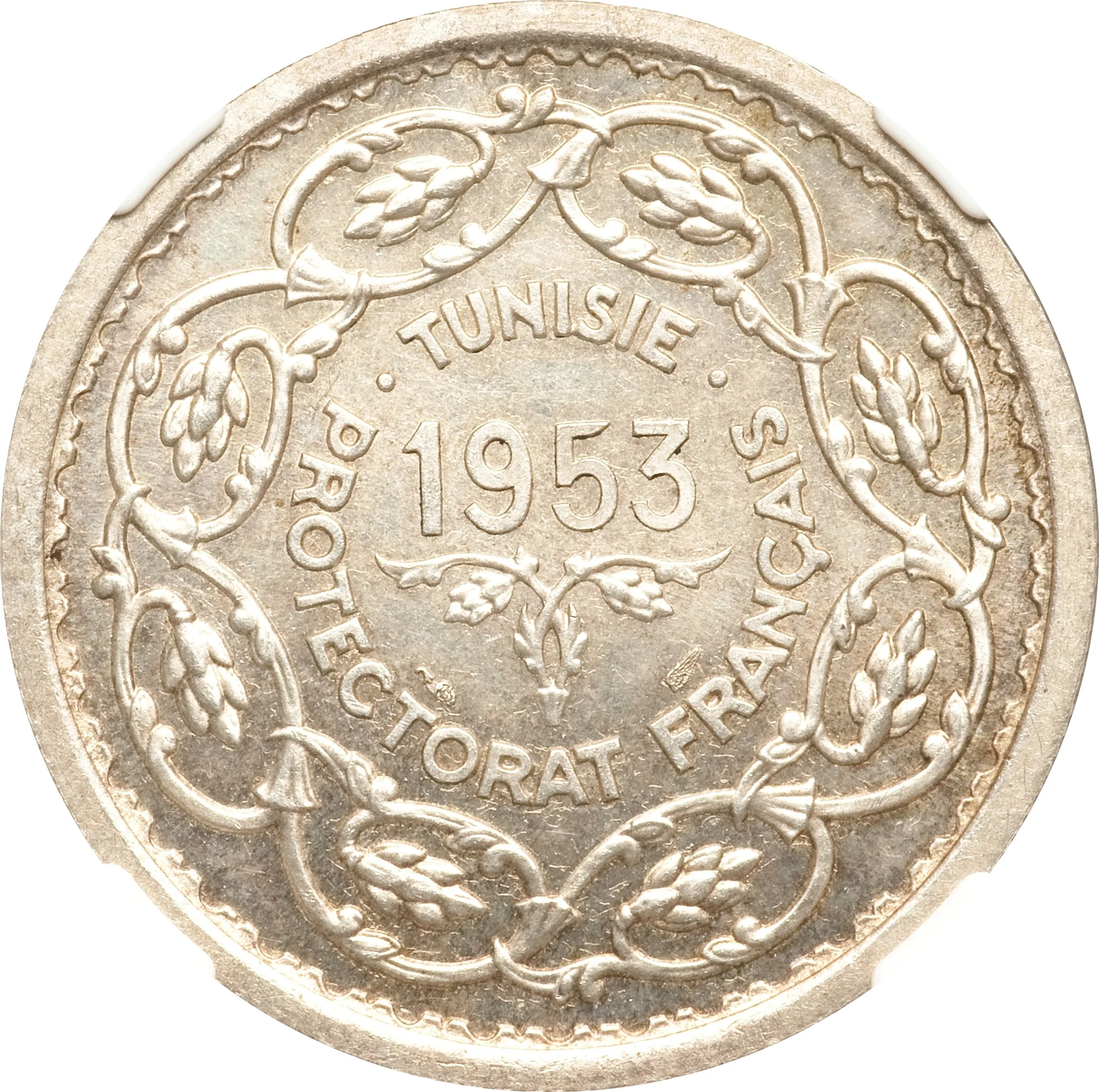
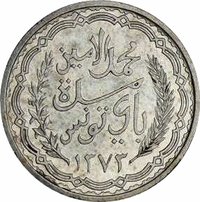
Inscription with dates in sprigs.
Inscription:
محمد الامين
مدة
باي تونس
١٣٧٣
مدة
باي تونس
١٣٧٣
Translation:
Muhammad al-Amin
Struck
In Tunis
1373
Struck
In Tunis
1373
Language: Arabic
Engraver: Lucien Georges Bazor
Reverse
Edge
Reeded
Mints
| Name | Mark |
|---|---|
| Monnaie de Paris | — |
Mintings
| Year | Mint Mark | Mintage | Quality | Collection |
|---|---|---|---|---|
| 1945 | — | 156 | ||
| 1946 | — | 53 | ||
| 1947 | — | 53 | ||
| 1948 | — | 53 | ||
| 1949 | — | 53 | ||
| 1950 | — | 53 | ||
| 1951 | — | 303 | ||
| 1952 | — | 303 | ||
| 1953 | — | 303 | ||
| 1954 | — | 303 | ||
| 1955 | — | 303 |
Historical background
In 1945, Tunisia's currency situation was defined by its colonial status under French rule. The Tunisian franc, pegged at parity to the French franc, served as the official currency, fully integrated into the Franc Zone. This monetary union ensured stability and facilitated trade with France, but it also meant that Tunisia's monetary policy was entirely directed from Paris, subordinating local economic needs to the interests of the colonial power and the postwar recovery of metropolitan France.
The immediate postwar period was one of significant economic strain and scarcity. Like much of Europe, Tunisia faced inflation and shortages of essential goods, pressures exacerbated by poor harvests and the lingering disruptions of World War II. The fixed peg to the weakened French franc, which itself was experiencing instability, imported these inflationary pressures directly into the Tunisian economy, eroding purchasing power and causing hardship for the local population.
This currency arrangement became a focal point of growing nationalist sentiment. Tunisian intellectuals and political leaders, advancing the cause for independence, began to critique the colonial economic system. They argued that control over a national currency and central bank was a fundamental pillar of sovereignty and necessary for autonomous development. Thus, in 1945, the currency was not just an economic instrument but also a symbol of colonial dependency, planting the seeds for future monetary reforms that would follow after independence in 1956.
The immediate postwar period was one of significant economic strain and scarcity. Like much of Europe, Tunisia faced inflation and shortages of essential goods, pressures exacerbated by poor harvests and the lingering disruptions of World War II. The fixed peg to the weakened French franc, which itself was experiencing instability, imported these inflationary pressures directly into the Tunisian economy, eroding purchasing power and causing hardship for the local population.
This currency arrangement became a focal point of growing nationalist sentiment. Tunisian intellectuals and political leaders, advancing the cause for independence, began to critique the colonial economic system. They argued that control over a national currency and central bank was a fundamental pillar of sovereignty and necessary for autonomous development. Thus, in 1945, the currency was not just an economic instrument but also a symbol of colonial dependency, planting the seeds for future monetary reforms that would follow after independence in 1956.
✨ Legendary