

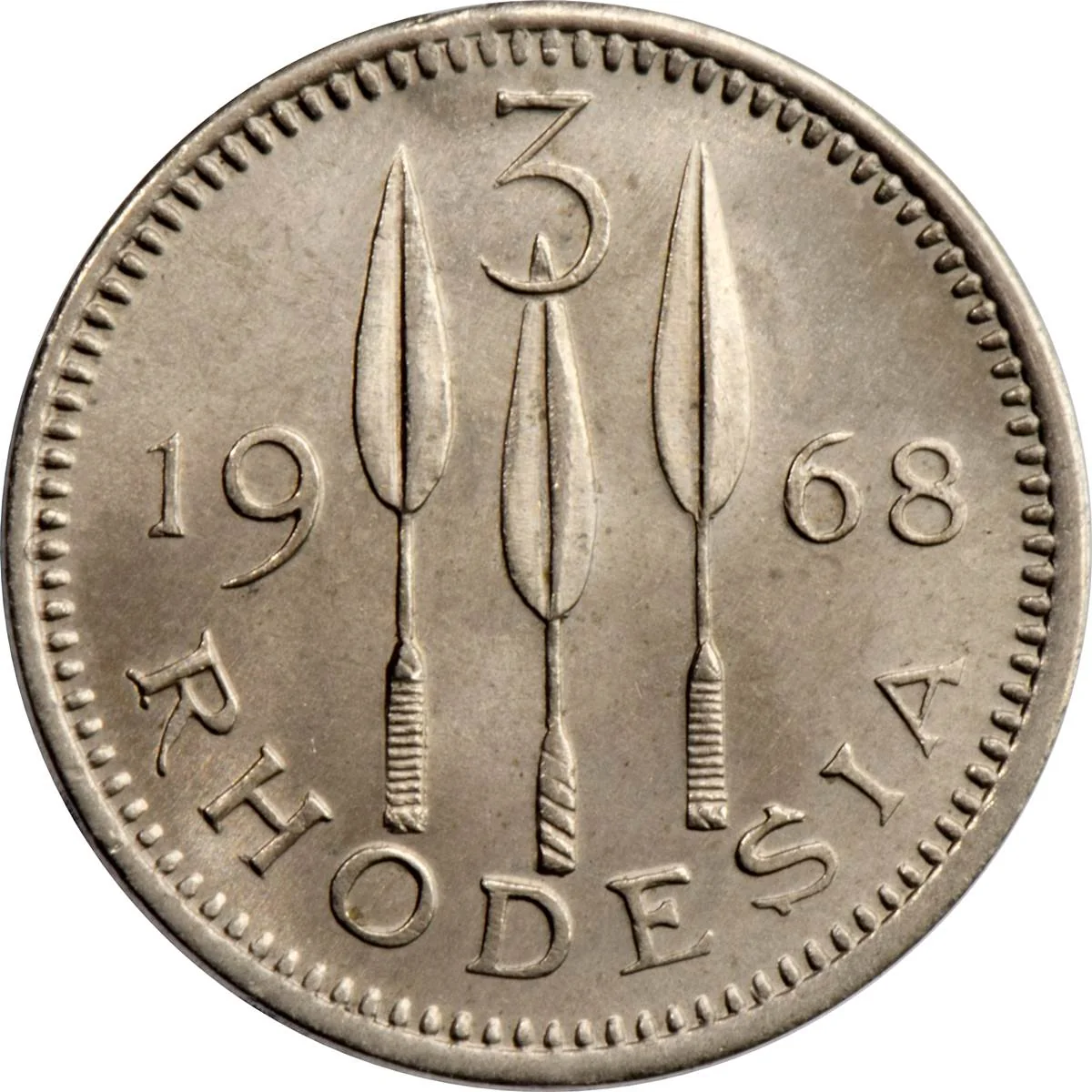
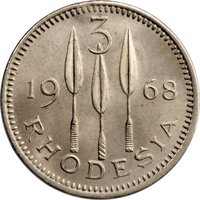
3 Pence – Rhodesia
Zimbabwe
Context
Year: 1968
Country: Zimbabwe 
Issuer: Rhodesia
Ruler: Elizabeth II
Currency:
(1964—1970)
Demonetized: Yes
Total mintage: 2,400,010
Material
Diameter: 16.15 mm
Weight: 1.4 g
Thickness: 0.95 mm
Shape: Round
Composition: Copper-nickel
Technique: Milled
Alignment: Medal alignment
flip
References
KM: #Click to copy to clipboard8
Numista: #7152
Obverse
Description:
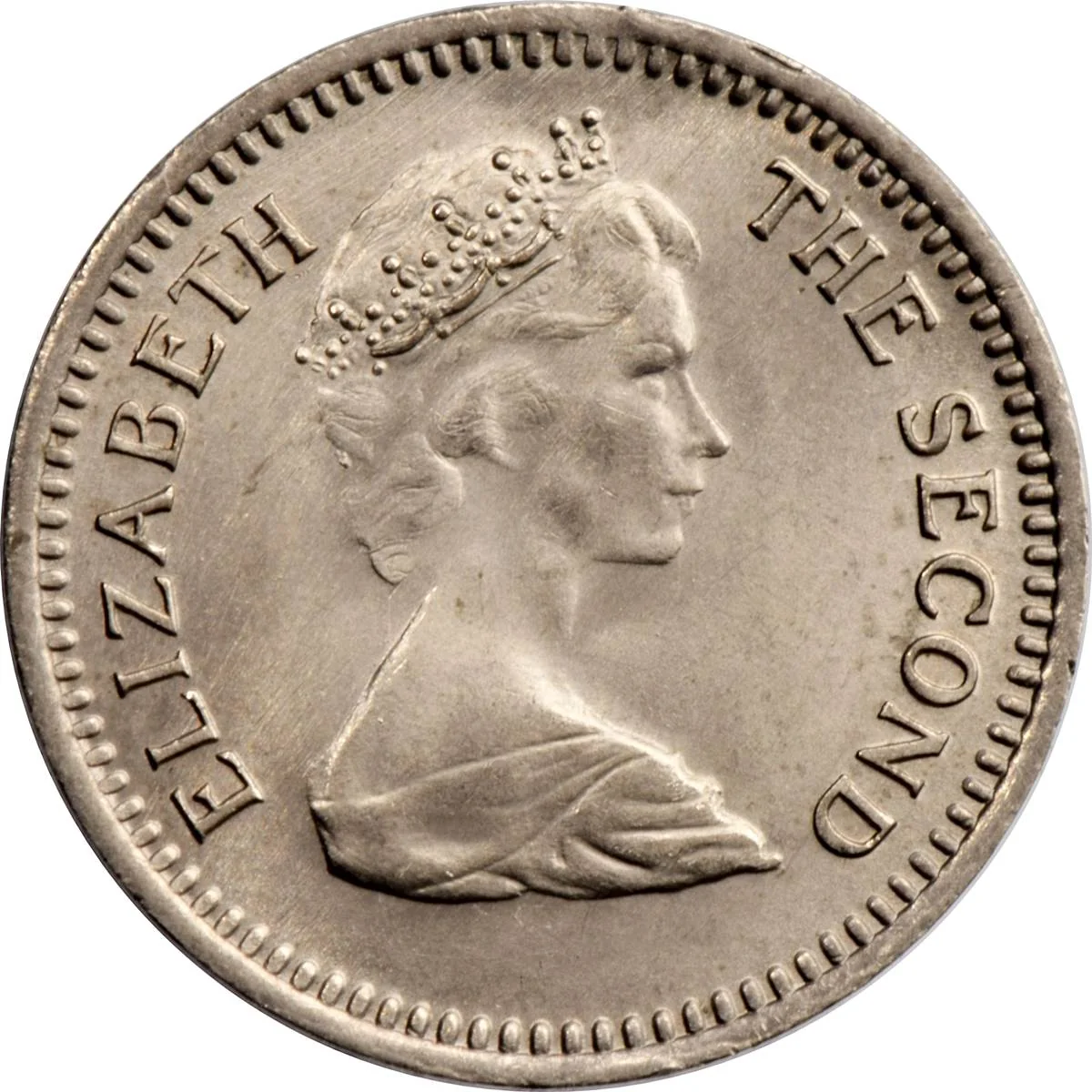
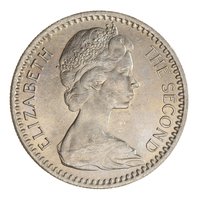
Queen Elizabeth II effigy with "ELIZABETH THE SECOND" inscription.
Inscription:
ELIZABETH THE SECOND
Translation:
ELIZABETH THE SECOND
Script: Latin
Language: English
Designer: Arnold Machin
Reverse
Edge
Plain
Mints
| Name | Mark |
|---|---|
| Pretoria | — |
Mintings
| Year | Mint Mark | Mintage | Quality | Collection |
|---|---|---|---|---|
| 1968 | — | 2,400,000 | ||
| 1968 | — | 10 | Proof |
Historical background
By 1968, Rhodesia's currency situation was a direct reflection of its illegal Unilateral Declaration of Independence (UDI) from Britain in 1965. The British government, refusing to recognize the white-minority regime of Ian Smith, had imposed comprehensive economic sanctions. These included freezing Rhodesia's assets in London and expelling it from the Sterling Area, which severed the colony's direct access to the British pound. In response, the Rhodesian government was forced to establish a central banking system and issue its own currency, the Rhodesian pound, which remained pegged at par with sterling but operated in an isolated and increasingly controlled financial environment.
Domestically, the government enacted strict exchange controls to conserve foreign reserves and prevent capital flight. The Reserve Bank of Rhodesia assumed tight authority over all foreign currency transactions, requiring approval for imports and limiting the amount of money residents could take out of the country. While these measures prevented an immediate collapse, they created a rigid, state-directed economy. A growing black market for foreign currency emerged, and the fixed exchange rate began to show signs of overvaluation as the real cost of sanctions and the burgeoning guerrilla war started to strain the economy.
Internationally, the Rhodesian pound was a non-convertible currency, worthless outside its borders except for illicit trade with a handful of sympathetic nations or through covert operations. The regime relied heavily on South Africa and Portuguese Mozambique for economic lifelines and access to global markets. Thus, the currency's stability in 1968 was artificially maintained by severe internal controls and external support from neighboring apartheid states, masking the underlying vulnerabilities that would lead to significant devaluation and the introduction of the Rhodesian dollar later in 1970.
Domestically, the government enacted strict exchange controls to conserve foreign reserves and prevent capital flight. The Reserve Bank of Rhodesia assumed tight authority over all foreign currency transactions, requiring approval for imports and limiting the amount of money residents could take out of the country. While these measures prevented an immediate collapse, they created a rigid, state-directed economy. A growing black market for foreign currency emerged, and the fixed exchange rate began to show signs of overvaluation as the real cost of sanctions and the burgeoning guerrilla war started to strain the economy.
Internationally, the Rhodesian pound was a non-convertible currency, worthless outside its borders except for illicit trade with a handful of sympathetic nations or through covert operations. The regime relied heavily on South Africa and Portuguese Mozambique for economic lifelines and access to global markets. Thus, the currency's stability in 1968 was artificially maintained by severe internal controls and external support from neighboring apartheid states, masking the underlying vulnerabilities that would lead to significant devaluation and the introduction of the Rhodesian dollar later in 1970.
🌱 Common