

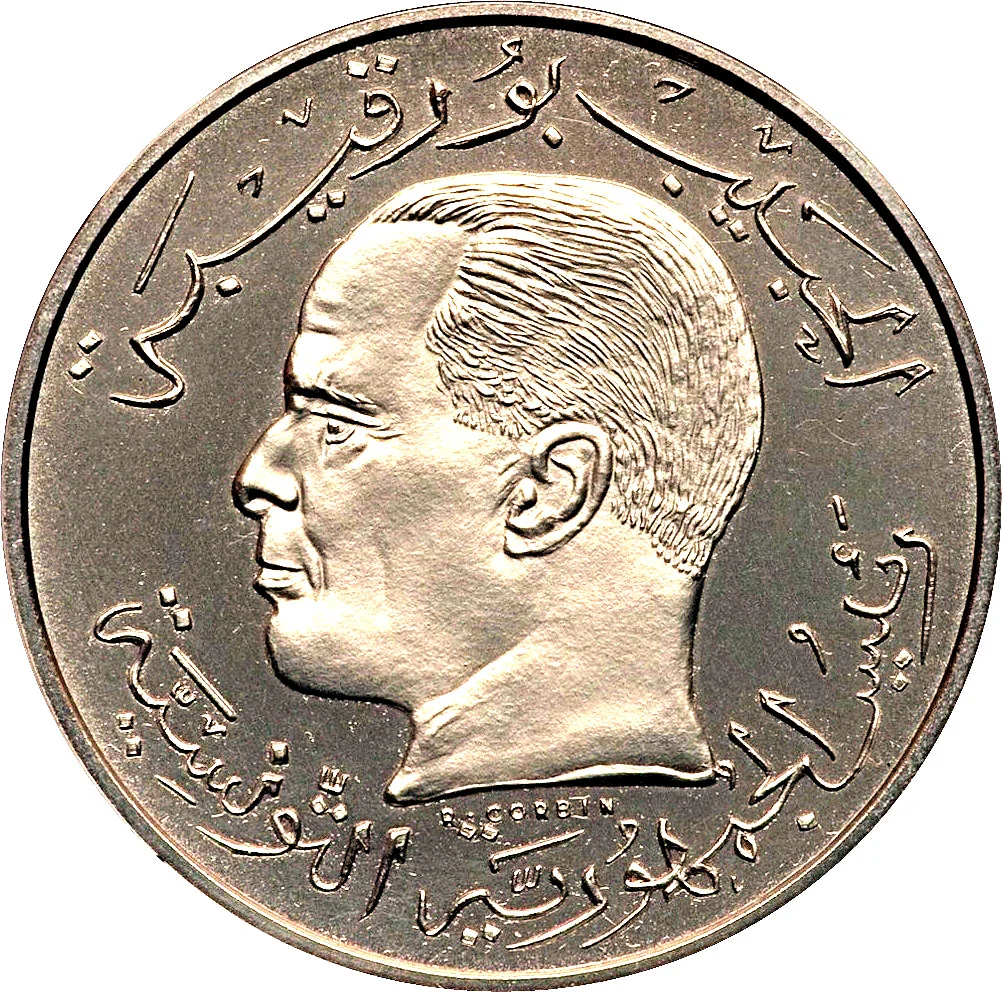
Obverse
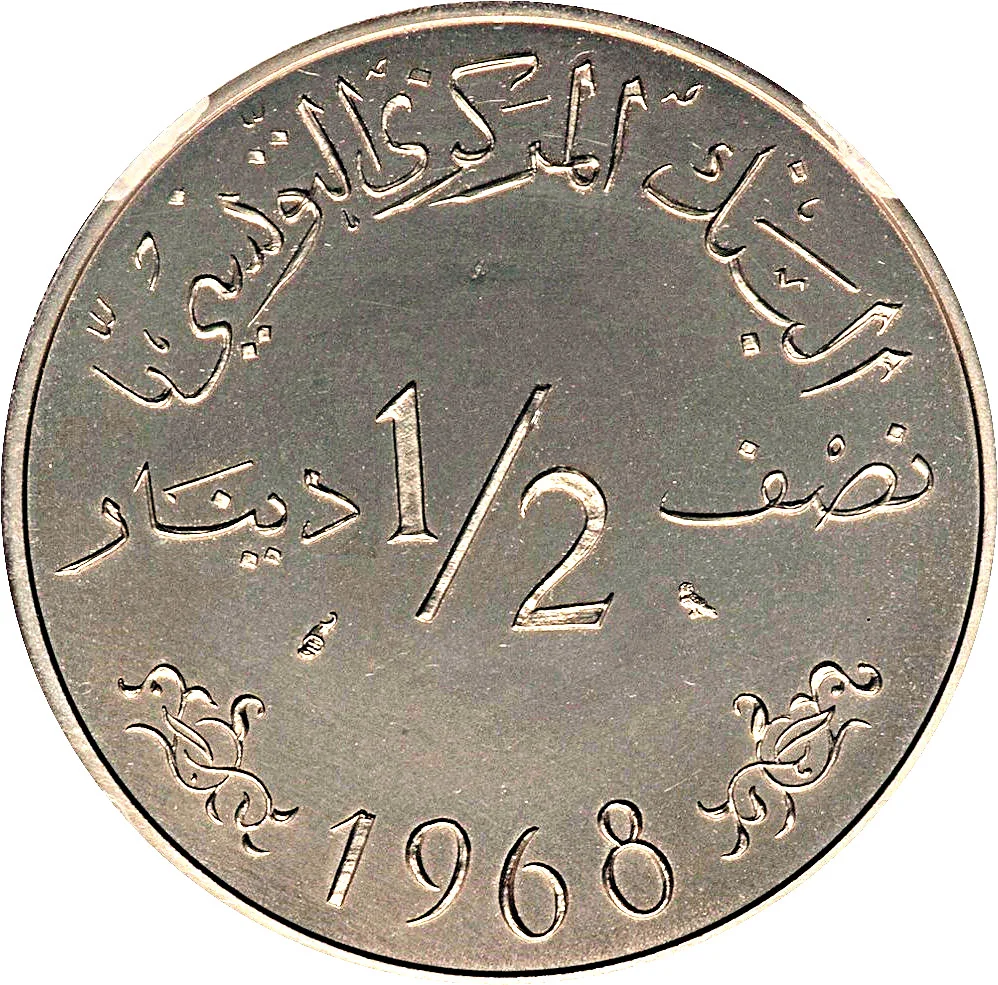
Reverse
Description:
Denomination
Inscription:
البنك المركزي التونسي
نصف ½ دينار
1968
نصف ½ دينار
1968
Translation:
Central Bank of Tunisia
Half ½ Dinar
1968
Half ½ Dinar
1968
Language: Arabic
Edge
Mints
| Name | Mark |
|---|---|
| Monnaie de Paris | — |
Mintings
| Year | Mint Mark | Mintage | Quality | Collection |
|---|---|---|---|---|
| 1968 | — | 500 |
Historical background
In 1968, Tunisia's currency situation was defined by the continued use of the Tunisian dinar, which had been introduced a decade earlier in 1958 to replace the Tunisian franc and establish monetary independence from France. The new currency was managed by the Central Bank of Tunisia (Banque Centrale de Tunisie), founded in 1958, which was tasked with steering the financial system of the young nation following its independence in 1956. The dinar was pegged to the US dollar at a fixed rate of 0.42 dinar per dollar, a regime chosen to provide stability and facilitate international trade and investment as the state pursued a development strategy blending state-led planning and limited private enterprise.
Economically, the period was one of consolidation following the initial post-independence years. The government, under President Habib Bourguiba and his influential Minister of Planning and Finance, Ahmed Ben Salah, was deeply engaged in a collectivist "socialist" experiment, investing heavily in agricultural cooperatives and state industries. This ambitious spending required careful currency management to control inflation and maintain the dinar's peg. While the fixed exchange rate provided predictability, it also limited monetary policy flexibility, requiring the government to rely on fiscal controls and administrative measures to manage the balance of payments and foreign exchange reserves.
Overall, the currency situation in 1968 was stable on the surface but faced underlying pressures. The dirigiste economic policies created imbalances, and the reliance on a dollar peg made Tunisia vulnerable to external shocks. These tensions would culminate just a year later, in 1969, with the dramatic abandonment of the cooperative agricultural policy and the fall of Ben Salah, events that would lead to a significant economic reorientation. Thus, 1968 represents the final year of a specific, state-controlled monetary and economic framework before a pivotal shift in Tunisia's development path.
Economically, the period was one of consolidation following the initial post-independence years. The government, under President Habib Bourguiba and his influential Minister of Planning and Finance, Ahmed Ben Salah, was deeply engaged in a collectivist "socialist" experiment, investing heavily in agricultural cooperatives and state industries. This ambitious spending required careful currency management to control inflation and maintain the dinar's peg. While the fixed exchange rate provided predictability, it also limited monetary policy flexibility, requiring the government to rely on fiscal controls and administrative measures to manage the balance of payments and foreign exchange reserves.
Overall, the currency situation in 1968 was stable on the surface but faced underlying pressures. The dirigiste economic policies created imbalances, and the reliance on a dollar peg made Tunisia vulnerable to external shocks. These tensions would culminate just a year later, in 1969, with the dramatic abandonment of the cooperative agricultural policy and the fall of Ben Salah, events that would lead to a significant economic reorientation. Thus, 1968 represents the final year of a specific, state-controlled monetary and economic framework before a pivotal shift in Tunisia's development path.
💎 Extremely Rare