

Obverse
Description:
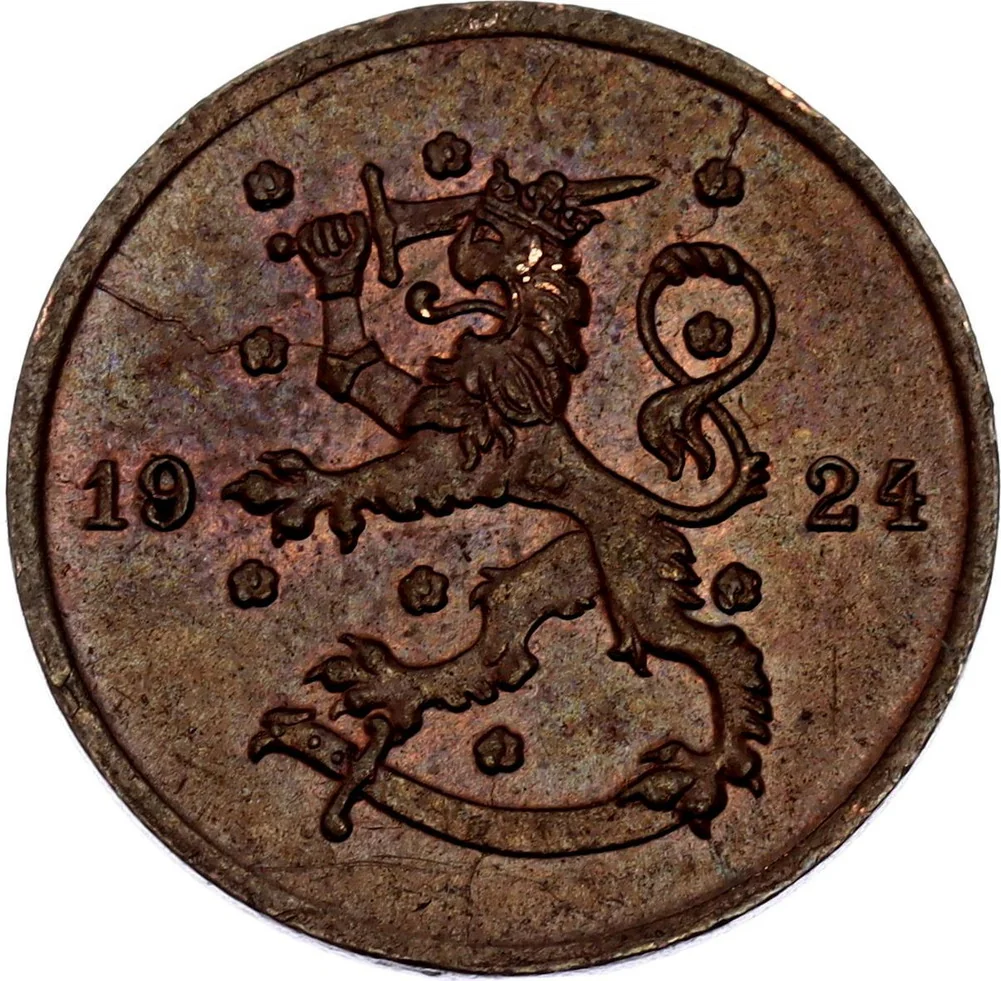
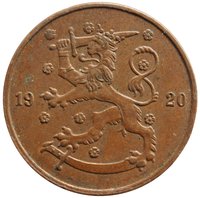
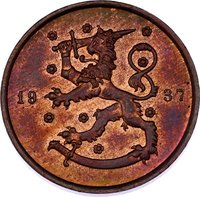
Finnish coat of arms: a rampant lion with an armored hand wielding a sword, trampling a sabre. Date flanking the shield.
Inscription:
1923
Script: Latin
Engraver: Isak Gustaf Sundell
Reverse
Description:
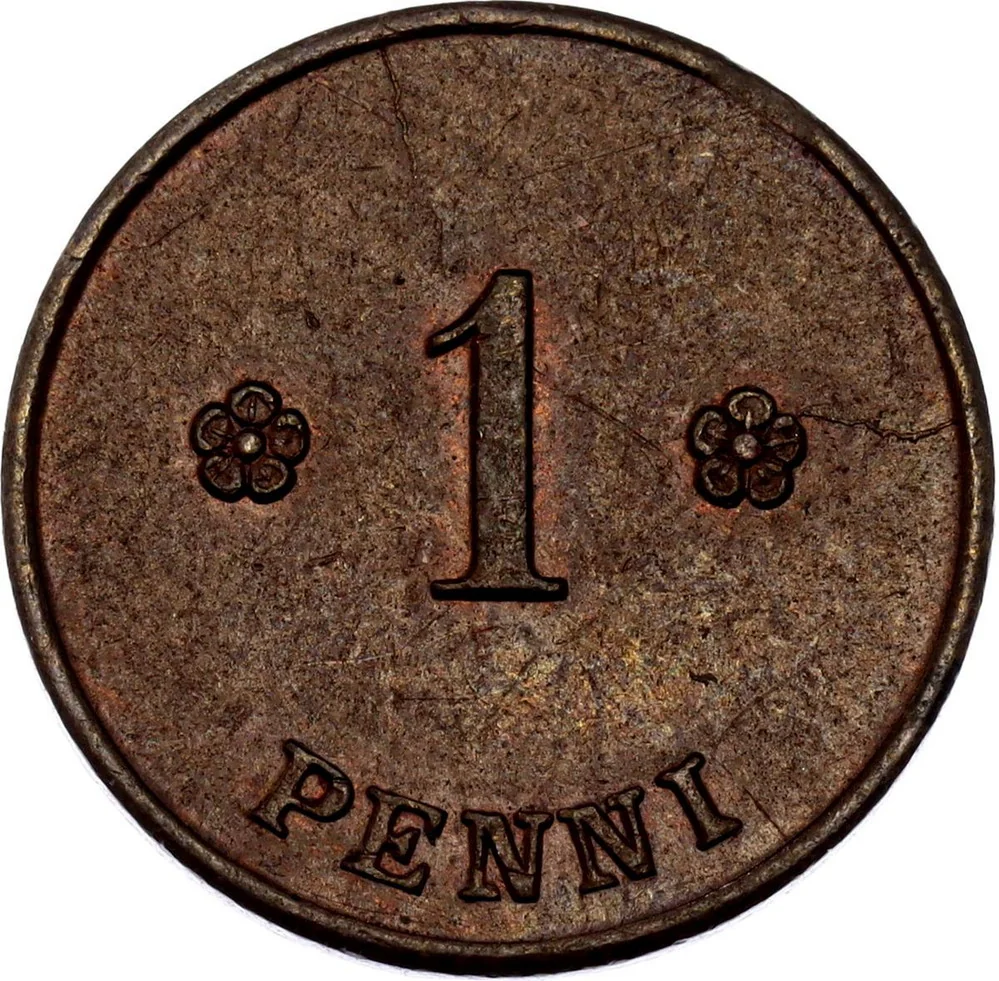
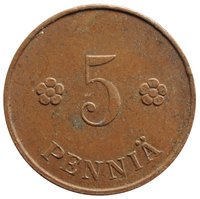
Denomination between rosettes.
Inscription:
1 PENNI
Translation:
One Penni
Script: Latin
Language: Finnish
Engraver: Isak Gustaf Sundell
Edge
Plain
Categories
| Animal> Feline |
| Plants> Flower |
| Symbols> Coat of Arms |
| Object> Cold weapons |
Mints
| Name | Mark |
|---|---|
| Mint of Finland | — |
Mintings
| Year | Mint Mark | Mintage | Quality | Collection |
|---|---|---|---|---|
| 1919 | — | 1,200,000 | ||
| 1920 | — | 720,000 | ||
| 1921 | — | 510,000 | ||
| 1922 | — | 1,060,000 | ||
| 1923 | — | 990,000 | ||
| 1924 | — | 2,180,000 |
Historical background
In 1919, Finland’s currency situation was a direct legacy of the political and economic turbulence following its declaration of independence in 1917 and the subsequent Civil War of 1918. The country had inherited the Russian ruble as its primary circulating medium, but the collapse of the Russian Empire and wartime inflation had severely devalued this currency, creating economic instability and a pressing need for a distinct national monetary system. To address this, the Finnish government took a decisive step in 1918 by establishing the Bank of Finland (Suomen Pankki) as the sole issuer of a new national currency, the Finnish markka (markka, or FIM).
The transition, however, was complex and gradual. While the new markka banknotes began issuance in 1918, old Russian rubles and various temporary notes remained in widespread circulation well into 1919, leading to a period of parallel currencies. The government worked to stabilize the value of the new markka by pegging it initially to gold, though this peg was theoretical given the economic conditions. A critical legal foundation was laid in 1919 with the "Lex Tulenheimo," a law that formally demonetized the Russian ruble and set final exchange rates for its conversion, a necessary but difficult step that aimed to draw a definitive line under the imperial monetary past.
Consequently, 1919 was a year of consolidation in Finland's monetary history. It marked the final phase of replacing the unstable ruble with the sovereign markka, a process essential for rebuilding trade, stabilizing prices, and reinforcing national sovereignty. Despite this progress, the young markka remained vulnerable, and the following decades would see continued challenges, including devaluations and eventual shifts in pegging regimes, as Finland sought to establish lasting financial stability in the volatile interwar period.
The transition, however, was complex and gradual. While the new markka banknotes began issuance in 1918, old Russian rubles and various temporary notes remained in widespread circulation well into 1919, leading to a period of parallel currencies. The government worked to stabilize the value of the new markka by pegging it initially to gold, though this peg was theoretical given the economic conditions. A critical legal foundation was laid in 1919 with the "Lex Tulenheimo," a law that formally demonetized the Russian ruble and set final exchange rates for its conversion, a necessary but difficult step that aimed to draw a definitive line under the imperial monetary past.
Consequently, 1919 was a year of consolidation in Finland's monetary history. It marked the final phase of replacing the unstable ruble with the sovereign markka, a process essential for rebuilding trade, stabilizing prices, and reinforcing national sovereignty. Despite this progress, the young markka remained vulnerable, and the following decades would see continued challenges, including devaluations and eventual shifts in pegging regimes, as Finland sought to establish lasting financial stability in the volatile interwar period.

🌱 Common