

500 lire – Vatican City
Add to wishlist
Circulating commemorative coins
Commemoration: Environment and Development
Vatican City
Context
Year: 1992
Issuer: Vatican City
Ruler: John Paul II
Currency:
(1929—2001)
Demonetization: 1 March 2002
Total mintage: 43,000
Material
References
KM: #
Numista: #11240
Value
Exchange value: 500 VAL
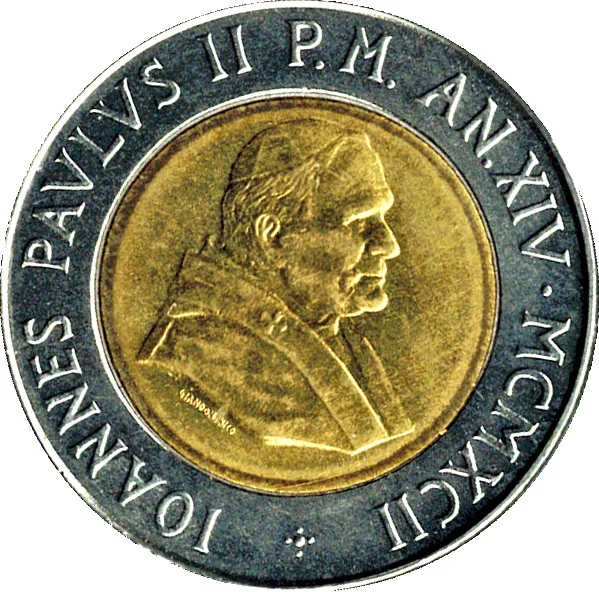
Obverse
Description:
Get in. Let's go.
Inscription:
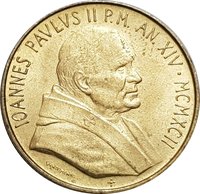
IOANNES PAVLVS II P.M. AN. XIV · MCMXCII
Translation:
JOHN PAUL II SUPREME PONTIFF YEAR 14 · 1992
Script: Latin
Language: Latin
Engraver: Sergio Giandomenico
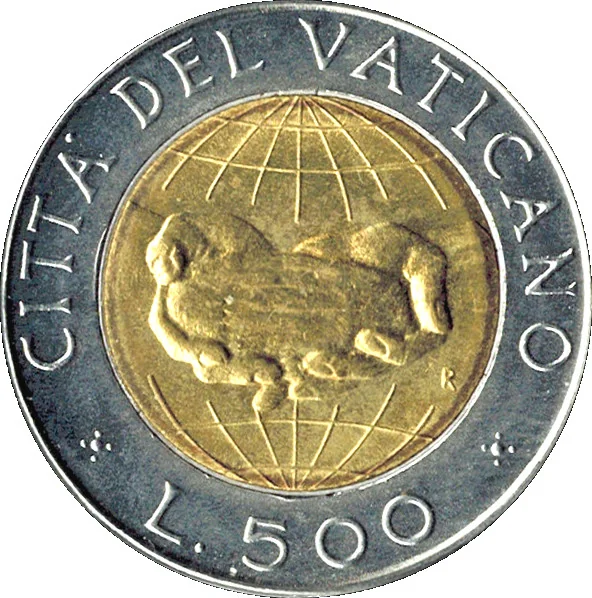
Reverse
Description:
Bread held in a globe.
Inscription:
CITTA' DEL VATICANO
R L. 500
R L. 500
Translation:
Vatican City State
500 Lire
500 Lire
Script: Latin
Language: Italian
Engraver: Sergio Giandomenico
Edge
Segmented reeding
Categories
| Person> Religious figure |
| Symbol> Hand |
| Organization> FAO |
| Religion> Religious objects |
| Symbol> Globe |
Mints
| Name | Mark |
|---|---|
| Rome | R |
Mintings
| Year | Mint Mark | Mintage | Quality | Collection |
|---|---|---|---|---|
| 1992 | — | 43,000 |
Historical background
In 1992, the currency situation in Vatican City was defined by its unique status as a sovereign state without an independent monetary policy. The city-state operated under the terms of the Lateran Treaty of 1929, which granted it the right to issue its own coinage. However, in practice, its monetary system was fully integrated with that of Italy. The Vatican lira was pegged at par with the Italian lira and was legal tender in both countries, though its coins were minted primarily for collectors and symbolic purposes rather than for general circulation.
This period was one of significant transition, as the European Community was advancing toward Economic and Monetary Union (EMU). The Vatican, while not a member of the European Community, sought to ensure its monetary continuity and stability. Consequently, it entered into a series of financial agreements with Italy, which acted as its intermediary with European institutions. A critical agreement in 1991 allowed the Vatican to continue minting limited quantities of its own coins, but it also committed the city-state to adopt the future European single currency, the euro, in lockstep with Italy, contingent on Italy's own qualification for the monetary union.
Therefore, the background of 1992 shows the Vatican navigating a path between its historical traditions and the impending reality of European integration. Its currency was functionally an extension of the Italian system, but diplomatic and legal preparations were already underway to secure its place within the new Eurozone framework. The year was thus a quiet prelude to a major change, with the Vatican lira's fate tied directly to the success of the Maastricht Treaty and Italy's economic convergence, setting the stage for the eventual replacement of the lira with the euro a decade later.
This period was one of significant transition, as the European Community was advancing toward Economic and Monetary Union (EMU). The Vatican, while not a member of the European Community, sought to ensure its monetary continuity and stability. Consequently, it entered into a series of financial agreements with Italy, which acted as its intermediary with European institutions. A critical agreement in 1991 allowed the Vatican to continue minting limited quantities of its own coins, but it also committed the city-state to adopt the future European single currency, the euro, in lockstep with Italy, contingent on Italy's own qualification for the monetary union.
Therefore, the background of 1992 shows the Vatican navigating a path between its historical traditions and the impending reality of European integration. Its currency was functionally an extension of the Italian system, but diplomatic and legal preparations were already underway to secure its place within the new Eurozone framework. The year was thus a quiet prelude to a major change, with the Vatican lira's fate tied directly to the success of the Maastricht Treaty and Italy's economic convergence, setting the stage for the eventual replacement of the lira with the euro a decade later.
🌱 Common