

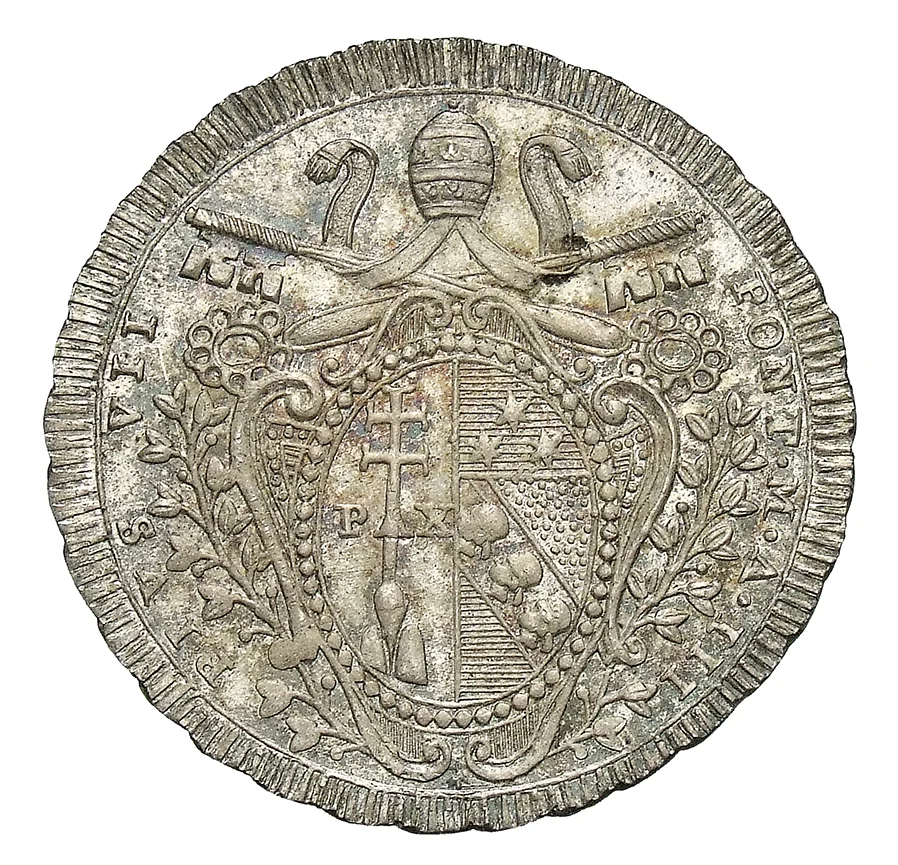
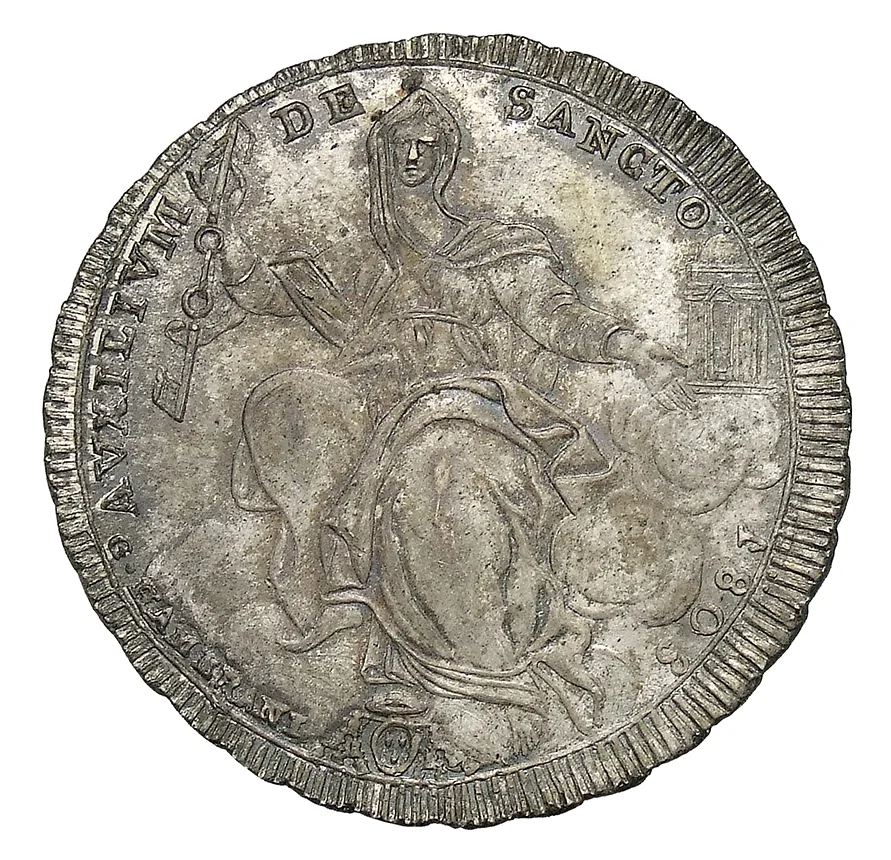
½ Scudo – Papal States
Vatican City
Context
Years: 1800–1816
Country: Vatican City 
Issuer: Papal States
Ruler: Pius VII
Currency:
(1534—1835)
Demonetized: Yes
Total mintage: 83,800
Material
References
KM: #Click to copy to clipboard1247
Numista: #112385
Value
Bullion value: $34.20
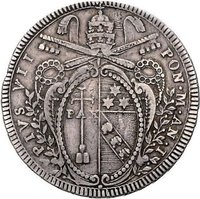
Obverse
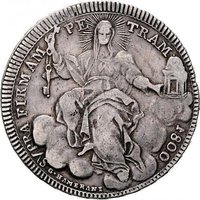
Reverse
Description:
Woman seated on clouds, holding keys and a church.
Inscription:
AVXILIUM DE SANCTO. 1802
GIIAMERAN
GIIAMERAN
Script: Latin
Edge
Mintings
| Year | Mint Mark | Mintage | Quality | Collection |
|---|---|---|---|---|
| 1800 | — | — | ||
| 1802 | — | 57,280 | ||
| 1803 | — | 26,520 | ||
| 1816 | — | — |
Historical background
In 1800, the Papal States found itself in a period of profound monetary instability and transition, directly resulting from the political and military upheavals of the French Revolutionary Wars. The state had been invaded by French troops in 1798, leading to the proclamation of the short-lived Roman Republic and the exile of Pope Pius VI. During this occupation, the French imposed a new, decimal-based currency system aligned with the French franc, introducing coins like the scudo romano divided into 100 baiocchi. This abruptly ended the ancient monetary tradition based on the scudo (divided into 10 paoli or 100 baiocchi) and the giulio, creating confusion and severing the currency from its historical and economic foundations.
The return of Pope Pius VII in 1800, following the French withdrawal, did not bring immediate monetary clarity. The papal government faced the daunting task of re-establishing sovereignty over a depleted treasury and a chaotic circulating medium. Both the old papal coins and the newer republican issues circulated simultaneously, alongside a variety of foreign coins, leading to erratic exchange rates and widespread counterfeiting. The state lacked the bullion reserves and minting capacity to quickly unify the system, leaving commerce and public finances in a state of disarray as authorities debated how to formally restore the pre-1798 system or adapt to the decimal reforms.
Ultimately, this currency confusion was a microcosm of the Papal States' broader struggle between tradition and the forces of modernization. The situation remained unresolved until 1808, when a formal monetary decree was finally issued, re-establishing the traditional scudo-based system. However, this stability was fleeting, as Napoleon's re-occupation and annexation of the Papal States in 1809 would once again impose the French franc system, ensuring that the currency question remained volatile until the final fall of the Napoleonic Empire.
The return of Pope Pius VII in 1800, following the French withdrawal, did not bring immediate monetary clarity. The papal government faced the daunting task of re-establishing sovereignty over a depleted treasury and a chaotic circulating medium. Both the old papal coins and the newer republican issues circulated simultaneously, alongside a variety of foreign coins, leading to erratic exchange rates and widespread counterfeiting. The state lacked the bullion reserves and minting capacity to quickly unify the system, leaving commerce and public finances in a state of disarray as authorities debated how to formally restore the pre-1798 system or adapt to the decimal reforms.
Ultimately, this currency confusion was a microcosm of the Papal States' broader struggle between tradition and the forces of modernization. The situation remained unresolved until 1808, when a formal monetary decree was finally issued, re-establishing the traditional scudo-based system. However, this stability was fleeting, as Napoleon's re-occupation and annexation of the Papal States in 1809 would once again impose the French franc system, ensuring that the currency question remained volatile until the final fall of the Napoleonic Empire.
✨ Legendary