

200 Zlotys (People's Republic of Poland) – Poland
Circulating commemorative coins
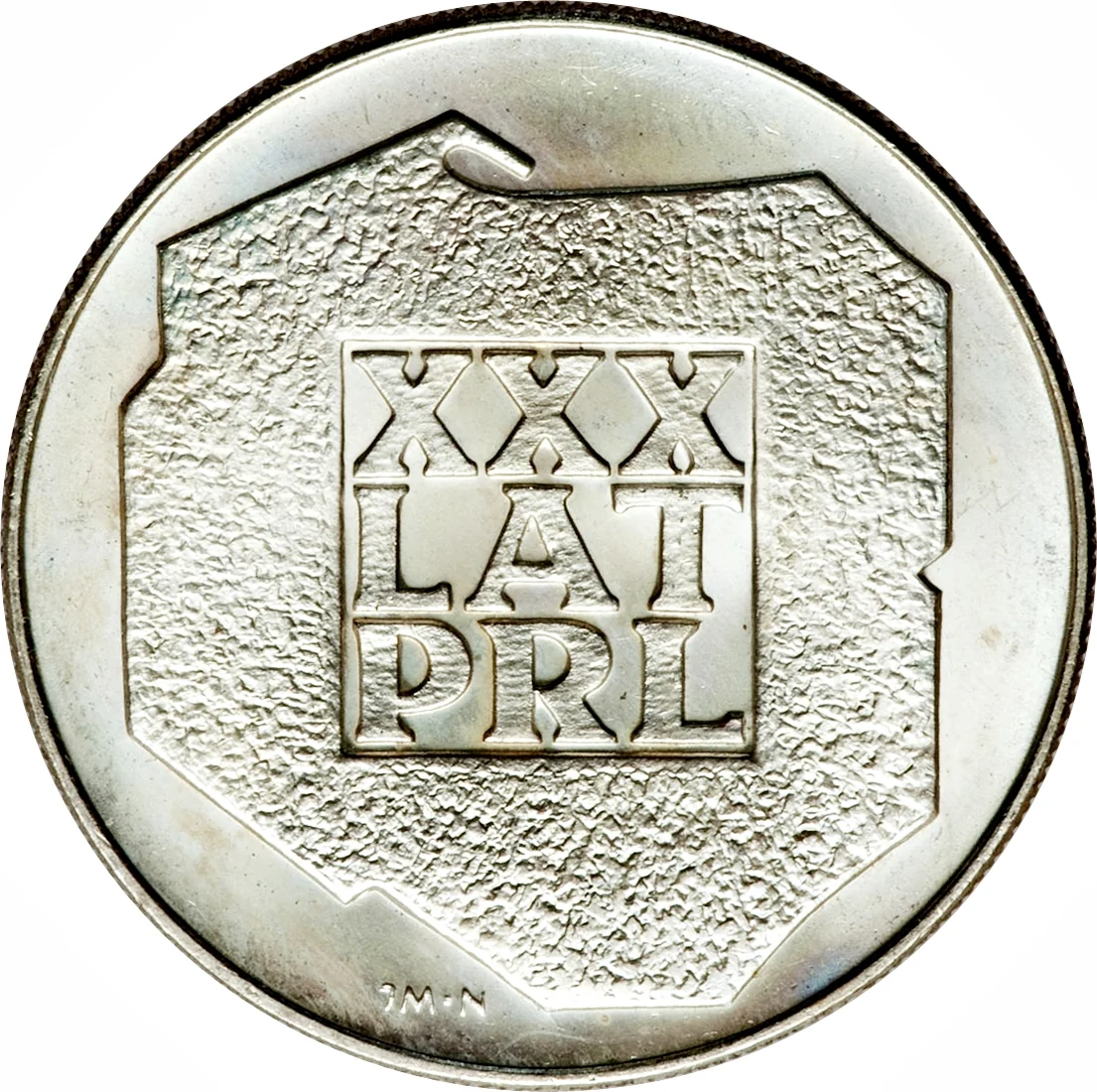
Commemoration: 30th Anniversary of People's Republic of Poland
Poland


Obverse
Description:
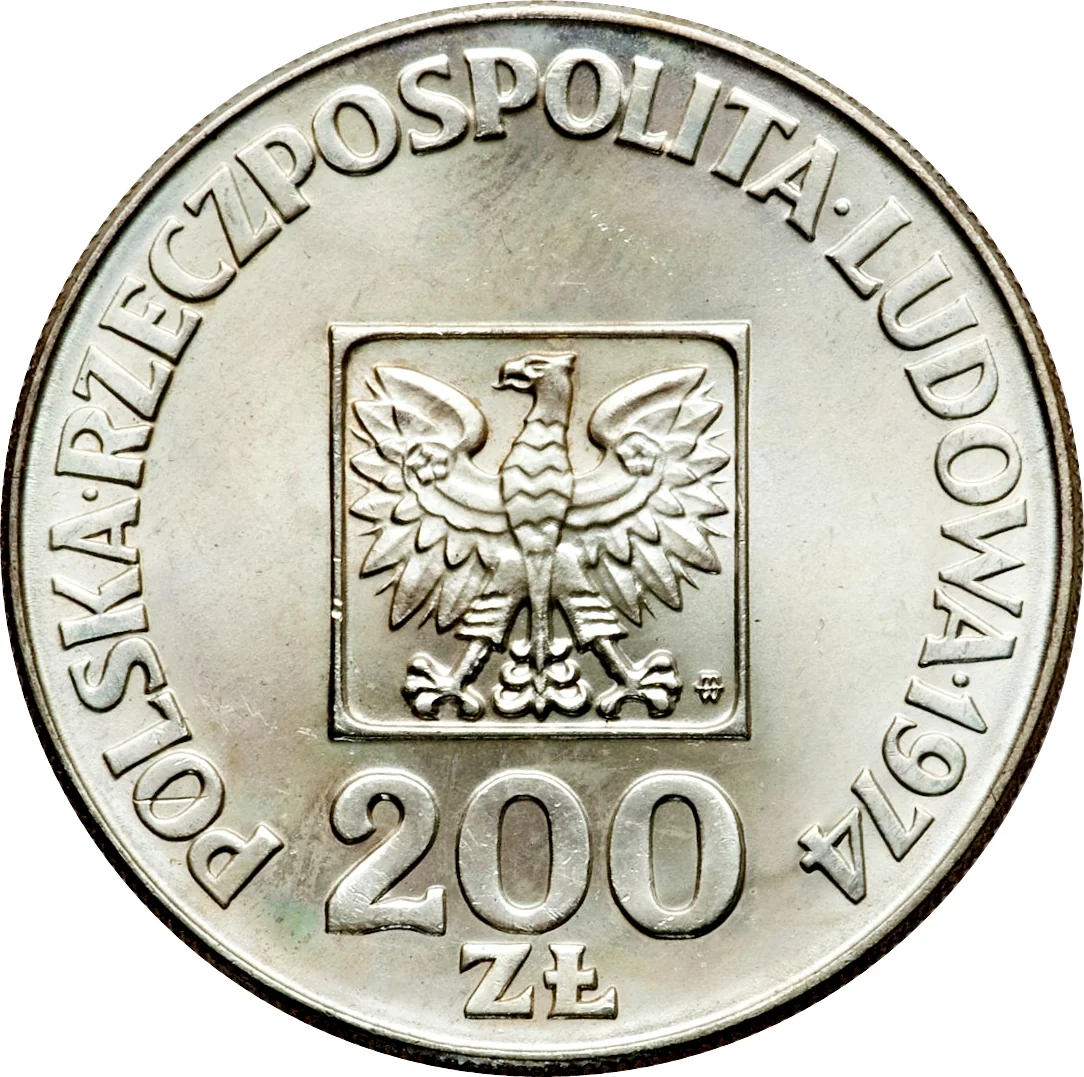
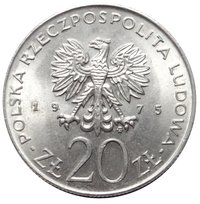
The Polish national coat of arms.
Inscription:
POLSKA · RZECZPOSPOLITA · LUDOWA · 1974
mw
200
ZŁ
mw
200
ZŁ
Translation:
People's Republic of Poland 1974
200
ZŁOTYCH
200
ZŁOTYCH
Script: Latin
Language: Polish
Engraver: Józef Markiewicz-Nieszcz
Reverse
Edge
Milled
Mints
| Name | Mark |
|---|---|
| Mint of Poland | (MW) |
Mintings
| Year | Mint Mark | Mintage | Quality | Collection |
|---|---|---|---|---|
| 1974 | MW | 13,062,041 | ||
| 1974 | MW | 6,000 | Proof |
Historical background
In 1974, Poland's currency situation was defined by the rigidities and growing contradictions of its centrally planned economy under the communist Polish People's Republic. The official currency, the złoty, was a non-convertible "soft currency," meaning it could not be freely exchanged for Western hard currencies like the US dollar or Deutsche Mark. Its value was set by administrative fiat rather than market forces, with an official exchange rate that bore little relation to its actual purchasing power or scarcity. Internally, this system maintained a facade of price stability for basic goods, but it masked underlying economic stresses and inefficient production.
Beneath this official facade, a critical dual-currency system thrived. Access to Western hard currency, primarily US dollars, became a powerful parallel economic force. Poles with access to dollars—from relatives abroad (Polonia) or work in foreign markets—could shop in a network of state-run Pewex and Baltona hard-currency shops. These stores offered high-quality, luxury, and often simply available goods that were absent from regular złoty shops, creating a stark two-tiered society divided by currency access. This dollarization highlighted the złoty's weakness and the failure of the planned economy to meet consumer demand.
The year 1974 fell within the era of Edward Gierek's "propaganda of success," following his rise to power after the 1970 protests. His strategy relied heavily on massive Western loans to import technology and consumer goods, aiming to modernize industry and placate the population. In the short term, this influx of credit temporarily improved the supply of goods and sustained an illusion of prosperity. However, it simultaneously buried the country under a mountain of foreign debt denominated in hard currency—a debt that would become unmanageable by the decade's end, setting the stage for the severe economic crises and social unrest of the 1980s. Thus, the currency situation in 1974 was a precarious calm, built on unsustainable borrowing and deepening internal disparities.
Beneath this official facade, a critical dual-currency system thrived. Access to Western hard currency, primarily US dollars, became a powerful parallel economic force. Poles with access to dollars—from relatives abroad (Polonia) or work in foreign markets—could shop in a network of state-run Pewex and Baltona hard-currency shops. These stores offered high-quality, luxury, and often simply available goods that were absent from regular złoty shops, creating a stark two-tiered society divided by currency access. This dollarization highlighted the złoty's weakness and the failure of the planned economy to meet consumer demand.
The year 1974 fell within the era of Edward Gierek's "propaganda of success," following his rise to power after the 1970 protests. His strategy relied heavily on massive Western loans to import technology and consumer goods, aiming to modernize industry and placate the population. In the short term, this influx of credit temporarily improved the supply of goods and sustained an illusion of prosperity. However, it simultaneously buried the country under a mountain of foreign debt denominated in hard currency—a debt that would become unmanageable by the decade's end, setting the stage for the severe economic crises and social unrest of the 1980s. Thus, the currency situation in 1974 was a precarious calm, built on unsustainable borrowing and deepening internal disparities.

🌱 Very Common