

½ new sheqel – Israel
Add to wishlist
Circulating commemorative coins
Commemoration: Hanukkah
Israel
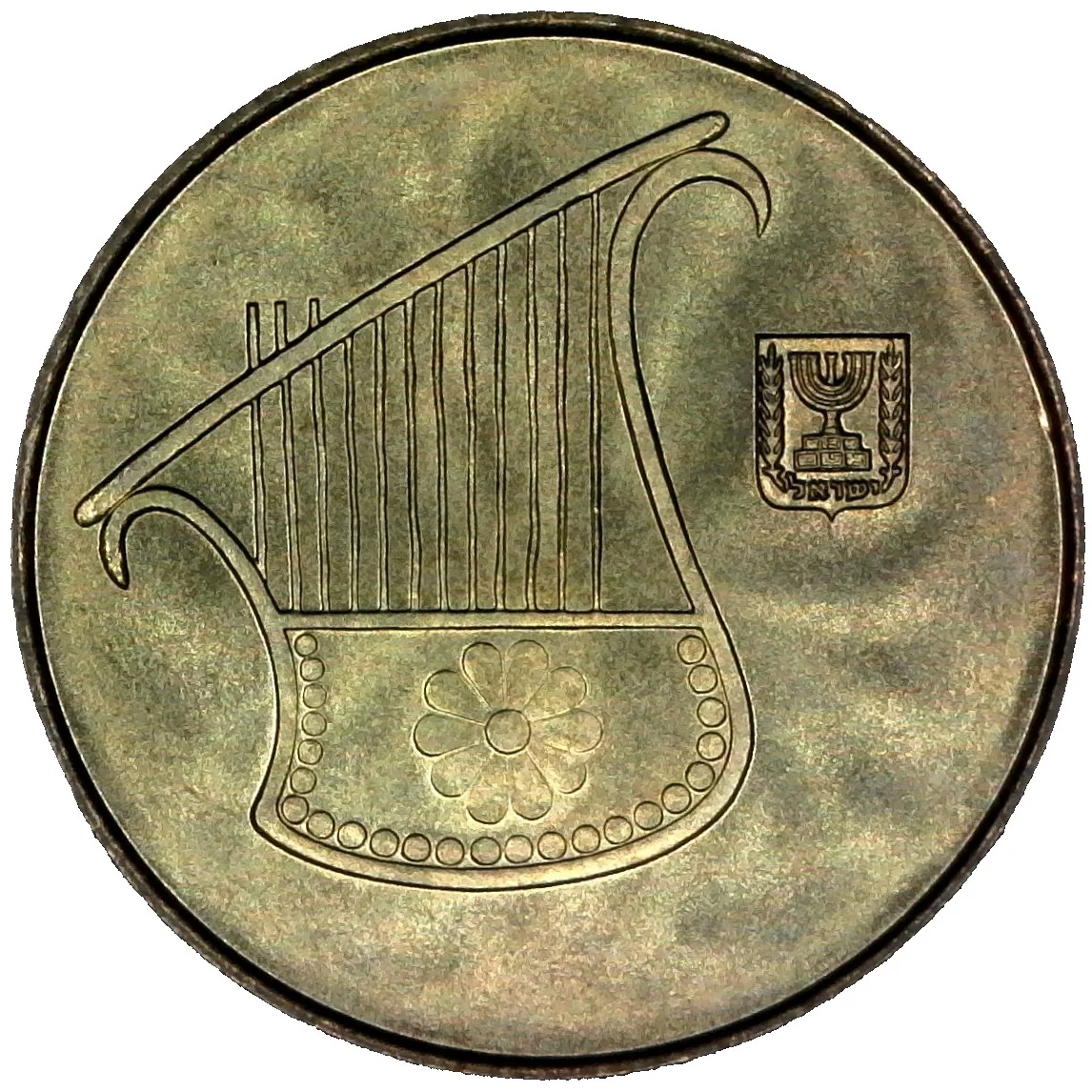
Obverse
Description:
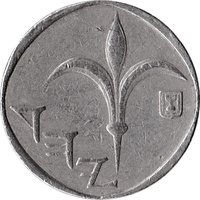
Lyre; Israel's state emblem. Ancient Hebrew seal inscribed "Maadana, the King's daughter".
Inscription:
ישראל
Translation:
Israel
Script: Hebrew
Language: Hebrew
Engraver: Nathan Karp
Reverse
Description:
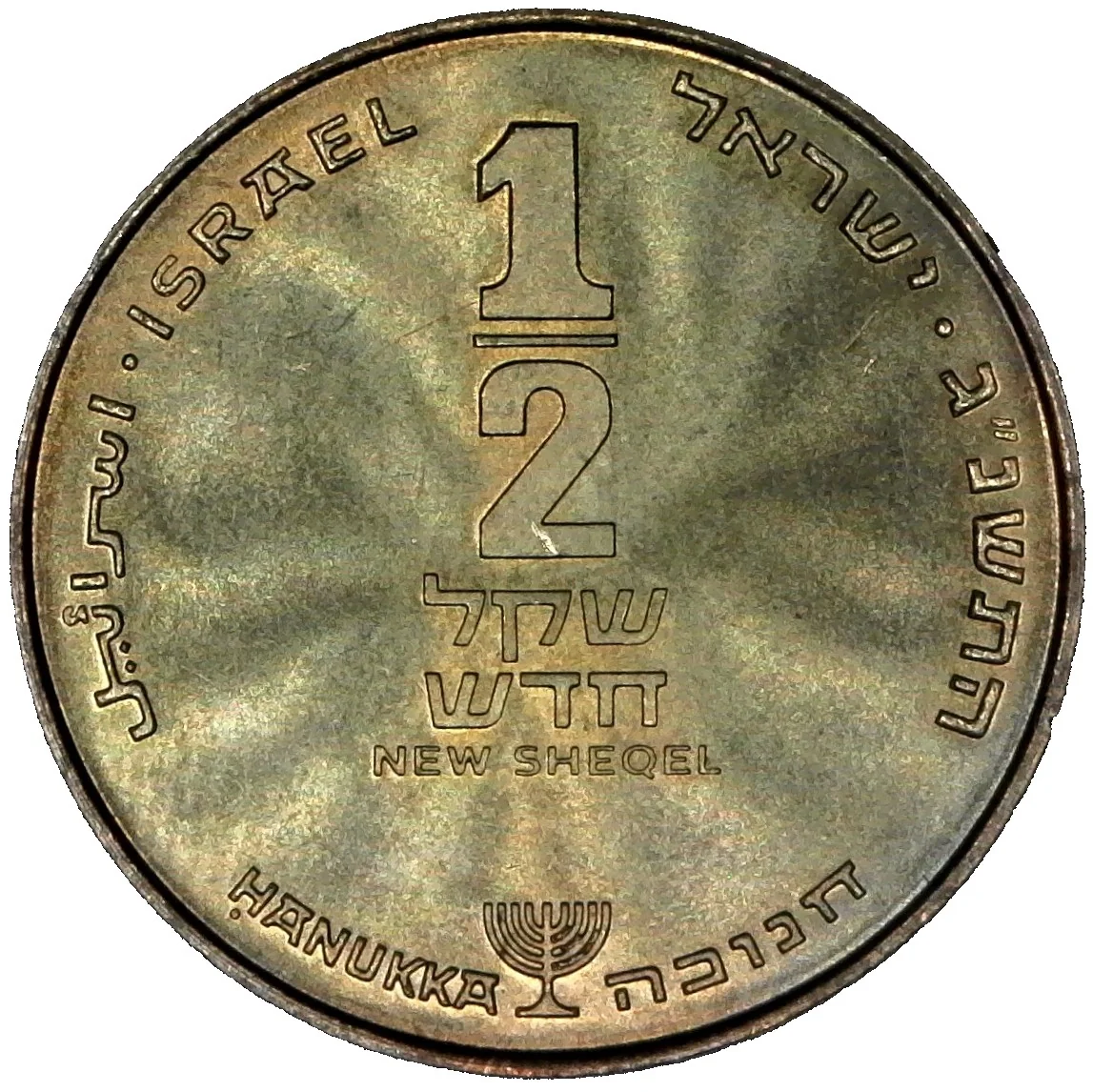
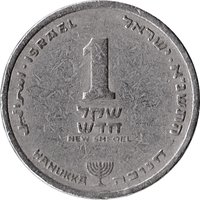
"1/2 New Sheqel" in Hebrew and English; the date in Hebrew; "Israel" in Hebrew, Arabic, and English; "Hanukka" in Hebrew and English flanking a small candelabrum.
Inscription:
اسرائيل • ISRAEL התשנ׳׳ה ישראל
1/2
שקל
חדש
NEW SHEQEL
HANUKKA חנוכה
1/2
שקל
חדש
NEW SHEQEL
HANUKKA חנוכה
Translation:
ISRAEL Hanukka 5755 Israel
1/2
New Sheqel
New Sheqel
Hanukka
1/2
New Sheqel
New Sheqel
Hanukka
Engraver: Gabi Neumann
Edge
Plain
Mints
| Name | Mark |
|---|---|
| Jerusalem | — |
| Monnaie de Paris | — |
| Royal Dutch Mint | — |
Mintings
| Year | Mint Mark | Mintage | Quality | Collection |
|---|---|---|---|---|
| 1985 | — | 14,305 | In sets | |
| 1987 | — | 1,004,000 | ||
| 1987 | — | 28,800 | In sets | |
| 1988 | — | 532,000 | ||
| 1989 | — | 504,000 | ||
| 1990 | — | 2,016,000 | ||
| 1991 | — | 960,000 | ||
| 1992 | — | 288,000 | ||
| 1993 | — | 304,000 | ||
| 1994 | — | 12,000 | In sets | |
| 1996 | — | 12,000 | In sets | |
| 1996 | — | 7,500 | In sets | |
| 1997 | — | 7,500 | In sets | |
| 1998 | — | 10,000 | In sets | |
| 1999 | — | 6,000 | In sets | |
| 2000 | — | 7,000 | In sets | |
| 2001 | — | 4,000 | In sets | |
| 2002 | — | 4,000 | In sets | |
| 2003 | — | 3,000 | In sets | |
| 2004 | — | 3,000 | In sets | |
| 2005 | — | 2,500 | In sets | |
| 2006 | — | 3,000 | In sets | |
| 2007 | — | 3,000 | In sets | |
| 2008 | — | 3,000 | In sets | |
| 2009 | — | 1,800 | In sets | |
| 2010 | — | 1,800 | In sets |
Historical background
In 1985, Israel faced a severe economic crisis characterized by hyperinflation, which had been accelerating since the early 1970s and peaked at an annual rate of nearly 450%. This "inflationary whirlwind" was the result of a deep structural imbalance: massive government deficits, largely financed by printing money, to fund extensive social programs, a large public sector, and military expenditures. Indexation mechanisms in the economy, while protecting wages and savings, had created a vicious cycle where prices and wages chased each other upward, eroding the currency's value and public confidence.
The situation reached a breaking point, compelling the national unity government led by Shimon Peres to implement a drastic and comprehensive stabilization plan in July 1985. Known as the Economic Stabilization Plan, its core measures included a sharp, one-time devaluation of the shekel followed by its pegging to the U.S. dollar, severe cuts to government subsidies and spending, a temporary freeze on wages and prices, and a commitment to cease financing the deficit by printing money. Crucially, the plan was supported by a significant $1.5 billion emergency loan from the United States.
The plan was a painful but resounding success. It abruptly halted hyperinflation, restoring stability to the Israeli shekel and marking a fundamental shift from a government-dominated economy toward greater liberalization and market orientation. The 1985 crisis and its resolution are considered a watershed moment in Israel's economic history, establishing fiscal discipline and laying the foundation for future growth, transforming the shekel from a notoriously weak currency into a stable one.
The situation reached a breaking point, compelling the national unity government led by Shimon Peres to implement a drastic and comprehensive stabilization plan in July 1985. Known as the Economic Stabilization Plan, its core measures included a sharp, one-time devaluation of the shekel followed by its pegging to the U.S. dollar, severe cuts to government subsidies and spending, a temporary freeze on wages and prices, and a commitment to cease financing the deficit by printing money. Crucially, the plan was supported by a significant $1.5 billion emergency loan from the United States.
The plan was a painful but resounding success. It abruptly halted hyperinflation, restoring stability to the Israeli shekel and marking a fundamental shift from a government-dominated economy toward greater liberalization and market orientation. The 1985 crisis and its resolution are considered a watershed moment in Israel's economic history, establishing fiscal discipline and laying the foundation for future growth, transforming the shekel from a notoriously weak currency into a stable one.
🌱 Very Common