

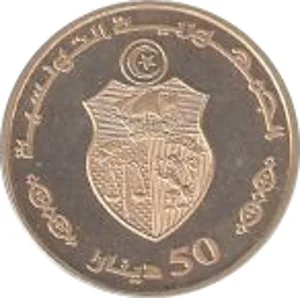
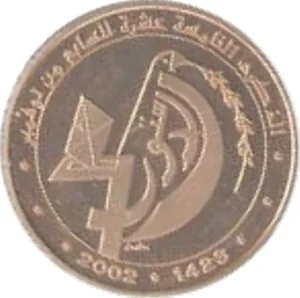
50 dinars (7 Nov 1987 Coup d'état) – Tunisia
Add to wishlist
Non-circulating coins
Commemoration: The 15th Anniversary of the 7 Nov 1987 Coup d'état
Tunisia
Context
Year: 2002
Islamic (Hijri) Year:: 1423
Issuer: Tunisia
Period:
(since 1957)
Currency:
(since 1958)
Total mintage: 580
Material
References
KM: #
Numista: #112347
Value
Exchange value: 50 TND
Bullion value: $2901.58
Obverse
Reverse
Edge
Reeded
Mintings
| Year | Mint Mark | Mintage | Quality | Collection |
|---|---|---|---|---|
| 2002 | — | 580 | Proof |
Historical background
In 2002, Tunisia's currency situation was characterized by a tightly managed exchange rate regime and a period of relative macroeconomic stability, yet it was also a point of growing debate regarding future economic liberalization. The Tunisian Dinar (TND) operated under a crawling peg system, where its value was primarily fixed against a basket of currencies (heavily weighted toward the Euro, with significant US Dollar and Japanese Yen components) and allowed to depreciate at a slow, pre-announced rate. This policy, managed by the Central Bank of Tunisia (BCT), provided predictability for importers and exporters, helped control inflation, and was a cornerstone of the country's economic planning throughout the 1990s.
This stability, however, came with trade-offs and underlying pressures. The dinar was widely considered overvalued, which hurt the competitiveness of Tunisian exports, particularly in the crucial textile and manufacturing sectors facing increased competition from Asian markets following the end of the Multi-Fibre Arrangement. Furthermore, the strict exchange controls in place limited capital mobility, creating a complex system of regulations for foreign transactions and deterring some foreign direct investment. The situation reflected a broader tension between maintaining control for stability and the need to enhance efficiency and integrate more fully into the global economy.
The year 2002 fell within a crucial period of transition, as Tunisia was implementing its Association Agreement with the European Union, which had been signed in 1995 and envisioned the gradual establishment of a free trade area. This agreement implicitly required a move toward greater currency convertibility and a more flexible exchange rate in the long term. Consequently, while the dinar's peg remained firmly in place in 2002, discussions among policymakers, international financial institutions, and economic analysts were increasingly focused on the necessary steps and timing for a future shift toward a more flexible exchange rate regime to bolster competitiveness and sustain growth.
This stability, however, came with trade-offs and underlying pressures. The dinar was widely considered overvalued, which hurt the competitiveness of Tunisian exports, particularly in the crucial textile and manufacturing sectors facing increased competition from Asian markets following the end of the Multi-Fibre Arrangement. Furthermore, the strict exchange controls in place limited capital mobility, creating a complex system of regulations for foreign transactions and deterring some foreign direct investment. The situation reflected a broader tension between maintaining control for stability and the need to enhance efficiency and integrate more fully into the global economy.
The year 2002 fell within a crucial period of transition, as Tunisia was implementing its Association Agreement with the European Union, which had been signed in 1995 and envisioned the gradual establishment of a free trade area. This agreement implicitly required a move toward greater currency convertibility and a more flexible exchange rate in the long term. Consequently, while the dinar's peg remained firmly in place in 2002, discussions among policymakers, international financial institutions, and economic analysts were increasingly focused on the necessary steps and timing for a future shift toward a more flexible exchange rate regime to bolster competitiveness and sustain growth.

✨ Legendary