

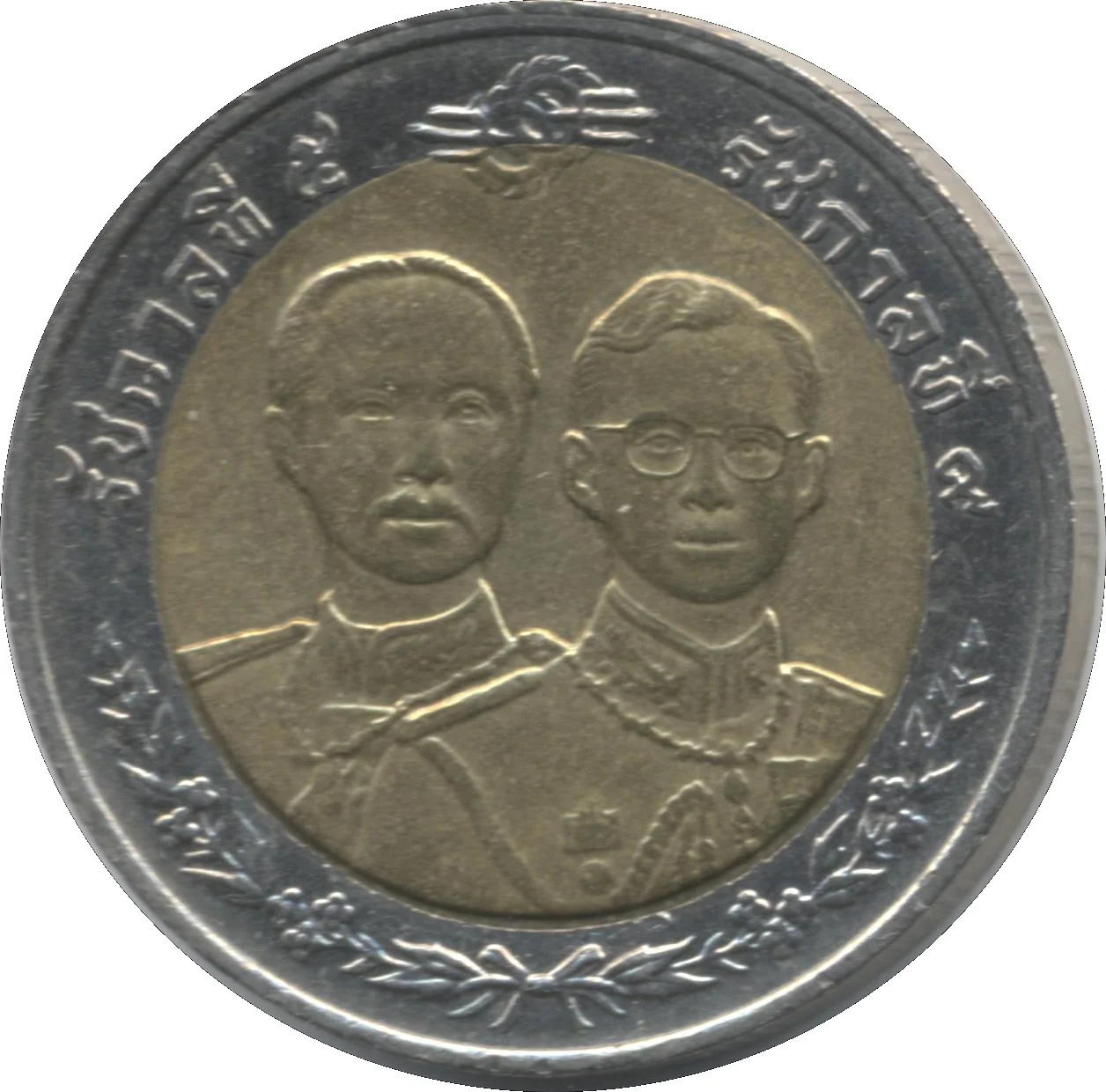
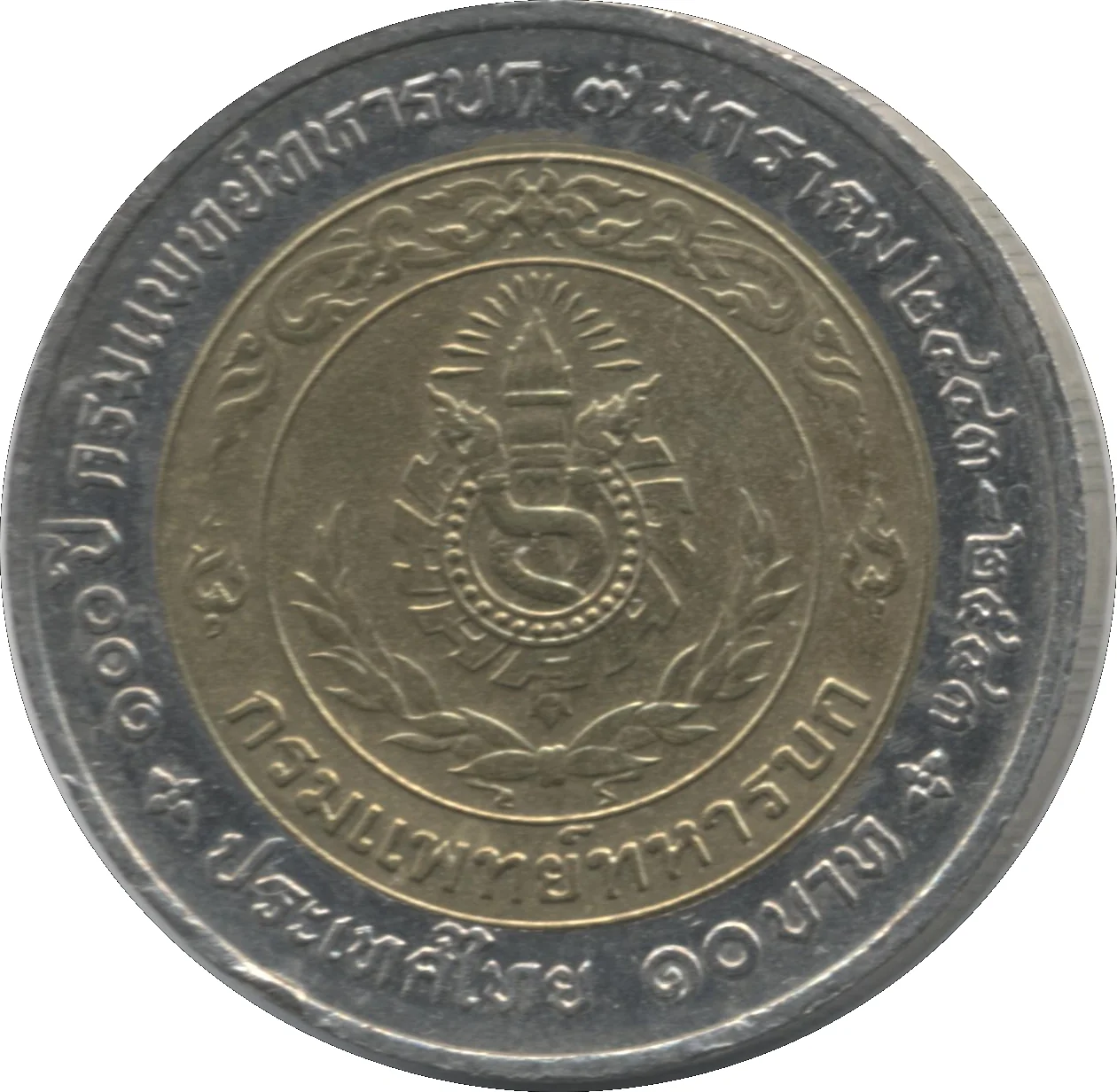
10 bahts (Royal Thai Army Medical Department) – Thailand
Circulating commemorative coins
Commemoration: 100th Anniversary of Royal Thai Army Medical Department
Thailand
Context
Year: 2000
Thai Year: 2543
Issuer: Thailand 
Ruler: Bhumibol Adulyadej
Currency:
(since 1897)
Total mintage: 3,000,017
Material
References
Y: #Click to copy to clipboard354
Numista: #7062
Value
Exchange value: 10 THB = $0.32
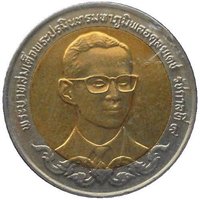
Obverse
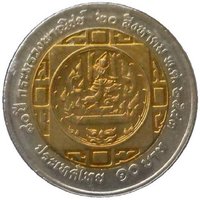
Reverse
Description:
Royal Thai Army Medical Department emblem: A Chakra with two entwined serpents and torches, above a laurel wreath.
Script: Thai
Edge
Segmented reeding, 15 smooth segments between 15 reeded segments, 5 reeds on each section.
Mintings
| Year | Mint Mark | Mintage | Quality | Collection |
|---|---|---|---|---|
| 2000 | — | 3,000,017 |
Historical background
In 2000, Thailand was in a period of fragile recovery and significant structural adjustment following the 1997 Asian Financial Crisis, which had originated with the collapse of the Thai baht. The currency, which had been pegged to the US dollar, was floated in July 1997 after speculative attacks exhausted the country's foreign reserves, leading to a dramatic devaluation. By 2000, the baht had stabilized but remained volatile, trading at around 40-45 baht to the US dollar, a stark contrast to the pre-crisis peg of 25 to 1. This devaluation had caused severe economic hardship, including a deep recession, a banking crisis, and a surge in corporate and national debt denominated in foreign currency.
The macroeconomic landscape in 2000 was defined by the conditions of a $17.2 billion International Monetary Fund (IMF) bailout package. Thailand was implementing stringent reforms, including fiscal austerity, high interest rates to support the currency, and major restructuring of the crippled financial sector. The focus was on debt resolution, corporate restructuring, and attracting foreign direct investment back into the economy. While exports benefited from the weaker baht, domestic demand remained weak, and the social costs were high, with increased unemployment and poverty rates lingering from the crisis years.
Looking forward, the currency situation in 2000 was a balancing act. The Bank of Thailand had shifted to a managed float regime, intervening only to prevent excessive volatility rather than targeting a specific rate. The priority was rebuilding foreign exchange reserves, which had been nearly depleted during the crisis, and restoring international confidence. The year represented a tentative turning point where the immediate firefighting of the crisis was over, but the long-term challenges of achieving sustainable growth with a stable, market-determined currency were fully underway.
The macroeconomic landscape in 2000 was defined by the conditions of a $17.2 billion International Monetary Fund (IMF) bailout package. Thailand was implementing stringent reforms, including fiscal austerity, high interest rates to support the currency, and major restructuring of the crippled financial sector. The focus was on debt resolution, corporate restructuring, and attracting foreign direct investment back into the economy. While exports benefited from the weaker baht, domestic demand remained weak, and the social costs were high, with increased unemployment and poverty rates lingering from the crisis years.
Looking forward, the currency situation in 2000 was a balancing act. The Bank of Thailand had shifted to a managed float regime, intervening only to prevent excessive volatility rather than targeting a specific rate. The priority was rebuilding foreign exchange reserves, which had been nearly depleted during the crisis, and restoring international confidence. The year represented a tentative turning point where the immediate firefighting of the crisis was over, but the long-term challenges of achieving sustainable growth with a stable, market-determined currency were fully underway.
🌱 Fairly Common