

½ penny – Southern Rhodesia
Add to wishlist
Zimbabwe
Context
Years: 1934–1936
Country: Zimbabwe
Issuer: Southern Rhodesia
Ruler: George V
Currency:
(1932—1955)
Demonetization: 1 January 1973
Total mintage: 480,000
Material
Diameter: 21.1 mm
Weight: 2.92 g
Shape: Round with a round hole
Composition: Copper-nickel
Technique: Milled
Alignment: Medal alignment
flip
References
KM: #
Numista: #7051
Obverse
Description:
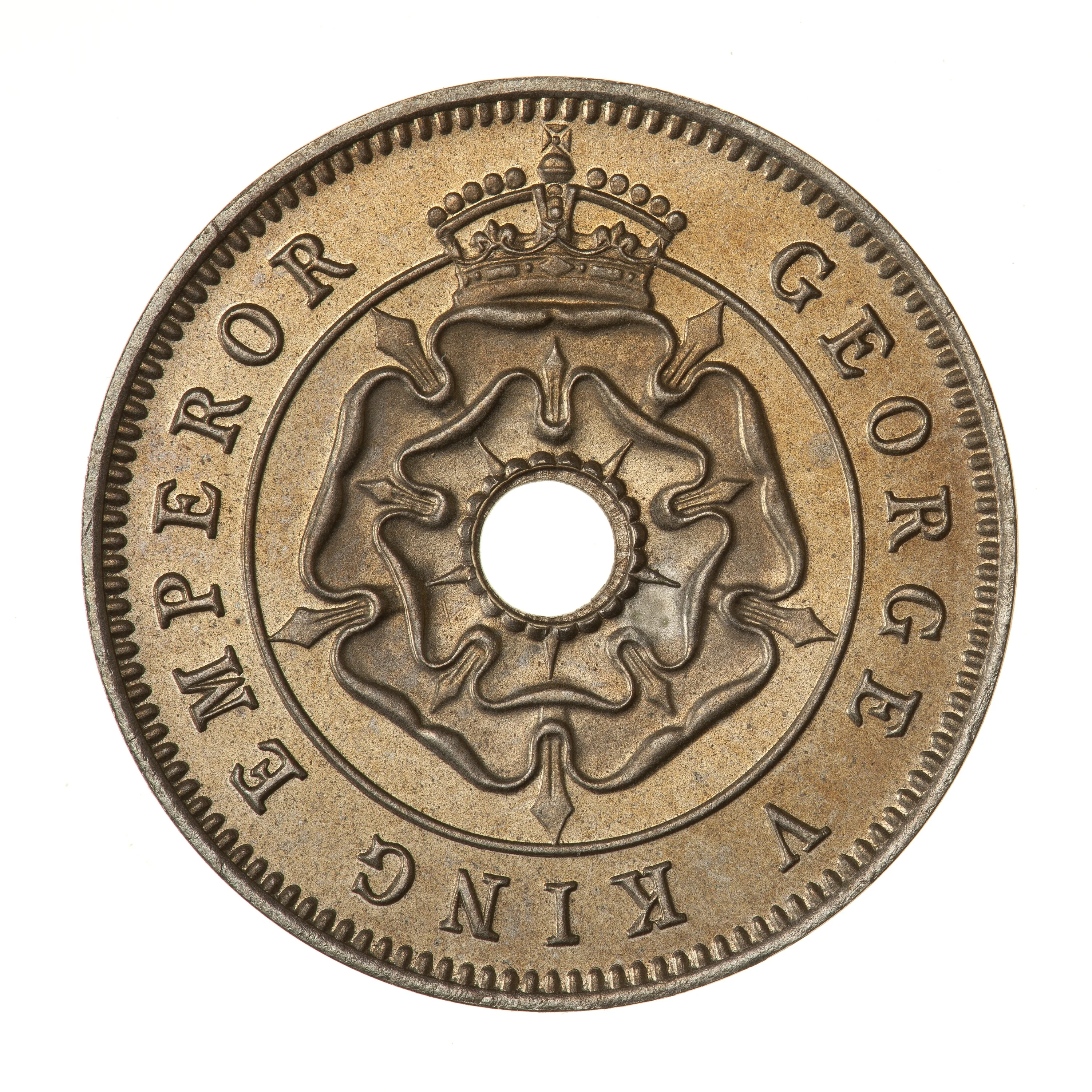
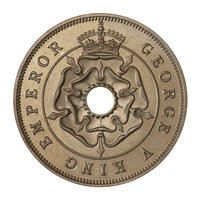
Crowned flower encircling hole, text around.
Inscription:
GEORGE V KING EMPEROR
Translation:
GEORGE V KING EMPEROR
Script: Latin
Language: English
Engraver: Derwent Wood
Reverse
Description:
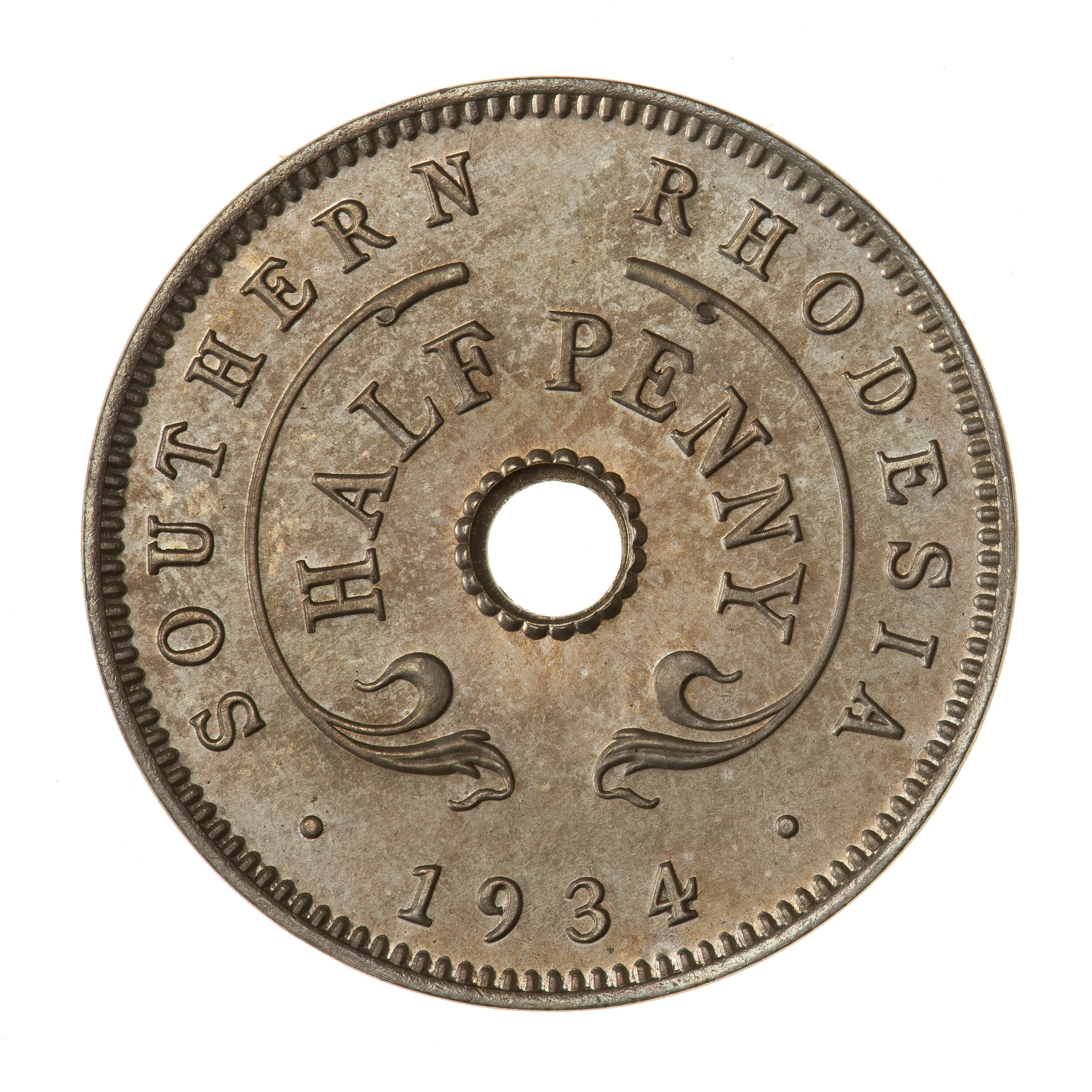
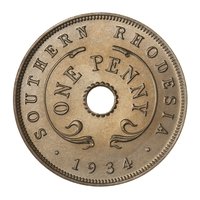
Denomination center, date below, name around top.
Inscription:
SOUTHERN RHODESIA
HALF PENNY
· 1934 ·
HALF PENNY
· 1934 ·
Script: Latin
Engraver: Royal Mint Engravers
Edge
Plain
Mints
| Name | Mark |
|---|---|
| Royal Mint (Tower Hill) | — |
Mintings
| Year | Mint Mark | Mintage | Quality | Collection |
|---|---|---|---|---|
| 1934 | — | 240,000 | ||
| 1934 | — | — | Proof | |
| 1936 | — | 240,000 | ||
| 1936 | — | — | Proof |
Historical background
In 1934, Southern Rhodesia’s currency was firmly integrated within the sterling area and operated under the Southern Rhodesia Currency Board, established in 1932. This system replaced the earlier use of British and South African currency in circulation. The board’s primary function was to ensure a full sterling reserve for the local currency issued, meaning the Rhodesian pound (£R) was pegged at par with the British pound sterling. This provided monetary stability and facilitated trade with the United Kingdom, the colony's dominant economic partner, by eliminating exchange risk.
The economy was heavily dependent on agricultural exports, particularly tobacco and maize, and the mining sector, which produced gold and other minerals. The global Great Depression of the early 1930s had severely impacted commodity prices, leading to economic hardship. By 1934, there were tentative signs of recovery, supported in part by the currency board's stability, which encouraged British investment. However, the rigid currency board system also meant Southern Rhodesia’s money supply was directly tied to its sterling reserves, limiting the government's ability to use independent monetary policy to stimulate the domestic economy during downturns.
Politically, the currency arrangement reflected the settler government's desire for economic credibility and strong links to Britain, following the 1923 grant of responsible government. There was little impetus for a central bank or a discretionary monetary policy. The system was viewed as a mark of financial prudence and imperial loyalty, ensuring that Southern Rhodesia’s currency was a fully convertible, reliable instrument for both domestic transactions and international trade, primarily oriented towards the British Empire. This framework would remain largely unchanged until the federation era in the 1950s.
The economy was heavily dependent on agricultural exports, particularly tobacco and maize, and the mining sector, which produced gold and other minerals. The global Great Depression of the early 1930s had severely impacted commodity prices, leading to economic hardship. By 1934, there were tentative signs of recovery, supported in part by the currency board's stability, which encouraged British investment. However, the rigid currency board system also meant Southern Rhodesia’s money supply was directly tied to its sterling reserves, limiting the government's ability to use independent monetary policy to stimulate the domestic economy during downturns.
Politically, the currency arrangement reflected the settler government's desire for economic credibility and strong links to Britain, following the 1923 grant of responsible government. There was little impetus for a central bank or a discretionary monetary policy. The system was viewed as a mark of financial prudence and imperial loyalty, ensuring that Southern Rhodesia’s currency was a fully convertible, reliable instrument for both domestic transactions and international trade, primarily oriented towards the British Empire. This framework would remain largely unchanged until the federation era in the 1950s.
🌱 Fairly Common