

2.5 euro – Portugal
Add to wishlist
Non-circulating coins
Commemoration: Fifa World Cup 2014 in Brazil
Portugal
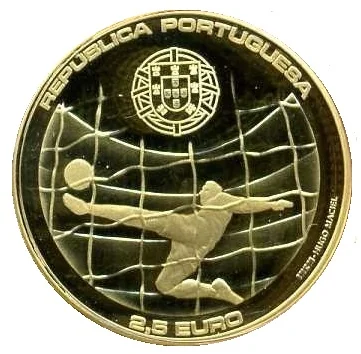
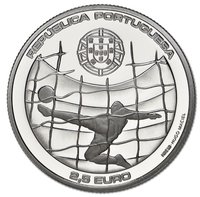
Obverse
Description:
Portugal's coat of arms above a goal net.
Inscription:
REPÚBLICA PORTUGUESA
INCM - HUGO MACIEL
2,5 EURO
INCM - HUGO MACIEL
2,5 EURO
Translation:
PORTUGUESE REPUBLIC
INCM - HUGO MACIEL
2.5 EURO
INCM - HUGO MACIEL
2.5 EURO
Script: Latin
Language: Portuguese
Engraver: Hugo Maciel
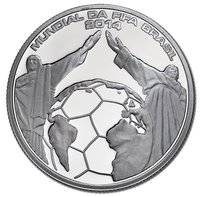
Reverse
Description:
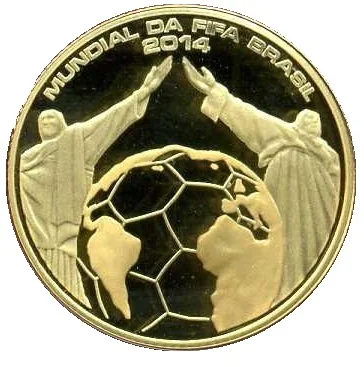
Christ the Redeemer statue halves flanking a soccer ball globe.
Inscription:
MUNDIAL DA FIFA BRASIL
2014
2014
Script: Latin
Engraver: Hugo Maciel
Edge
Reeded.
Categories
| Sport> Football> FIFA World Cup |
| Symbols> Coat of Arms |
Mintings
| Year | Mint Mark | Mintage | Quality | Collection |
|---|---|---|---|---|
| 2014 | INCM | 4,988 | Proof |
Historical background
In 2014, Portugal was in the final year of its three-year €78 billion international bailout program, agreed upon with the European Commission, European Central Bank, and International Monetary Fund (the "Troika") in 2011. The country's currency situation was defined by its membership in the Eurozone, meaning it used the euro and had relinquished control over its monetary policy to the European Central Bank (ECB). This framework was both a source of stability and constraint; it provided credibility and prevented a currency crisis but also removed the traditional tools of devaluation and independent interest rate adjustments to boost competitiveness and manage debt.
The primary economic challenges were not of a volatile national currency but of internal adjustment within the single currency. Portugal was undergoing a painful process of "internal devaluation"—pushing down wages and prices relative to its Eurozone peers to regain competitiveness, as it could not devalue its exchange rate. Austerity measures, including tax hikes and spending cuts, had contributed to a deep recession and high unemployment, though 2014 saw the beginnings of a fragile recovery. The country's focus was on meeting its bailout targets, reducing its budget deficit, and stabilizing its public debt, which exceeded 130% of GDP.
By May 2014, Portugal successfully exited the bailout program without requesting a precautionary credit line, marking a significant milestone. This "clean exit" was seen as a vote of confidence from financial markets, with government bond yields having fallen substantially from their crisis peaks. However, the legacy of the crisis period remained, with high public and private debt burdens and structural economic weaknesses. The currency situation was stable within the euro, but the underlying economic adjustments required for long-term prosperity within the monetary union were far from complete.
The primary economic challenges were not of a volatile national currency but of internal adjustment within the single currency. Portugal was undergoing a painful process of "internal devaluation"—pushing down wages and prices relative to its Eurozone peers to regain competitiveness, as it could not devalue its exchange rate. Austerity measures, including tax hikes and spending cuts, had contributed to a deep recession and high unemployment, though 2014 saw the beginnings of a fragile recovery. The country's focus was on meeting its bailout targets, reducing its budget deficit, and stabilizing its public debt, which exceeded 130% of GDP.
By May 2014, Portugal successfully exited the bailout program without requesting a precautionary credit line, marking a significant milestone. This "clean exit" was seen as a vote of confidence from financial markets, with government bond yields having fallen substantially from their crisis peaks. However, the legacy of the crisis period remained, with high public and private debt burdens and structural economic weaknesses. The currency situation was stable within the euro, but the underlying economic adjustments required for long-term prosperity within the monetary union were far from complete.
✨ Legendary