

50 dinars (7 Nov 1987 Coup d'état) – Tunisia
Add to wishlist
Non-circulating coins
Commemoration: The 10th Anniversary of the 7 Nov 1987 Coup d'état
Tunisia
Context
Material
References
KM: #
Numista: #112316
Value
Exchange value: 50 TND
Bullion value: $2910.52
Obverse
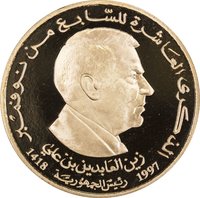
Description:
Bust of Ben Ali facing right with French text.
Inscription:
10e ANNIVERSAIRE DU 7 NOVEMBRE
Zine El Abidine Ben Ali
1418 Président de la République 1997
Zine El Abidine Ben Ali
1418 Président de la République 1997
Translation:
Tenth Anniversary of November 7
Zine El Abidine Ben Ali
1418 President of the Republic 1997
Zine El Abidine Ben Ali
1418 President of the Republic 1997
Language: French
Reverse
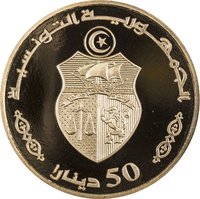
Description:
Arms with French motto
Inscription:
REPUBLIQUE TUNISIENNE
50 DINARS
50 DINARS
Translation:
Tunisian Republic
50 Dinars
50 Dinars
Language: French
Edge
Reeded
Mintings
| Year | Mint Mark | Mintage | Quality | Collection |
|---|---|---|---|---|
| 1997 | — | — | Proof |
Historical background
In 1997, Tunisia's currency situation was characterized by a period of cautious stability and gradual liberalization under a managed exchange rate regime. The Tunisian dinar (TND) was not freely convertible and its value was set against a basket of currencies of the country's major trading partners, primarily weighted toward the French franc and the US dollar. This system, administered by the Central Bank of Tunisia (BCT), aimed to maintain export competitiveness and control inflation, which had been successfully tamed after the economic turbulence of the 1980s.
The year fell within a broader context of structural adjustment programs agreed upon with the International Monetary Fund (IMF) and the World Bank, which encouraged a slow shift from a heavily regulated economy toward greater market orientation. As part of this, Tunisia was progressing with a phased approach to current account convertibility, having introduced a limited foreign exchange market (the "market for convertible dinars") for commercial banks in 1994. However, capital controls remained strict, and the dinar's exchange rate saw only minor, controlled adjustments, reflecting the government's priority of macroeconomic stability over rapid liberalization.
Economically, 1997 was a year of solid growth, bolstered by strong agricultural output and a growing manufacturing sector, particularly in textiles and electronics for export. This performance, coupled with prudent fiscal management, provided a favorable backdrop for the currency's stability. The managed dinar helped control import costs and provided predictability for businesses, but it also signaled the ongoing constraints of a system that would face future pressures for greater flexibility as Tunisia further integrated into the global economy.
The year fell within a broader context of structural adjustment programs agreed upon with the International Monetary Fund (IMF) and the World Bank, which encouraged a slow shift from a heavily regulated economy toward greater market orientation. As part of this, Tunisia was progressing with a phased approach to current account convertibility, having introduced a limited foreign exchange market (the "market for convertible dinars") for commercial banks in 1994. However, capital controls remained strict, and the dinar's exchange rate saw only minor, controlled adjustments, reflecting the government's priority of macroeconomic stability over rapid liberalization.
Economically, 1997 was a year of solid growth, bolstered by strong agricultural output and a growing manufacturing sector, particularly in textiles and electronics for export. This performance, coupled with prudent fiscal management, provided a favorable backdrop for the currency's stability. The managed dinar helped control import costs and provided predictability for businesses, but it also signaled the ongoing constraints of a system that would face future pressures for greater flexibility as Tunisia further integrated into the global economy.
✨ Legendary