

5 pesos (Leyte Gulf Landing) – Philippines
Add to wishlist
Circulating commemorative coins
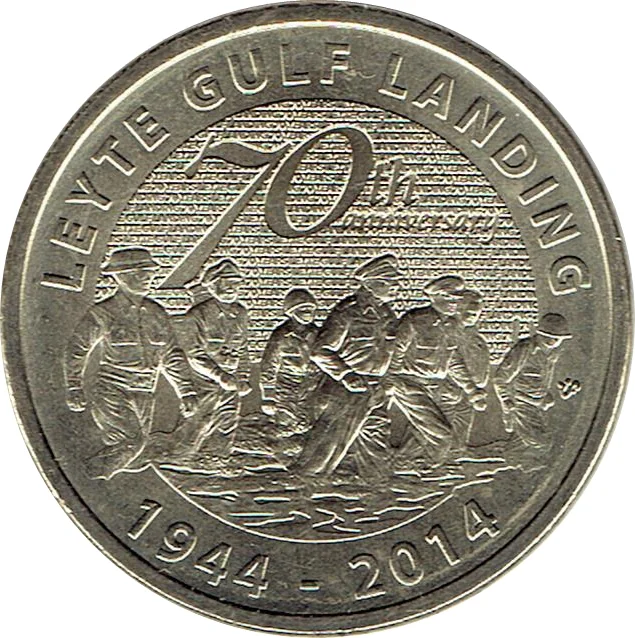
Commemoration: 70th Anniversary of Leyte Gulf Landing
Philippines
Context
Material
Diameter: 27 mm
Weight: 7.7 g
Thickness: 1.85 mm
Shape: Round
Composition: Nickel brass
Standard: Silver quarter ounce
Magnetic: No
Technique: Milled
Alignment: Medal alignment
flip
References
KM: #
Numista: #69960
Value
Exchange value: 5 PHP
Obverse
Reverse
Description:
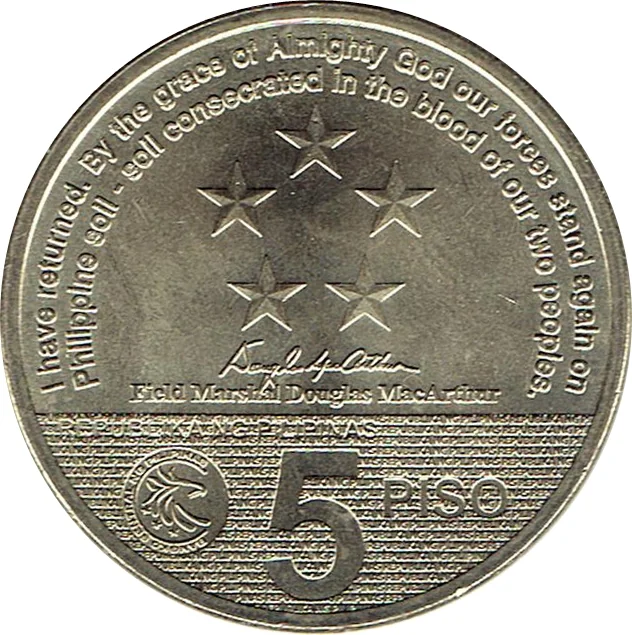
Five-star general insignia with MacArthur's signature and bank seal.
Inscription:
I have returned. By the grace of Almighty God our forces stand again on Philippine soil - soil consecrated in the blood of our two peoples.
Field Marshal Douglas Mc Arthur
REPUBLIKA NG PILIPINAS
5 PISO
Field Marshal Douglas Mc Arthur
REPUBLIKA NG PILIPINAS
5 PISO
Translation:
I have returned. By the grace of Almighty God our forces stand again on Philippine soil - soil consecrated in the blood of our two peoples.
Field Marshal Douglas MacArthur
REPUBLIC OF THE PHILIPPINES
5 PESOS
Field Marshal Douglas MacArthur
REPUBLIC OF THE PHILIPPINES
5 PESOS
Script: Latin
Edge
Plain
Categories
| Person> Military leader |
| Person> Politician |
Mints
| Name | Mark |
|---|---|
| BSP Security Plant Complex | (PI) |
Mintings
| Year | Mint Mark | Mintage | Quality | Collection |
|---|---|---|---|---|
| 2014 | PI | — |
Historical background
In 2014, the Philippine peso (PHP) demonstrated notable resilience and strength, largely defying the regional trend of currency weakness seen in many emerging markets. For much of the year, it traded within a relatively stable band, averaging around PHP 44 to PHP 45 against the US dollar. This stability was underpinned by robust fundamentals: strong overseas Filipino worker (OFW) remittances, which consistently exceeded $2 billion monthly, a thriving Business Process Outsourcing (BPO) sector, and a steady inflow of foreign direct investment. These sources created a persistent supply of US dollars into the economy, providing a solid floor for the peso and reflecting confidence in the country's growth story under the Aquino administration.
However, the currency was not without its pressures. The primary challenge came from the Philippines' widening trade deficit, as strong domestic demand and reconstruction efforts following Typhoon Haiyan (Yolanda) in late 2013 fueled imports of capital goods and consumer products. Furthermore, the anticipation and eventual commencement of the US Federal Reserve's "tapering" of its quantitative easing program in 2014 led to periodic volatility, causing occasional outflows of hot money from local bond and equity markets. The Bangko Sentral ng Pilipinas (BSP) actively managed these pressures through strategic interventions in the foreign exchange market and its key policy rate, which it held steady for most of the year to balance growth with inflation and currency stability.
Overall, 2014 was characterized by the peso's managed strength amidst external headwinds. It ended the year as one of Asia's better-performing currencies, a testament to the country's structural inflows. The BSP's conservative monetary policy and substantial foreign exchange reserves, which reached record levels, provided ample buffers. This environment of stability supported the Philippines' position as one of the fastest-growing economies in the region, even as policymakers remained vigilant against the risks posed by global financial volatility and the nation's growing current account shortfall.
However, the currency was not without its pressures. The primary challenge came from the Philippines' widening trade deficit, as strong domestic demand and reconstruction efforts following Typhoon Haiyan (Yolanda) in late 2013 fueled imports of capital goods and consumer products. Furthermore, the anticipation and eventual commencement of the US Federal Reserve's "tapering" of its quantitative easing program in 2014 led to periodic volatility, causing occasional outflows of hot money from local bond and equity markets. The Bangko Sentral ng Pilipinas (BSP) actively managed these pressures through strategic interventions in the foreign exchange market and its key policy rate, which it held steady for most of the year to balance growth with inflation and currency stability.
Overall, 2014 was characterized by the peso's managed strength amidst external headwinds. It ended the year as one of Asia's better-performing currencies, a testament to the country's structural inflows. The BSP's conservative monetary policy and substantial foreign exchange reserves, which reached record levels, provided ample buffers. This environment of stability supported the Philippines' position as one of the fastest-growing economies in the region, even as policymakers remained vigilant against the risks posed by global financial volatility and the nation's growing current account shortfall.
🌱 Common