

5 centimes – Tunisia
Add to wishlist
Tunisia
Context
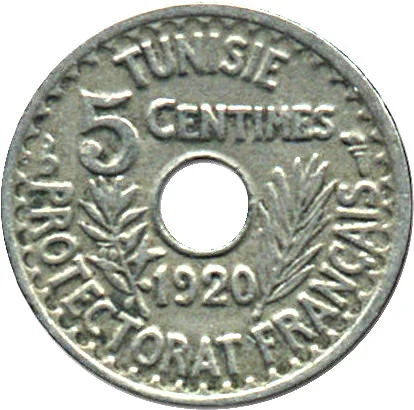
Year: 1920
Islamic (Hijri) Year:: 1339
Issuer: Tunisia
Currency:
(1891—1957)
Demonetized: Yes
Total mintage: 1,793,594
Material
Diameter: 17 mm
Weight: 2 g
Shape: Round with a round hole
Composition: Nickel brass
Magnetic: No
Technique: Milled
Alignment: Coin alignment
flip
References
KM: #
Numista: #11225
Value
Exchange value: 0.05 TNF
Obverse
Description:
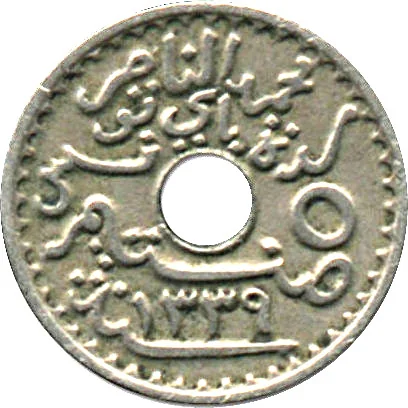
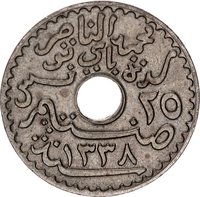
Inscription with central hole: value, date.
Inscription:
٥
١٣٣٩
١٣٣٩
Script: Arabic
Engraver: Henri-Auguste Patey
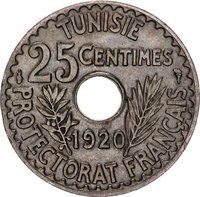
Reverse
Edge
Plain
Mints
| Name | Mark |
|---|---|
| Monnaie de Paris | — |
Mintings
| Year | Mint Mark | Mintage | Quality | Collection |
|---|---|---|---|---|
| 1920 | — | 1,793,594 |
Historical background
In 1920, Tunisia's currency situation was defined by its status as a French protectorate, established in 1881. The monetary system was under the direct control of France, which had replaced the previous Ottoman and local currencies with the Tunisian franc. This currency was pegged at par with the French franc, effectively integrating Tunisia into the French monetary zone. The Banque de l'Algérie, which had a monopoly on note issuance for France's North African territories, also served as the central bank for Tunisia, further cementing French financial dominance.
Economically, the post-World War I period presented significant challenges. Like much of the world, Tunisia experienced high inflation and economic dislocation following the war. The fixed peg to the French franc, while ensuring stability in trade with the metropole, meant Tunisia imported France's own monetary instability and inflationary pressures. This period also saw increased integration of the Tunisian economy into the French colonial system, with currency policy deliberately designed to facilitate the export of agricultural products (like wheat and olives) to France and the import of French manufactured goods, often to the detriment of local industry.
Consequently, the currency regime of 1920 was a clear instrument of colonial policy. It provided administrative and commercial convenience for the French administration and settler community (colons), but it offered little monetary sovereignty to Tunisians. The system prioritized the economic interests of the protectorate power, binding Tunisia's financial fate directly to decisions made in Paris and the performance of the French franc, a relationship that would characterize the country's economy for decades to come.
Economically, the post-World War I period presented significant challenges. Like much of the world, Tunisia experienced high inflation and economic dislocation following the war. The fixed peg to the French franc, while ensuring stability in trade with the metropole, meant Tunisia imported France's own monetary instability and inflationary pressures. This period also saw increased integration of the Tunisian economy into the French colonial system, with currency policy deliberately designed to facilitate the export of agricultural products (like wheat and olives) to France and the import of French manufactured goods, often to the detriment of local industry.
Consequently, the currency regime of 1920 was a clear instrument of colonial policy. It provided administrative and commercial convenience for the French administration and settler community (colons), but it offered little monetary sovereignty to Tunisians. The system prioritized the economic interests of the protectorate power, binding Tunisia's financial fate directly to decisions made in Paris and the performance of the French franc, a relationship that would characterize the country's economy for decades to come.
🌱 Fairly Common