

10 Francs (Montgolfier Balloon) – France
Circulating commemorative coins
Commemoration: 200th Anniversary of the Montgolfier Balloon
France
Context
Year: 1983
Issuer: France 
Period:
(since 1958)
Currency:
(1960—2001)
Demonetization: 1 July 1993
Total mintage: 4,000
Material
Diameter: 26 mm
Weight: 10 g
Thickness: 2.5 mm
Shape: Round
Composition: Copper-aluminium-nickel
Technique: Milled
Alignment: Coin alignment
flip
References
KM: #Click to copy to clipboard952
Numista: #696
Value
Exchange value: 10 FRF
Inflation-adjusted value: 26.46 FRF
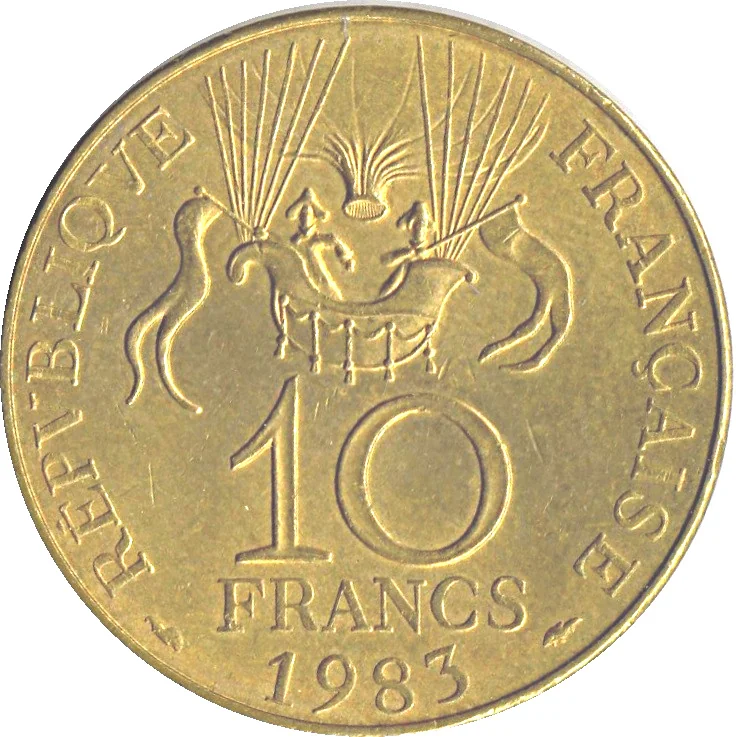
Obverse
Description:
Gondola of the first manned hydrogen balloon (1783).
Inscription:
RÉPVBLIQVE FRANÇAISE
10
FRANCS
1983
10
FRANCS
1983
Translation:
FRENCH REPUBLIC
10
FRANCS
1983
10
FRANCS
1983
Script: Latin
Language: French
Engraver: Daniel Ponce
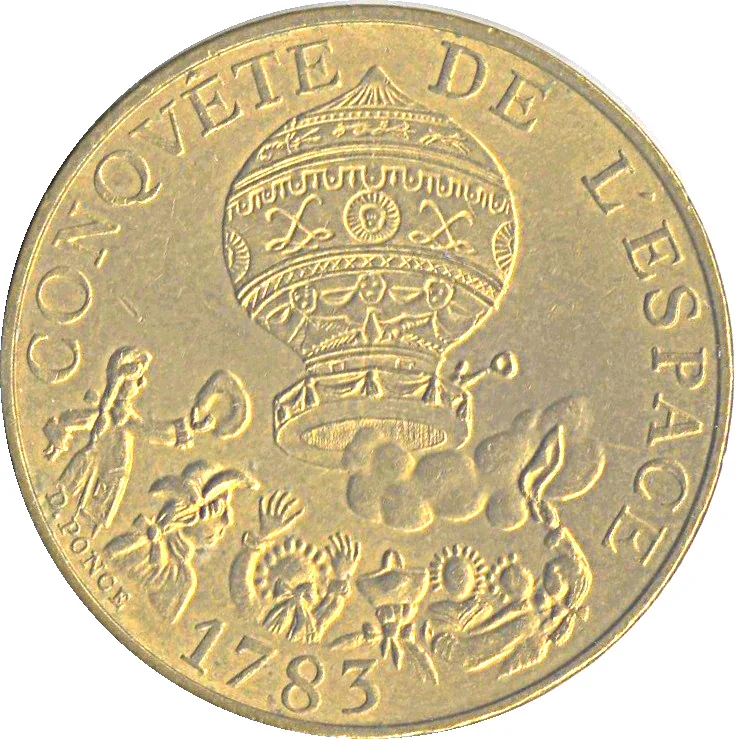
Reverse
Description:
First manned hot air balloon flight, November 21, 1783.
Inscription:
CONQVÊTE DE L'ESPACE
D.PONCE 1783
D.PONCE 1783
Translation:
Conquest of Space
D. Ponce 1783
D. Ponce 1783
Script: Latin
Language: French
Engraver: Daniel Ponce
Edge
Inscripted with the French motto
Legend:
LIBERTE EGALITE FRATERNITE
Translation:
Liberty Equality Fraternity
Language: French
Mints
| Name | Mark |
|---|---|
| Monnaie de Paris | — |
Mintings
| Year | Mint Mark | Mintage | Quality | Collection |
|---|---|---|---|---|
| 1983 | — | 4,000 |
Historical background
By 1983, France found itself at a critical juncture in its post-war economic history, grappling with the severe consequences of its experiment with "socialism in one country." Elected in 1981, President François Mitterrand’s government had initially pursued a reflationary policy of increased public spending, nationalizations, and higher wages to stimulate growth and reduce unemployment. However, this expansionary stance, pursued largely alone while other major economies like the US and Germany prioritized disinflation, led to a rapid deterioration of France’s external accounts. The franc came under intense and repeated speculative attack, forcing three devaluations within the European Monetary System (EMS) between 1981 and 1983, as capital fled the country.
The pivotal moment arrived in March 1983, following a massive run on the franc. Faced with a stark choice between abandoning the EMS (and the European project) to pursue an isolated, protectionist path or committing fully to European integration and economic orthodoxy, Mitterrand made the historic "tournant de la rigueur" (the turn to austerity). This decision, championed by ministers like Jacques Delors, meant prioritizing the defense of the franc’s parity within the EMS above domestic stimulus. It entailed a harsh package of spending cuts, wage freezes, and tax increases to restore trade competitiveness and investor confidence, effectively ending the initial Keynesian phase of Mitterrand’s presidency.
This policy U-turn had profound and lasting implications. It cemented France’s commitment to European monetary cooperation, a path that would eventually lead to the euro, and aligned its economic policy with German-style stability-oriented principles. Domestically, it marked the end of traditional French dirigisme and began a long era of "franc fort" (strong franc) policy, which prioritized price stability and exchange rate discipline, often at the cost of higher unemployment. The crisis of 1983 thus fundamentally redefined France’s economic policy framework for decades to come.
The pivotal moment arrived in March 1983, following a massive run on the franc. Faced with a stark choice between abandoning the EMS (and the European project) to pursue an isolated, protectionist path or committing fully to European integration and economic orthodoxy, Mitterrand made the historic "tournant de la rigueur" (the turn to austerity). This decision, championed by ministers like Jacques Delors, meant prioritizing the defense of the franc’s parity within the EMS above domestic stimulus. It entailed a harsh package of spending cuts, wage freezes, and tax increases to restore trade competitiveness and investor confidence, effectively ending the initial Keynesian phase of Mitterrand’s presidency.
This policy U-turn had profound and lasting implications. It cemented France’s commitment to European monetary cooperation, a path that would eventually lead to the euro, and aligned its economic policy with German-style stability-oriented principles. Domestically, it marked the end of traditional French dirigisme and began a long era of "franc fort" (strong franc) policy, which prioritized price stability and exchange rate discipline, often at the cost of higher unemployment. The crisis of 1983 thus fundamentally redefined France’s economic policy framework for decades to come.
🌱 Very Common