

¼ Dinar (Accession of King Hussein) – Jordan
Circulating commemorative coins
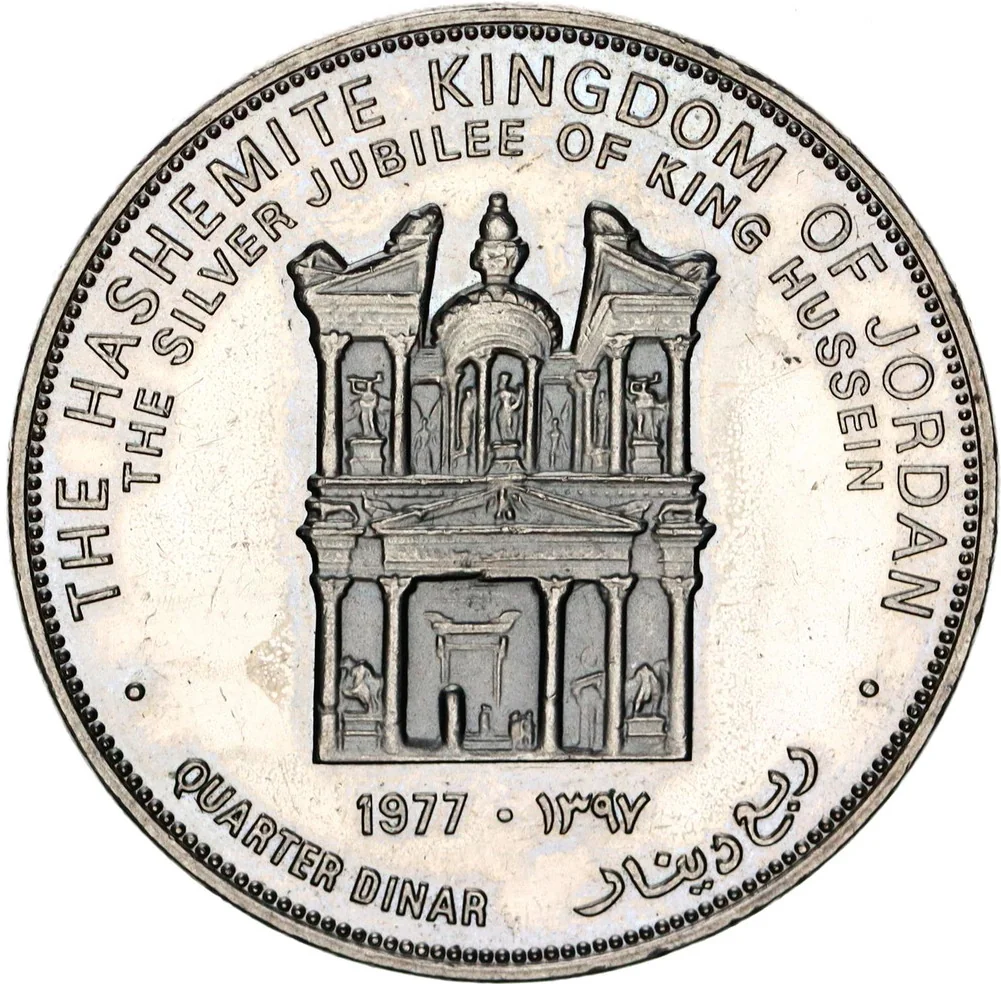
Commemoration: 25th Anniversary of the Accession of King Ḥusayn
Jordan
Context
Year: 1977
Islamic (Hijri) Year: 1397
Issuer: Jordan 
Ruler: Hussein bin Talal
Currency:
(since 1949)
Total mintage: 200,000
Material
Diameter: 34 mm
Weight: 17 g
Shape: Round
Composition: Copper-nickel
Technique: Milled
Alignment: Medal alignment
flip
References
KM: #Click to copy to clipboard30
Numista: #6952
Value
Exchange value: ¼ JOD
Obverse
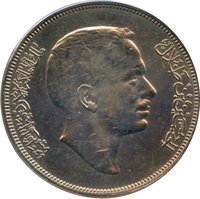
Description:
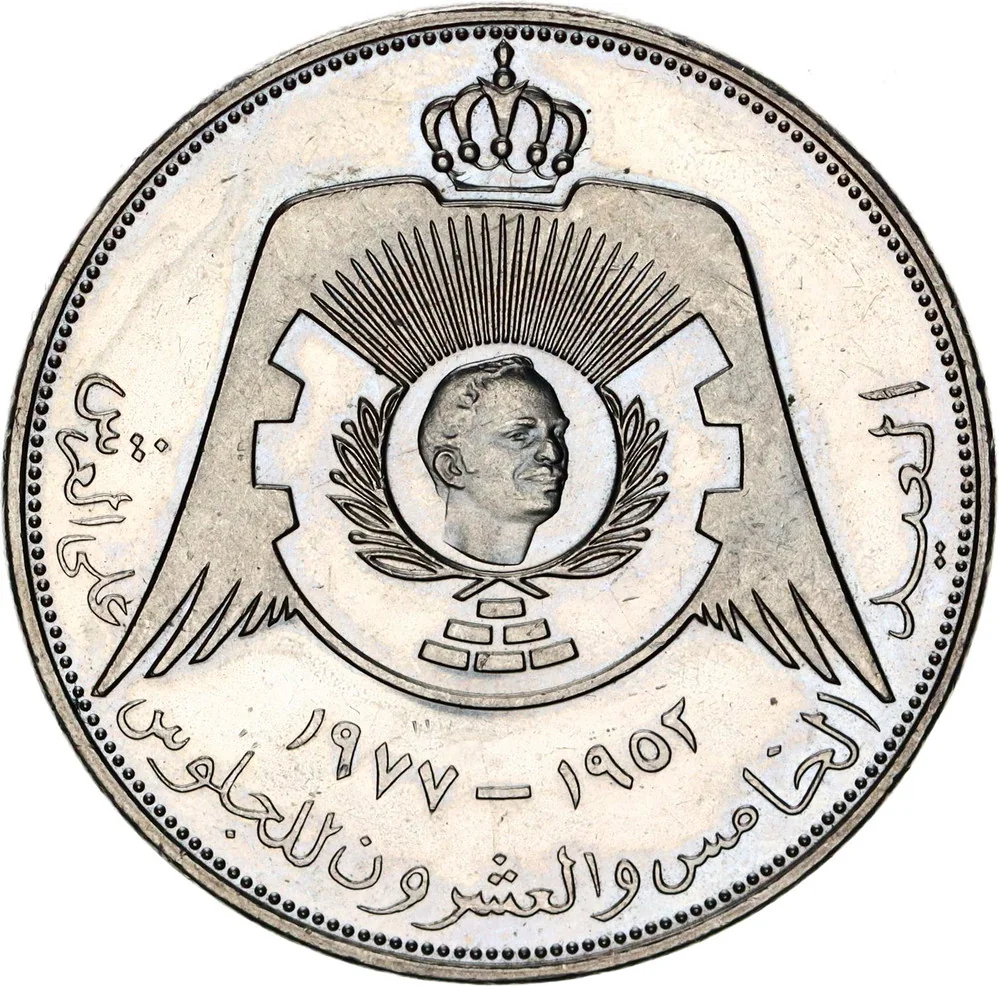
Quarter-right portrait within a circle of sprigs, topped by a crown with the date below.
Inscription:
العيد الخامس والعشرون للجلوس على العرش
١٩٥٢ - ١٩٧٧
١٩٥٢ - ١٩٧٧
Translation:
The Twenty-Fifth Anniversary of the Accession to the Throne
1952 - 1977
1952 - 1977
Language: Arabic
Reverse
Edge
Milled
Mints
| Name | Mark |
|---|---|
| Royal Mint | — |
Mintings
| Year | Mint Mark | Mintage | Quality | Collection |
|---|---|---|---|---|
| 1977 | — | 200,000 |
Historical background
In 1977, Jordan's currency situation was characterized by stability and confidence, underpinned by the strength of the Jordanian Dinar (JOD). The dinar was, and remains, pegged to a basket of currencies, though during this period it was widely understood to be effectively anchored to the U.S. Dollar. This peg provided a crucial anchor for the economy, controlling inflation and fostering predictable conditions for trade and investment. The stability was a notable achievement given the regional volatility, as Jordan had navigated the economic disruptions of the 1973 Arab-Israeli War and the 1975-76 Lebanese Civil War without significant currency turmoil.
This monetary stability was managed by the Central Bank of Jordan (CBJ), which maintained substantial foreign exchange reserves, largely bolstered by robust external inflows. These inflows came from three primary sources: remittances from Jordanian expatriates working in the oil-rich Gulf states, foreign aid (particularly from other Arab nations), and a growing tourism sector. The influx of hard currency allowed the CBJ to confidently support the peg, ensuring the dinar's convertibility and its reputation as one of the region's most reliable currencies.
However, this apparent stability existed alongside underlying economic vulnerabilities. The Jordanian economy was heavily dependent on these external financial sources, making it susceptible to regional political shifts and fluctuations in oil prices that could affect aid and remittances. Furthermore, the country faced a persistent trade deficit, importing far more goods (including essential food and energy) than it exported. Therefore, while the currency itself was strong and stable in 1977, its foundation relied on a continuous cycle of external subsidies rather than a robust, self-sufficient productive base, indicating potential challenges for long-term economic resilience.
This monetary stability was managed by the Central Bank of Jordan (CBJ), which maintained substantial foreign exchange reserves, largely bolstered by robust external inflows. These inflows came from three primary sources: remittances from Jordanian expatriates working in the oil-rich Gulf states, foreign aid (particularly from other Arab nations), and a growing tourism sector. The influx of hard currency allowed the CBJ to confidently support the peg, ensuring the dinar's convertibility and its reputation as one of the region's most reliable currencies.
However, this apparent stability existed alongside underlying economic vulnerabilities. The Jordanian economy was heavily dependent on these external financial sources, making it susceptible to regional political shifts and fluctuations in oil prices that could affect aid and remittances. Furthermore, the country faced a persistent trade deficit, importing far more goods (including essential food and energy) than it exported. Therefore, while the currency itself was strong and stable in 1977, its foundation relied on a continuous cycle of external subsidies rather than a robust, self-sufficient productive base, indicating potential challenges for long-term economic resilience.
🌱 Common