

25 Colones – Costa Rica
Costa Rica
Context
Years: 2001–2003
Issuer: Costa Rica 
Issuing organization: Central Bank of Costa Rica
Period:
(since 1948)
Currency:
(since 1896)
Total mintage: 25,000,000
Material
Diameter: 25.5 mm
Weight: 7 g
Thickness: 2.07 mm
Shape: Round
Composition: Copper-aluminium-nickel
Magnetic: No
Technique: Milled
Alignment: Coin alignment
flip
References
KM: #Click to copy to clipboard229a
Numista: #6941
Value
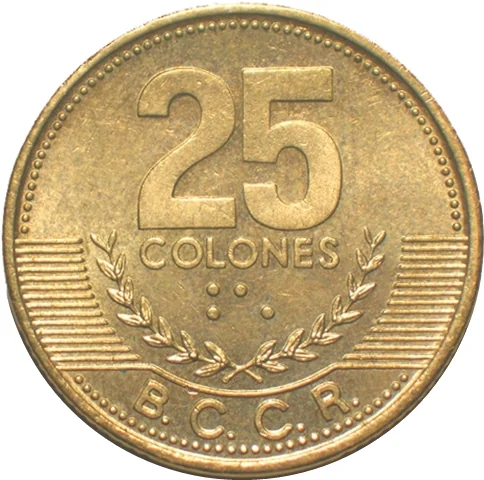
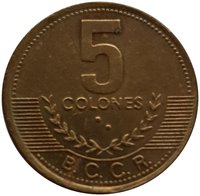
Exchange value: 25 CRC
Obverse
Description:
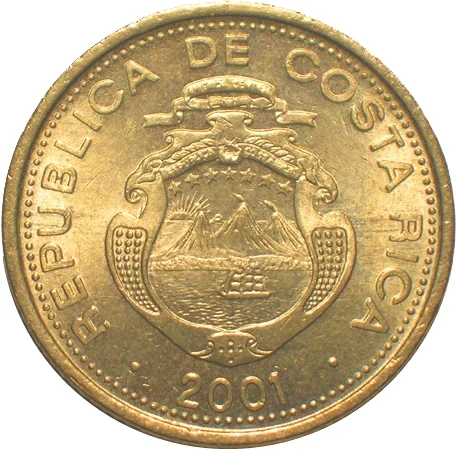
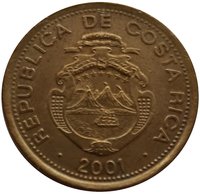
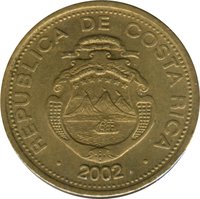
Costa Rica's coat of arms features seven stars for its provinces, three volcanoes for its mountain ranges, two ships for its position between oceans, and a sunrise, with the date below.
Inscription:
REPUBLICA DE COSTA RICA
AMERICA CENTRAL
REPUBLICA DE COSTA RICA
2001
AMERICA CENTRAL
REPUBLICA DE COSTA RICA
2001
Translation:
REPUBLIC OF COSTA RICA
CENTRAL AMERICA
REPUBLIC OF COSTA RICA
2001
CENTRAL AMERICA
REPUBLIC OF COSTA RICA
2001
Script: Latin
Language: Spanish
Reverse
Edge
Segmented (4 smooth, 4 milled)
Categories
| Geography> Mountain |
| Symbols> Coat of Arms |
| Transportation> Watercraft |
| Symbol> Wreath |
Mints
| Name | Mark |
|---|---|
| Casa de Moneda de Chile | — |
Mintings
| Year | Mint Mark | Mintage | Quality | Collection |
|---|---|---|---|---|
| 2001 | — | 10,000,000 | ||
| 2003 | — | 15,000,000 |
Historical background
In 2001, Costa Rica's currency situation was defined by a managed float regime for the colón (₡) within a crawling band system. The Central Bank of Costa Rica (BCCR) set a central exchange rate against the US dollar and allowed the colón to fluctuate within a band of +/- 2.25%. This system aimed to provide a balance between stability and flexibility, permitting gradual depreciation to maintain export competitiveness while mitigating severe volatility. However, the period was marked by significant dollarization of the economy, with a large portion of loans, deposits, and even real estate transactions conducted in US dollars, creating a vulnerability for those without dollar income.
The year saw persistent depreciation pressure on the colón, driven by several key factors. A widening current account deficit, fueled by high oil prices and strong demand for imported goods, increased demand for foreign currency. Furthermore, political uncertainty surrounding national elections and concerns over the fiscal deficit, which was exacerbated by losses at state-owned banks, undermined investor confidence. These factors led to consistent interventions by the BCCR, which spent substantial international reserves to defend the colón's band, seeking to curb inflationary pass-through from a weaker currency.
Ultimately, the pressures of 2001 set the stage for a significant policy shift the following year. The crawling band system proved difficult and costly to maintain, and in February 2002, the BCCR transitioned to a free float exchange rate regime. This move was preceded by a one-time 7% devaluation within the band in late 2001, a final attempt to adjust the currency before abandoning the band entirely. Thus, 2001 represented the final year of Costa Rica's long-standing crawling peg system, a transitional period where economic imbalances and external shocks overwhelmed the mechanisms designed to provide controlled exchange rate stability.
The year saw persistent depreciation pressure on the colón, driven by several key factors. A widening current account deficit, fueled by high oil prices and strong demand for imported goods, increased demand for foreign currency. Furthermore, political uncertainty surrounding national elections and concerns over the fiscal deficit, which was exacerbated by losses at state-owned banks, undermined investor confidence. These factors led to consistent interventions by the BCCR, which spent substantial international reserves to defend the colón's band, seeking to curb inflationary pass-through from a weaker currency.
Ultimately, the pressures of 2001 set the stage for a significant policy shift the following year. The crawling band system proved difficult and costly to maintain, and in February 2002, the BCCR transitioned to a free float exchange rate regime. This move was preceded by a one-time 7% devaluation within the band in late 2001, a final attempt to adjust the currency before abandoning the band entirely. Thus, 2001 represented the final year of Costa Rica's long-standing crawling peg system, a transitional period where economic imbalances and external shocks overwhelmed the mechanisms designed to provide controlled exchange rate stability.
🌱 Very Common