


Obverse
Description:
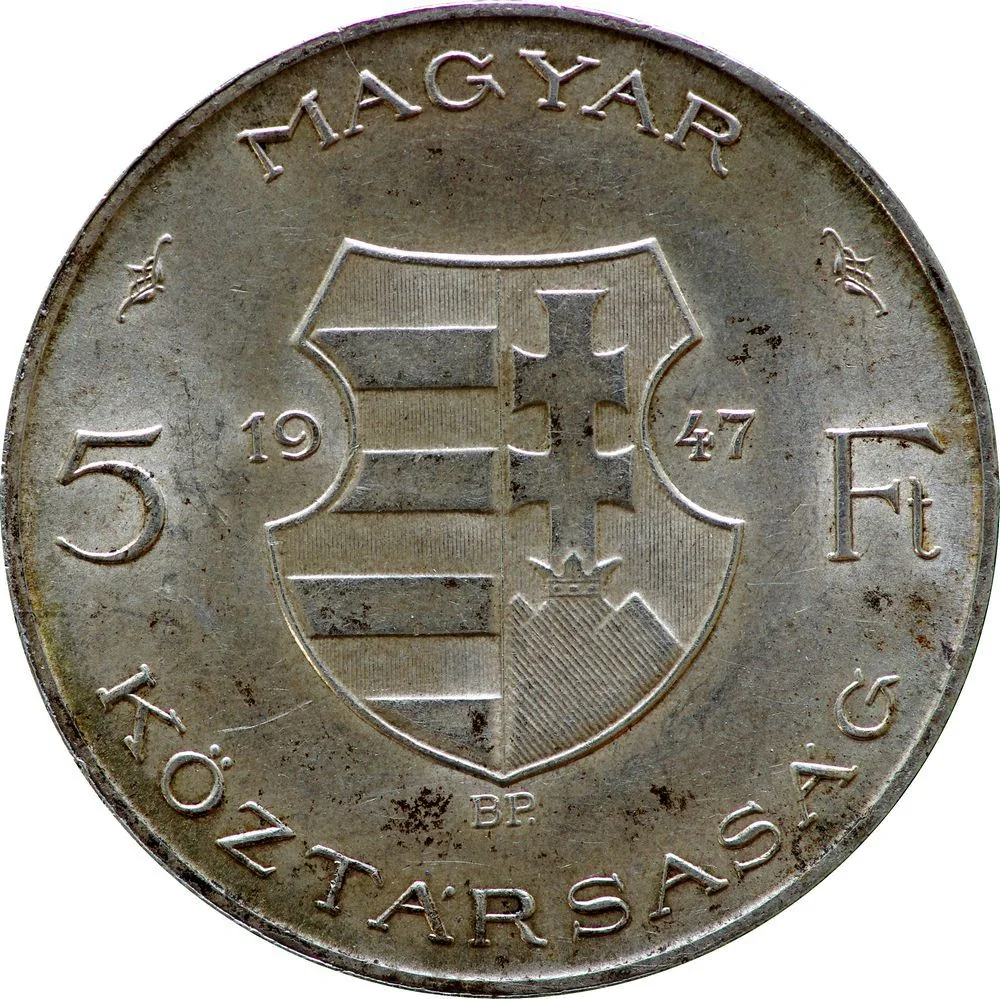
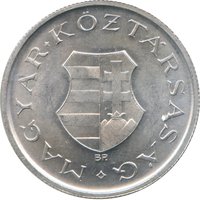
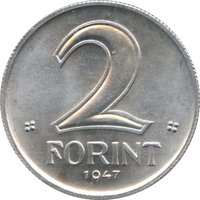
Value and date flank the Kossuth coat of arms.
Inscription:
MAGYAR
5 Ft
19 47
BP
KÖZTÁRSASÁG
5 Ft
19 47
BP
KÖZTÁRSASÁG
Translation:
People's Republic
5 Forint
1947
Budapest
5 Forint
1947
Budapest
Script: Latin
Language: Hungarian
Engraver: Iván István
Reverse
Description:
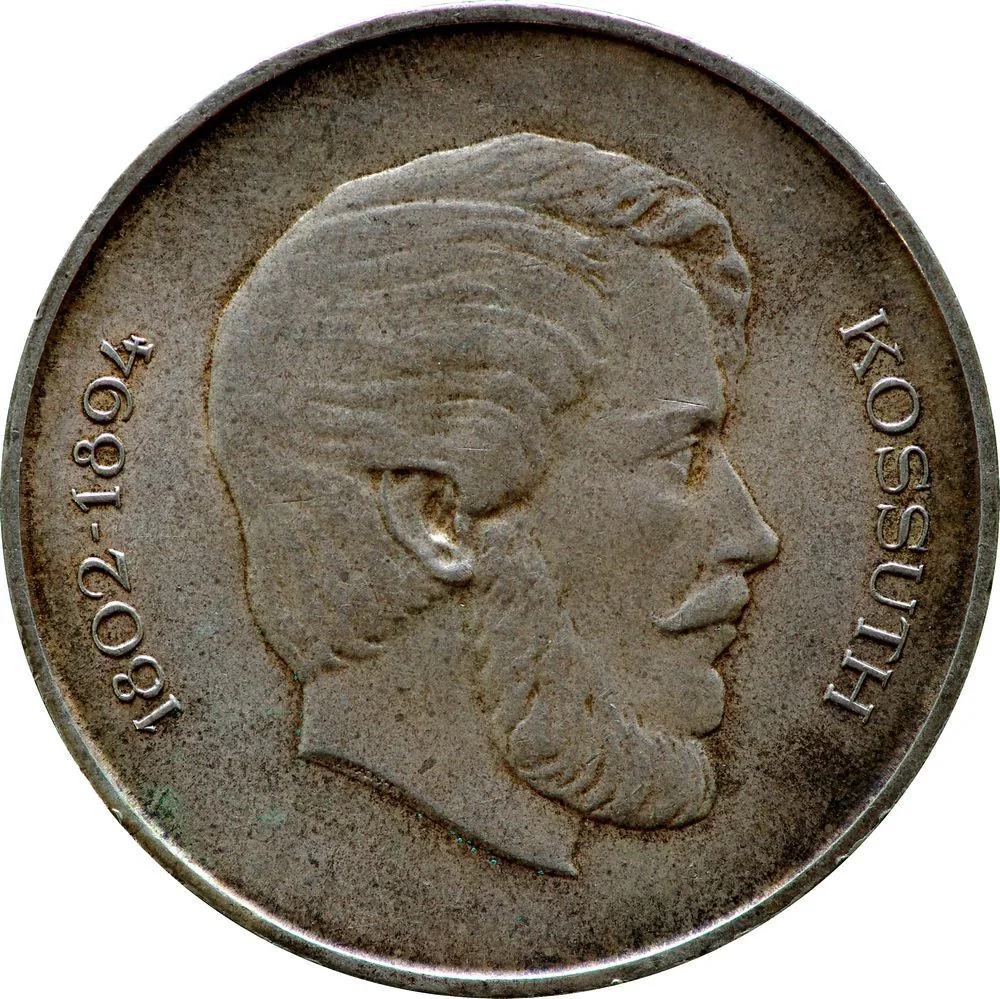
Right-facing portrait
Inscription:
1802-1894
KOSSUTH
KOSSUTH
Script: Latin
Engraver: Iván István
Edge
Smooth with incused symbols separating "M" "Á" "P" "V" (Magyar Állami PénzVerő)
Legend:
MÁPV
Translation:
Long live the Hungarian Soviet Republic.
Language: Hungarian
Mints
| Name | Mark |
|---|---|
| Hungarian mint | BP. |
Historical background
In 1947, Hungary was grappling with one of the most severe hyperinflations in economic history, a direct legacy of World War II. The national currency, the pengő, had been rendered virtually worthless by the war's devastation, the burdens of occupation and reparations, and the government's recourse to printing money to cover expenses. By mid-1946, inflation peaked at a staggering 41.9 quadrillion percent, leading to the introduction of a temporary currency, the tax pengő, and finally a new, stable currency—the forint—in August 1946. However, the stability of the new forint remained fragile throughout 1947.
The primary challenge in 1947 was consolidating this hard-won stability under the growing influence of the Hungarian Communist Party, which was steadily consolidating power with Soviet backing. The government, led by Prime Minister Lajos Dinnyés but increasingly directed by Communist leader Mátyás Rákosi, faced immense pressure to fund reconstruction and a growing bureaucracy without reigniting inflation. This was achieved through a combination of strict monetary discipline, including a limited supply of forints backed by gold and foreign currency reserves, and extensive state control over the economy, including price controls and the allocation of key resources.
Ultimately, the currency situation in 1947 was a pivotal economic and political battleground. The successful stabilization of the forint provided the Communist-led government with crucial legitimacy and a tool for control. It allowed for the implementation of the first Three-Year Plan in 1947, which began steering Hungary toward a Soviet-style command economy. Thus, the defeat of hyperinflation laid the financial groundwork for the subsequent nationalization of industry and the full establishment of a communist state by 1949.
The primary challenge in 1947 was consolidating this hard-won stability under the growing influence of the Hungarian Communist Party, which was steadily consolidating power with Soviet backing. The government, led by Prime Minister Lajos Dinnyés but increasingly directed by Communist leader Mátyás Rákosi, faced immense pressure to fund reconstruction and a growing bureaucracy without reigniting inflation. This was achieved through a combination of strict monetary discipline, including a limited supply of forints backed by gold and foreign currency reserves, and extensive state control over the economy, including price controls and the allocation of key resources.
Ultimately, the currency situation in 1947 was a pivotal economic and political battleground. The successful stabilization of the forint provided the Communist-led government with crucial legitimacy and a tool for control. It allowed for the implementation of the first Three-Year Plan in 1947, which began steering Hungary toward a Soviet-style command economy. Thus, the defeat of hyperinflation laid the financial groundwork for the subsequent nationalization of industry and the full establishment of a communist state by 1949.
🌱 Common