

5 Centavos – Chile
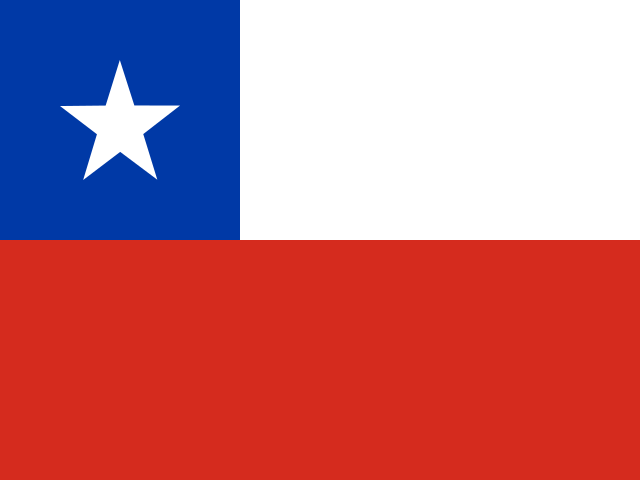
Chile
Context
Material
Diameter: 16.5 mm
Weight: 2 g
Thickness: 1.33 mm
Shape: Round
Composition: Copper-nickel
Technique: Milled
Alignment: Coin alignment
flip
References
KM: #Click to copy to clipboard165
Numista: #6921
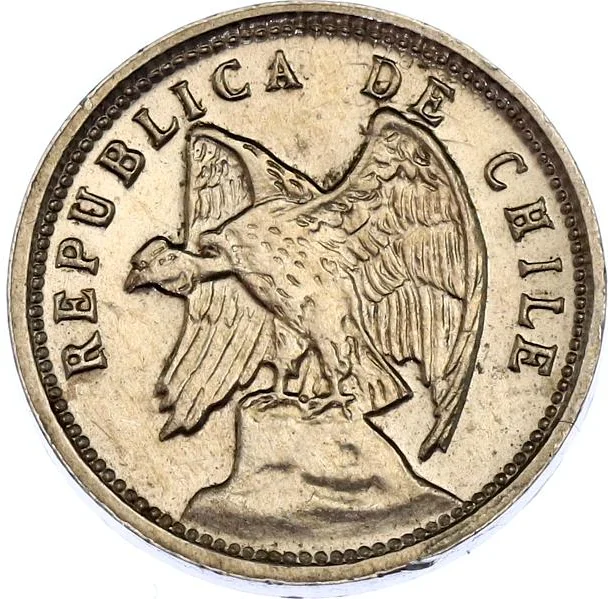
Obverse
Description:
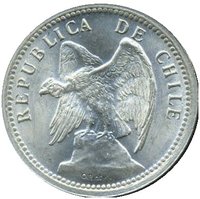
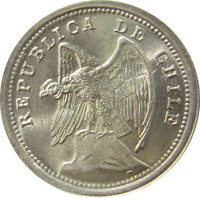
Defiant Andean Condor on rock, wings outstretched. Designer's name O. ROTY below.
Inscription:
REPUBLICA DE CHILE
Translation:
Republic of Chile
Script: Latin
Language: Spanish
Engraver: Louis-Oscar Roty
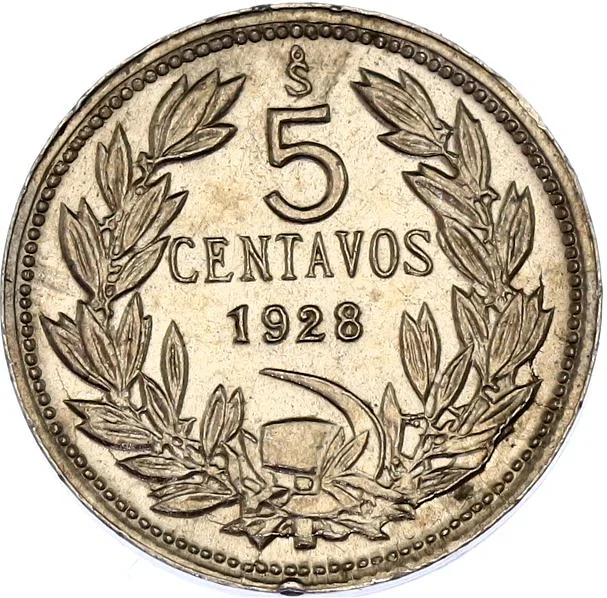
Reverse
Description:
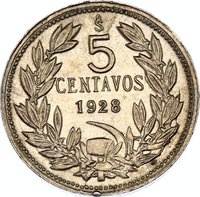
Mintmark, date, and value encircled by wreath.
Inscription:
So
5
CENTAVOS
1937
5
CENTAVOS
1937
Script: Latin
Edge
Plain
Mints
| Name | Mark |
|---|---|
| Casa de Moneda de Chile | (So) |
Mintings
| Year | Mint Mark | Mintage | Quality | Collection |
|---|---|---|---|---|
| 1920 | So | 718,000 | ||
| 1921 | So | 2,406,000 | ||
| 1922 | So | 3,872,000 | ||
| 1923 | So | 2,150,000 | ||
| 1925 | So | 994,000 | ||
| 1926 | So | 594,000 | ||
| 1927 | So | 1,276,000 | ||
| 1928 | So | 5,197,000 | ||
| 1933 | So | 3,000,000 | ||
| 1934 | So | — | ||
| 1936 | So | 2,000,000 | ||
| 1937 | So | 2,000,000 | ||
| 1938 | So | 2,000,000 |
Historical background
In 1920, Chile's currency situation was defined by the paper peso, a fiat currency that had been in circulation since 1879 when the country abandoned the gold standard to finance the War of the Pacific. This shift led to a period of significant inflation and currency depreciation, as the government financed spending by printing money without metallic backing. By the early 20th century, the value of the paper peso against the British pound sterling was a fraction of its pre-1879 parity, reflecting a long-term loss of purchasing power and creating economic instability for both international trade and domestic prices.
The immediate post-World War I context exacerbated these issues. A wartime export boom for Chilean nitrates and copper had brought a temporary influx of foreign exchange, but the collapse of the nitrate market after 1919—due to the invention of synthetic alternatives—triggered a severe economic crisis. Government revenues plummeted, leading to even greater fiscal deficits financed by the printing press. Consequently, inflation accelerated sharply, eroding real wages and living standards, particularly for the urban working class, and contributing to widespread social unrest.
Politically, the currency crisis was central to the presidential election of 1920, which pitted the conservative establishment against the reformist Liberal Alliance led by Arturo Alessandri. The "currency question" — specifically whether to return to a gold standard or stabilize the paper peso — was a major debate. While a return to gold was seen as a path to discipline and stability, it was also feared it would cause severe deflation and economic contraction. The crisis thus underscored a fundamental struggle between monetary orthodoxy and the pressing social demands that would define Chilean politics for the ensuing decades.
The immediate post-World War I context exacerbated these issues. A wartime export boom for Chilean nitrates and copper had brought a temporary influx of foreign exchange, but the collapse of the nitrate market after 1919—due to the invention of synthetic alternatives—triggered a severe economic crisis. Government revenues plummeted, leading to even greater fiscal deficits financed by the printing press. Consequently, inflation accelerated sharply, eroding real wages and living standards, particularly for the urban working class, and contributing to widespread social unrest.
Politically, the currency crisis was central to the presidential election of 1920, which pitted the conservative establishment against the reformist Liberal Alliance led by Arturo Alessandri. The "currency question" — specifically whether to return to a gold standard or stabilize the paper peso — was a major debate. While a return to gold was seen as a path to discipline and stability, it was also feared it would cause severe deflation and economic contraction. The crisis thus underscored a fundamental struggle between monetary orthodoxy and the pressing social demands that would define Chilean politics for the ensuing decades.
🌱 Very Common