

10 centimes – France
Add to wishlist
France
Context
Years: 1944–1946
Issuer: France
Period:
(1944—1946)
Currency:
(1795—1959)
Demonetization: 20 March 1947
Total mintage: 64,365,660
Material
Diameter: 17 mm
Weight: 1.5 g
Thickness: 1.3 mm
Shape: Round with a round hole
Composition: Zinc
Magnetic: No
Technique: Milled
Alignment: Coin alignment
flip
References
KM: #
Numista: #690
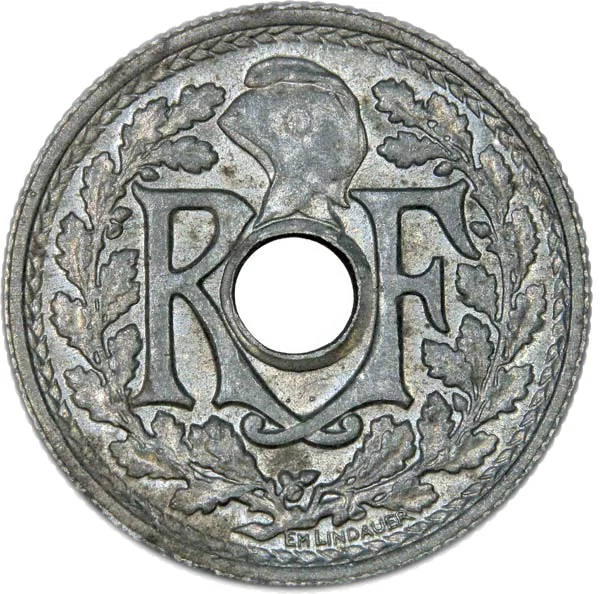
Obverse
Description:
RF split by hole in wreath
Inscription:
R F
EM LINDAUER
EM LINDAUER
Translation:
R(es) F(ublica) Lindauer
Script: Latin
Language: Latin
Engraver: Edmond-Émile Lindauer
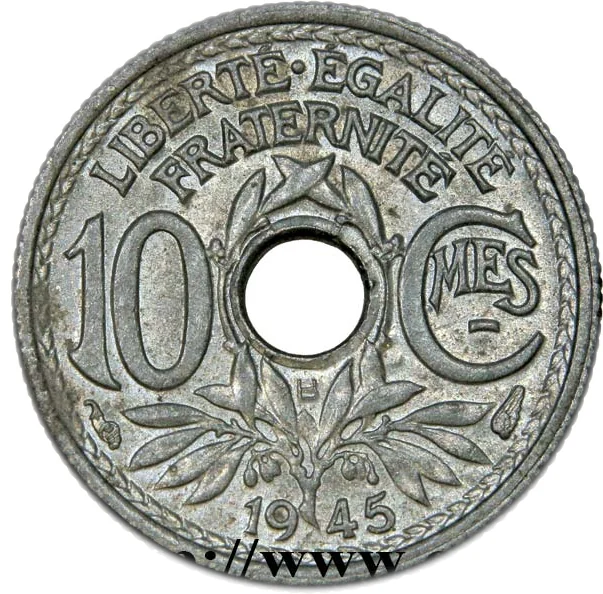
Reverse
Description:
Value/hole, date below.
Inscription:
LIBERTÉ·ÉGALITÉ
FRATERNITÉ
10 CMES
B
1945
FRATERNITÉ
10 CMES
B
1945
Translation:
LIBERTY EQUALITY
FRATERNITY
10 CENTIMES
B
1945
FRATERNITY
10 CENTIMES
B
1945
Script: Latin
Language: French
Engraver: Edmond-Émile Lindauer
Edge
Reeded
Mints
| Name | Mark |
|---|---|
| Monnaie de Paris | — |
| Beaumont-le-Roger | B |
| Castelsarrasin | C |
Mintings
Historical background
In the summer of 1944, France was gripped by a severe monetary crisis characterized by a chaotic dual-currency system. The official currency was the German-mandated franc, which had been artificially pegged at an exploitative rate of 20 francs to 1 Reichsmark. Alongside this, the occupying forces had introduced the Reichskreditkassenscheine, a military currency used to finance the occupation by essentially forcing the Banque de France to provide massive, inflationary advances. More critically, the Vichy government and the German authorities had printed enormous quantities of francs to fund their operations and the war economy, leading to a vast increase in the money supply and a severe erosion of purchasing power, all while goods were scarce due to rationing and plunder.
Simultaneously, the provisional government of General Charles de Gaulle, through the Caisse Centrale de la France Libre, had been preparing for liberation by issuing Free French francs. These notes, printed in the UK and the US, were intended to establish the authority of the new government and replace the compromised Vichy and occupation currencies. Upon the Allied landings, a critical and immediate challenge was to impose this new currency as the sole legal tender, a process fraught with difficulty. In many areas, all four types of money—Vichy francs, occupation notes, Reichskreditkassenscheine, and Free French francs—circulated simultaneously, causing widespread confusion and rampant black-market speculation.
The new provisional government's first major financial act was the monetary reform of June 1945. This did not involve a currency swap but was a definitive political act: the demonetization of all Vichy and occupation notes. Holders were forced to exchange them for new notes issued by the liberated Banque de France, a process accompanied by strict audits to identify and penalize war profiteers who had accumulated large, illicit cash holdings. This painful but necessary surgery stabilized the currency, restored state monetary sovereignty, and laid the groundwork for France's postwar financial reconstruction, albeit at the cost of wiping out many ordinary savings eroded by inflation.
Simultaneously, the provisional government of General Charles de Gaulle, through the Caisse Centrale de la France Libre, had been preparing for liberation by issuing Free French francs. These notes, printed in the UK and the US, were intended to establish the authority of the new government and replace the compromised Vichy and occupation currencies. Upon the Allied landings, a critical and immediate challenge was to impose this new currency as the sole legal tender, a process fraught with difficulty. In many areas, all four types of money—Vichy francs, occupation notes, Reichskreditkassenscheine, and Free French francs—circulated simultaneously, causing widespread confusion and rampant black-market speculation.
The new provisional government's first major financial act was the monetary reform of June 1945. This did not involve a currency swap but was a definitive political act: the demonetization of all Vichy and occupation notes. Holders were forced to exchange them for new notes issued by the liberated Banque de France, a process accompanied by strict audits to identify and penalize war profiteers who had accumulated large, illicit cash holdings. This painful but necessary surgery stabilized the currency, restored state monetary sovereignty, and laid the groundwork for France's postwar financial reconstruction, albeit at the cost of wiping out many ordinary savings eroded by inflation.
🌱 Very Common