

10 Rials (Revolution) – Iran
Circulating commemorative coins
Commemoration: 1st Anniversary of Revolution
Iran
Context
Year: 1979
Iranian - Persian Year: 1358
Issuer: Iran 
Period:
(since 1979)
Currency:
(since 1932)
Demonetized: Yes
Material
Diameter: 28 mm
Weight: 6.8 g
Thickness: 1.7 mm
Shape: Round
Composition: Copper-nickel
Technique: Milled
Alignment: Coin alignment
flip
References
KM: #Click to copy to clipboard1243
Numista: #6884
Value
Exchange value: 10 IRR
Obverse
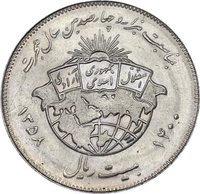
Description:
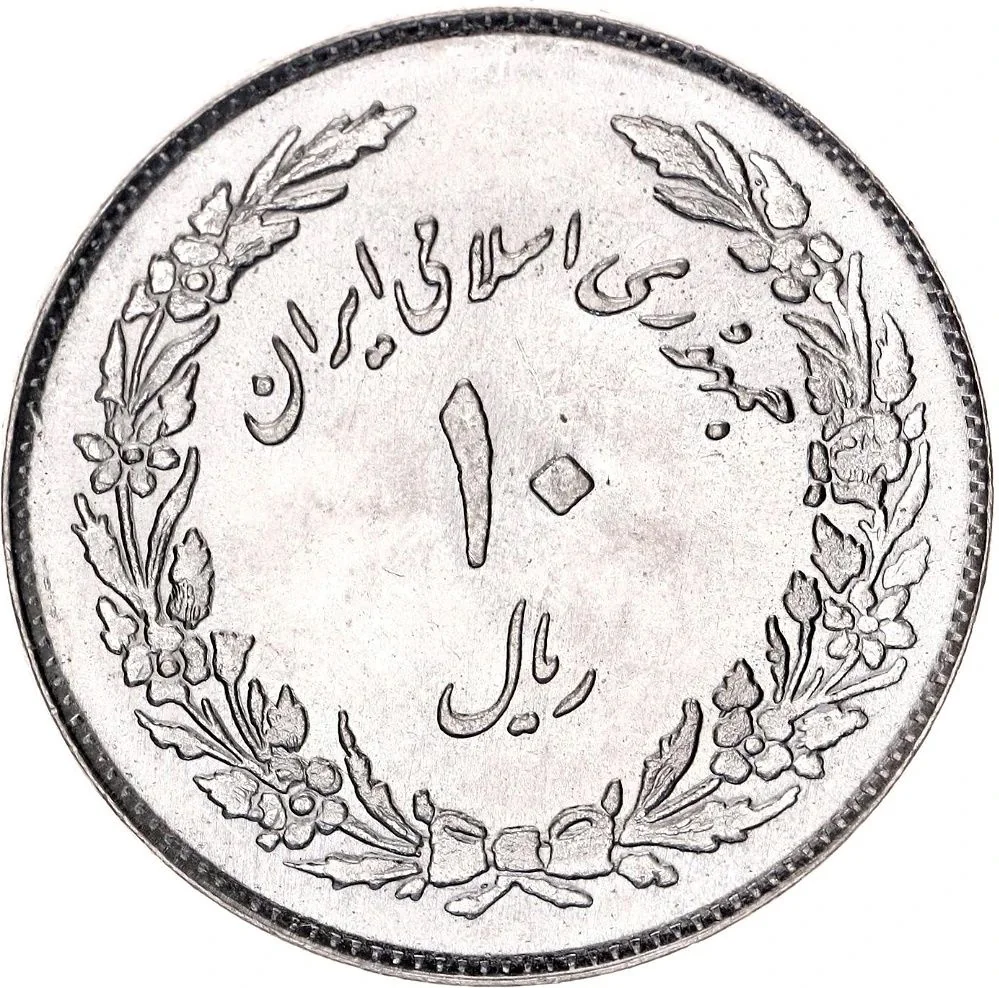
Value in wreath
Reverse
Description:
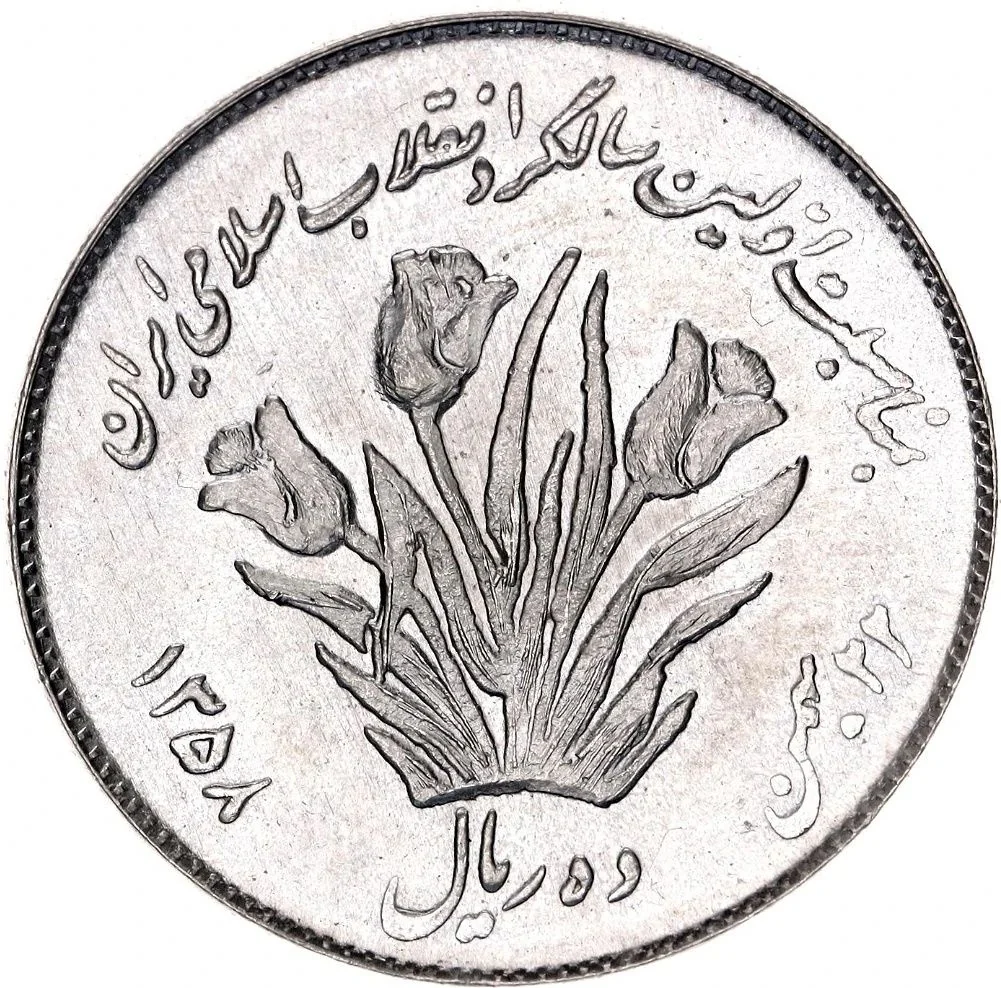
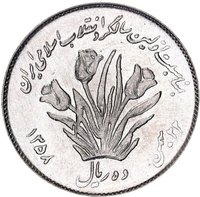
Tulips flank dates and value.
Edge
Reeded
Categories
| Event> Revolution |
| Plants> Flower |
Mintings
| Year | Mint Mark | Mintage | Quality | Collection |
|---|---|---|---|---|
| 1979 | — | — |
Historical background
The currency situation in Iran in 1979 was one of profound instability and transition, directly resulting from the seismic political upheaval of the Iranian Revolution. The overthrow of the Pahlavi monarchy and the establishment of the Islamic Republic under Ayatollah Khomeini created a climate of economic uncertainty. International confidence collapsed, leading to massive capital flight as wealthy individuals and businesses moved assets abroad. The new revolutionary government, preoccupied with consolidating power and pursuing ideological goals, had not yet established a coherent economic policy, leaving a vacuum that disrupted normal financial operations and trade.
This political crisis manifested in severe pressure on the Iranian rial. The currency, which had been relatively stable under the Shah, began a sharp and sustained depreciation. The US dollar, which traded at approximately 70 rials in the late 1970s, surged to over 100 rials on the unofficial market by 1979, with the gap between the official and black-market rates widening dramatically. This depreciation was fueled by the sudden halt in oil exports following the revolution, which choked the state's primary source of foreign currency revenue, and by the imposition of US sanctions in November 1979 after the seizure of the American embassy in Tehran.
Consequently, the new regime faced immediate and severe economic challenges: rampant inflation, shortages of imported goods, and a collapsing formal exchange rate system. The government responded with strict currency controls, rationing access to foreign exchange for essential imports. These measures, however, often exacerbated shortages and fueled a growing black market. Thus, in 1979, Iran's currency was less an instrument of commerce and more a reflection of the country's sudden isolation, internal turmoil, and the uncertain economic direction of its revolutionary new government.
This political crisis manifested in severe pressure on the Iranian rial. The currency, which had been relatively stable under the Shah, began a sharp and sustained depreciation. The US dollar, which traded at approximately 70 rials in the late 1970s, surged to over 100 rials on the unofficial market by 1979, with the gap between the official and black-market rates widening dramatically. This depreciation was fueled by the sudden halt in oil exports following the revolution, which choked the state's primary source of foreign currency revenue, and by the imposition of US sanctions in November 1979 after the seizure of the American embassy in Tehran.
Consequently, the new regime faced immediate and severe economic challenges: rampant inflation, shortages of imported goods, and a collapsing formal exchange rate system. The government responded with strict currency controls, rationing access to foreign exchange for essential imports. These measures, however, often exacerbated shortages and fueled a growing black market. Thus, in 1979, Iran's currency was less an instrument of commerce and more a reflection of the country's sudden isolation, internal turmoil, and the uncertain economic direction of its revolutionary new government.
🌱 Common