

20 Euro – Slovakia
Non-circulating coins
Commemoration: Protected Opalfield - Dubnícke Mines
Slovakia
Context
Material
References
KM: #Click to copy to clipboard135
Numista: #68574
Value
Exchange value: 20 EUR = $23.63
Bullion value: $88.43
Inflation-adjusted value: 29.42 EUR
Obverse
Description:
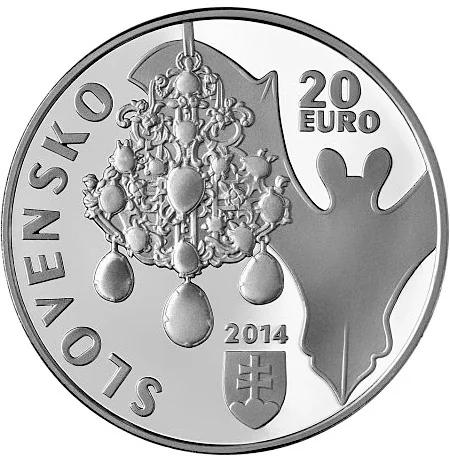
The obverse features Isabella's opal necklace with a bat silhouette, acknowledging the mines as a winter habitat, and the Slovak national emblem below.
Inscription:
SLOVENSKO
20
EURO
2014
20
EURO
2014
Script: Latin
Engraver: Dalibor Schmidt
Reverse
Description:
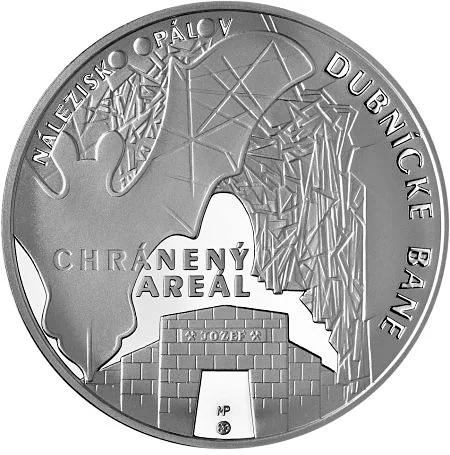
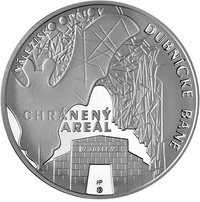
The reverse depicts a bat inside the mine and the entrance to the characteristic "Jozef" tunnel. The designer's initials "MP" and the Kremnica Mint mark are at the bottom edge.
Inscription:
NÁLEZISKO OPÁLOV DUBNÍCKE BANE
CHRÁNENÝ AREÁL
JOZEF
MP
CHRÁNENÝ AREÁL
JOZEF
MP
Translation:
OPÁLOV DUBNÍCKE BANE FIND SITE
PROTECTED AREA
JOZEF
MP
PROTECTED AREA
JOZEF
MP
Script: Latin
Language: Slovak
Engraver: Dalibor Schmidt
Designer: Mária Poldaufová
Edge
Smooth with inscriptions in hollow
Legend:
OSOBITOSTI PRÍRODY SLOVENSKA
Translation:
Peculiarities of Slovak Nature
Language: Slovak
Categories
| Industry |
Mints
| Name | Mark |
|---|---|
| Kremnica | — |
Mintings
| Year | Mint Mark | Mintage | Quality | Collection |
|---|---|---|---|---|
| 2014 | — | 5,300 | Proof | |
| 2014 | — | 2,750 |
Historical background
In 2014, Slovakia was a stable member of the Eurozone, having adopted the euro as its official currency on January 1, 2009. This move replaced the Slovak koruna (SKK) and was seen as a key milestone in the country's integration into the European core, following its EU accession in 2004. By 2014, the euro was well-established in daily use, and the initial transition period was long over, with the currency providing macroeconomic stability, lower transaction costs for trade, and a symbol of Slovakia's economic convergence with Western Europe.
The primary currency-related discussions in Slovakia during 2014 were not about the euro itself, but rather its management at the European level and the country's fiscal stance within the monetary union. As a member of the Eurozone, Slovakia's monetary policy was set by the European Central Bank (ECB), which was actively employing unconventional measures like low interest rates and preparing for quantitative easing to combat low inflation and stimulate the euro area economy following the sovereign debt crisis. Domestically, the government of Prime Minister Robert Fico maintained a fiscally conservative approach, emphasizing its achievement of low budget deficits and declining public debt, which stood in contrast to the struggles of some southern Eurozone members.
Furthermore, Slovakia's economic performance within the single currency was relatively strong in 2014. It was often called the "Eurozone's tiger" for its robust GDP growth, driven by a successful automotive manufacturing sector. The fixed exchange rate eliminated currency risk for major exporters like Volkswagen, further solidifying the country's position as a manufacturing hub. While some political voices occasionally questioned the benefits of euro membership, particularly regarding the cost of bailouts for other countries during the crisis, there was no serious political movement or public debate about leaving the euro. The currency situation was characterized by stability and a focus on leveraging Eurozone membership for continued economic growth.
The primary currency-related discussions in Slovakia during 2014 were not about the euro itself, but rather its management at the European level and the country's fiscal stance within the monetary union. As a member of the Eurozone, Slovakia's monetary policy was set by the European Central Bank (ECB), which was actively employing unconventional measures like low interest rates and preparing for quantitative easing to combat low inflation and stimulate the euro area economy following the sovereign debt crisis. Domestically, the government of Prime Minister Robert Fico maintained a fiscally conservative approach, emphasizing its achievement of low budget deficits and declining public debt, which stood in contrast to the struggles of some southern Eurozone members.
Furthermore, Slovakia's economic performance within the single currency was relatively strong in 2014. It was often called the "Eurozone's tiger" for its robust GDP growth, driven by a successful automotive manufacturing sector. The fixed exchange rate eliminated currency risk for major exporters like Volkswagen, further solidifying the country's position as a manufacturing hub. While some political voices occasionally questioned the benefits of euro membership, particularly regarding the cost of bailouts for other countries during the crisis, there was no serious political movement or public debate about leaving the euro. The currency situation was characterized by stability and a focus on leveraging Eurozone membership for continued economic growth.
💎 Very Rare