

2 reales – New Spain
Add to wishlist
Circulating commemorative coins
Commemoration: Fernando VII Proclamation - Queretaro issue
Mexico
Context
Year: 1808
Country: Mexico
Issuer: New Spain
Ruler: Ferdinand VII
Currency:
(1535—1897)
Demonetized: Yes
Material
References
KM: #
Numista: #68325
Value
Bullion value: $15.00
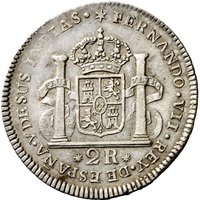
Obverse
Description:
Shield between pillars, crowned.
Inscription:
FERNANDO*VII*REY*DE*ESPAÑA*Y*DE*LAS*INDIAS
Translation:
FERDINAND VII KING OF SPAIN AND OF THE INDIES
Language: Spanish
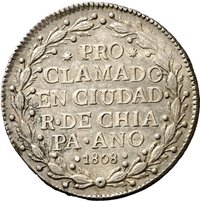
Reverse
Description:
Legend and date encircled by wreath.
Inscription:
PROCLAMADO
EN QUERETARO
POR SU ALFZ RL
D.PEDRO SEPTI
EN*AÑO 1808
EN QUERETARO
POR SU ALFZ RL
D.PEDRO SEPTI
EN*AÑO 1808
Translation:
Proclaimed in Querétaro by his Lieutenant Colonel Don Pedro Septien, year 1808.
Language: Spanish
Edge
Milled.
Mintings
| Year | Mint Mark | Mintage | Quality | Collection |
|---|---|---|---|---|
| 1808 | — | — |
Historical background
In 1808, the currency system of New Spain (modern-day Mexico) was a complex and strained relic of the colonial era, directly tied to the political crisis engulfing the Spanish Empire. The core unit was the silver peso, or "real de a ocho," minted from the vast silver output of mines like Zacatecas and Guanajuato. This coin was renowned for its purity and was a de facto global currency. However, the system was cumbersome, relying on a binary standard of both silver and gold, with a proliferation of subsidiary copper coins (tlacos and pilones) for everyday use, which were often unstable and subject to counterfeiting.
The year 1808 was a point of severe financial pressure. The abdication of King Ferdinand VII during the Napoleonic invasion of Spain created a legitimacy crisis, cutting off clear royal authority and disrupting transatlantic trade and remittances. To finance military defenses against possible foreign invasion and to fund the administration in the power vacuum, colonial authorities increasingly resorted to emergency measures. This included the issuance of paper money, a novel and largely distrusted concept in the colony, and the requisitioning of church and private silver to be minted into coin, straining the metallic supply.
This monetary instability occurred against a backdrop of growing internal dissent and economic anxiety. The disruption of traditional trade with Spain, combined with heavy taxation and inflationary pressures from the increased money supply, exacerbated social tensions. The fragile currency system thus became both a symptom and a cause of the wider disintegration of colonial order, setting the stage for the financial chaos that would accompany the Mexican War of Independence, which would begin just two years later in 1810.
The year 1808 was a point of severe financial pressure. The abdication of King Ferdinand VII during the Napoleonic invasion of Spain created a legitimacy crisis, cutting off clear royal authority and disrupting transatlantic trade and remittances. To finance military defenses against possible foreign invasion and to fund the administration in the power vacuum, colonial authorities increasingly resorted to emergency measures. This included the issuance of paper money, a novel and largely distrusted concept in the colony, and the requisitioning of church and private silver to be minted into coin, straining the metallic supply.
This monetary instability occurred against a backdrop of growing internal dissent and economic anxiety. The disruption of traditional trade with Spain, combined with heavy taxation and inflationary pressures from the increased money supply, exacerbated social tensions. The fragile currency system thus became both a symptom and a cause of the wider disintegration of colonial order, setting the stage for the financial chaos that would accompany the Mexican War of Independence, which would begin just two years later in 1810.

✨ Legendary