

1 Sen – Brunei
Brunei
Context
Years: 1986–1993
Issuer: Brunei 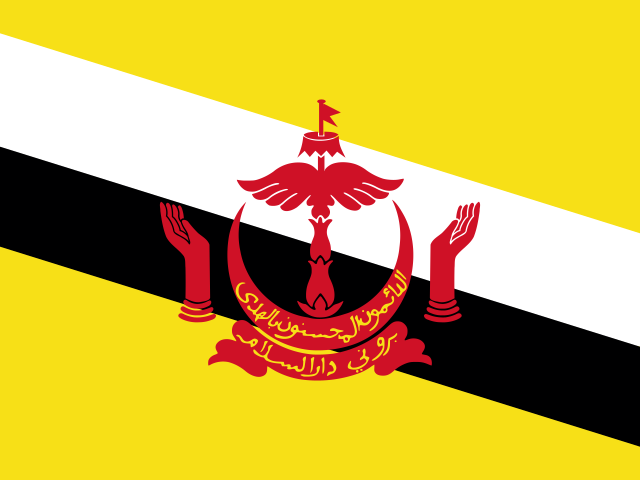
Ruler: Hassanal Bolkiah
Currency:
(since 1967)
Total mintage: 4,788,000
Material
References
KM: #Click to copy to clipboard15a
Numista: #6801
Value
Exchange value: 0.01 BND
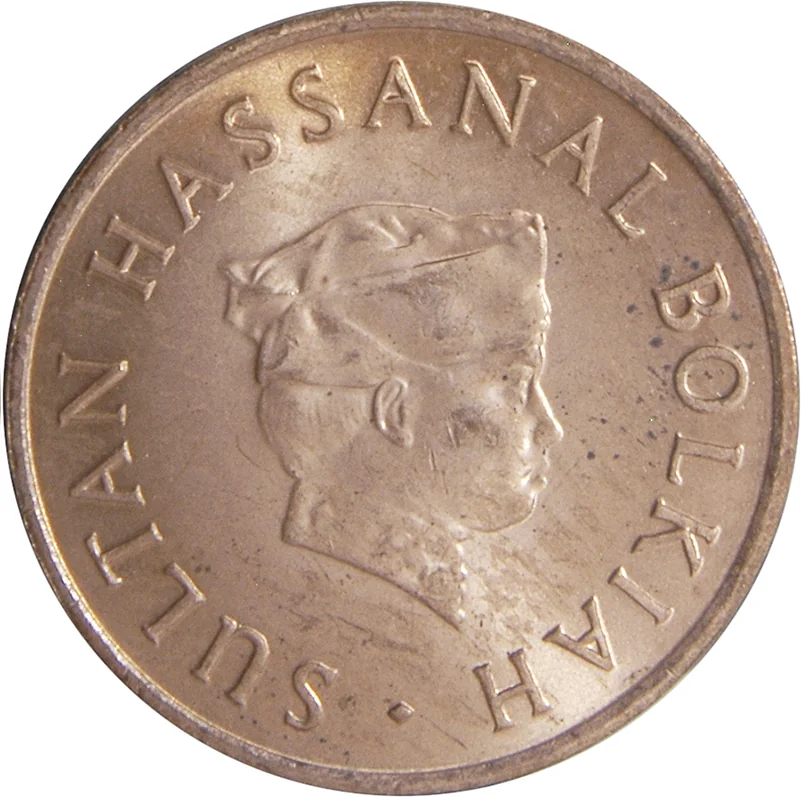
Obverse
Description:
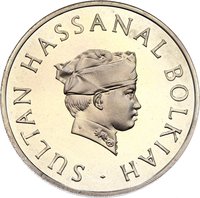
Bust of Sultan Hassanal Bolkiah facing right.
Inscription:
SULTAN HASSANAL BOLKIAH ·
Script: Latin
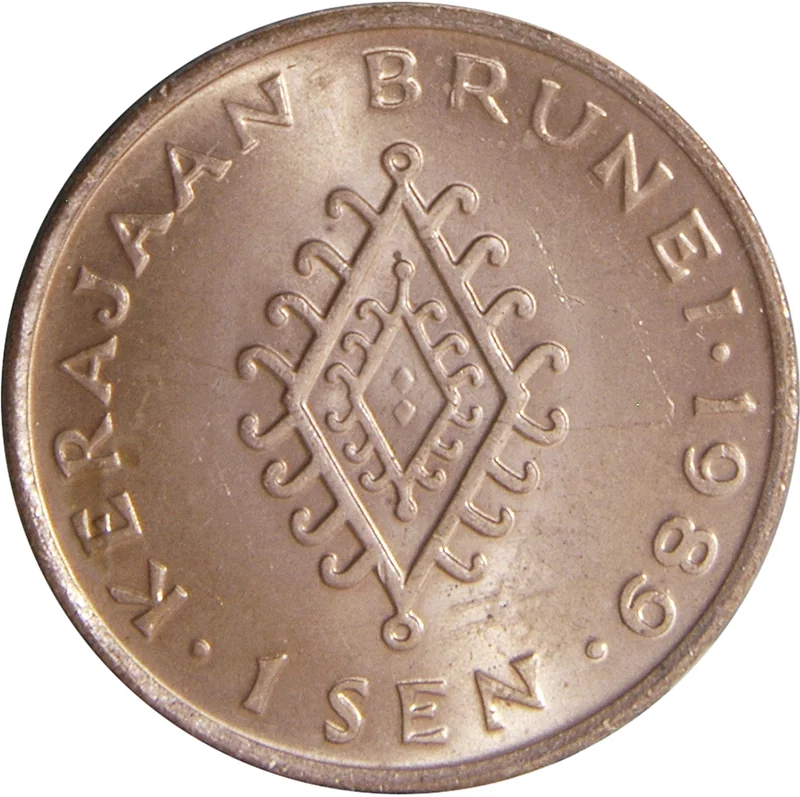
Reverse
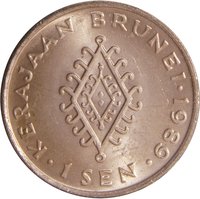
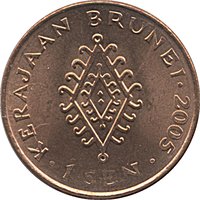
Description:
Native design, date right, denomination below, legend without "I" in title.
Inscription:
· KERAJAAN BRUNEI · 1989 ·
1 SEN
1 SEN
Script: Latin
Engraver: Christopher Ironside
Edge
Plain
Mintings
| Year | Mint Mark | Mintage | Quality | Collection |
|---|---|---|---|---|
| 1986 | — | 102,000 | ||
| 1987 | — | 390,000 | ||
| 1988 | — | 500,000 | ||
| 1989 | — | 601,000 | ||
| 1990 | — | 680,000 | ||
| 1991 | — | 680,000 | ||
| 1992 | — | 887,000 | ||
| 1993 | — | 948,000 |
Historical background
In 1986, Brunei faced a significant economic challenge rooted in its heavy dependence on hydrocarbon revenues, which accounted for over 90% of its export earnings. The global oil price crash of that year, which saw prices plummet from around $27 per barrel to under $10, severely impacted the nation's finances. This shock exposed the vulnerability of Brunei's undiversified economy, leading to a sharp contraction in GDP and a substantial decline in government revenue, which forced a reconsideration of public spending and long-term economic planning.
Despite this fiscal pressure, Brunei's currency situation remained uniquely stable due to its institutional framework. The Brunei Dollar (BND) was and remains pegged at par to the Singapore Dollar (SGD) through a long-standing Currency Interchangeability Agreement established in 1967. This arrangement meant that both currencies were legal tender in each other's countries, creating a de facto currency board system. Consequently, the BND was backed by substantial foreign reserves, primarily derived from past oil and gas wealth, insulating it from direct speculative attacks or devaluation during the crisis.
The 1986 downturn, therefore, did not trigger a currency crisis but rather a fiscal and wake-up call for the Sultanate. The stability of the BND-SGD peg provided a crucial anchor, preventing monetary instability and inflation from compounding the economic difficulties. The government's response was to draw on its considerable sovereign wealth reserves to cushion the impact, avoiding drastic cuts that could have led to social unrest. This event underscored the dual nature of Brunei's economy: a vulnerable commodity-dependent fiscal base shielded by a robust monetary arrangement and vast financial buffers accumulated during earlier oil booms.
Despite this fiscal pressure, Brunei's currency situation remained uniquely stable due to its institutional framework. The Brunei Dollar (BND) was and remains pegged at par to the Singapore Dollar (SGD) through a long-standing Currency Interchangeability Agreement established in 1967. This arrangement meant that both currencies were legal tender in each other's countries, creating a de facto currency board system. Consequently, the BND was backed by substantial foreign reserves, primarily derived from past oil and gas wealth, insulating it from direct speculative attacks or devaluation during the crisis.
The 1986 downturn, therefore, did not trigger a currency crisis but rather a fiscal and wake-up call for the Sultanate. The stability of the BND-SGD peg provided a crucial anchor, preventing monetary instability and inflation from compounding the economic difficulties. The government's response was to draw on its considerable sovereign wealth reserves to cushion the impact, avoiding drastic cuts that could have led to social unrest. This event underscored the dual nature of Brunei's economy: a vulnerable commodity-dependent fiscal base shielded by a robust monetary arrangement and vast financial buffers accumulated during earlier oil booms.
🌱 Fairly Common