

10 Centimes (Leopold II's reign) – Belgium
Circulating commemorative coins
Commemoration: 50 Years of Leopold II Kingdom
Belgium

Obverse
Description:
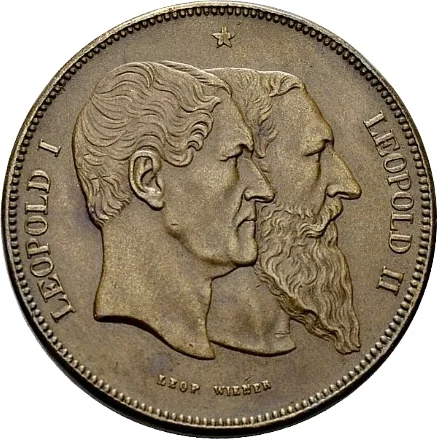
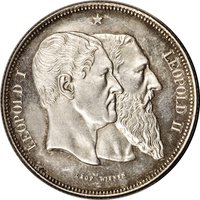
Conjoined busts of Leopold I and II, flanked by their names. A star above, designer below.
Inscription:
LEOPOLD I * LEOPOLD II
LEOP WIENER
LEOP WIENER
Translation:
LEOPOLD I * LEOPOLD II
LEOPOLD WIENER
LEOPOLD WIENER
Script: Latin
Engraver: Léopold Wiener
Reverse
Description:
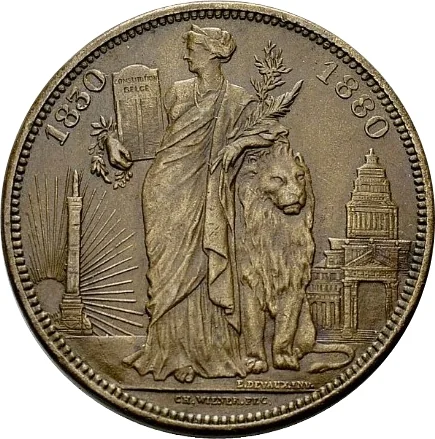
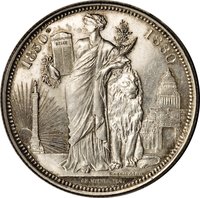
A woman leans on a lion, holding the Belgian constitution, with the Congress column and Brussels courthouse flanking her. Designer names are below.
Inscription:
1830 1880
CONSTITUTION BELGE
E.DEVAUX.INV
CH.WIENER.FRC.
CONSTITUTION BELGE
E.DEVAUX.INV
CH.WIENER.FRC.
Translation:
1830 1880
BELGIAN CONSTITUTION
E.DEVAUX.INVENTOR
CH.WIENER.SCULPTOR
BELGIAN CONSTITUTION
E.DEVAUX.INVENTOR
CH.WIENER.SCULPTOR
Script: Latin
Language: French
Engraver: Léopold Wiener
Edge
Plain
Mints
| Name | Mark |
|---|---|
| Royal Mint of Belgium | — |
Mintings
| Year | Mint Mark | Mintage | Quality | Collection |
|---|---|---|---|---|
| 1880 | — | — |
Historical background
In 1880, Belgium's currency situation was defined by its membership in the Latin Monetary Union (LMU), a multinational agreement it had helped found in 1865. This union standardized coinage among member nations (including France, Italy, Switzerland, and later Greece) around a bimetallic system based on both gold and silver. Belgian francs were legally interchangeable with the francs of other member states, facilitating trade and travel. Consequently, Belgian coins in circulation were not exclusively domestic; French, Italian, and Swiss coins of equivalent value also circulated freely within the country, creating a de facto multinational monetary zone.
However, this system was under significant strain by 1880. The fixed mint ratio between gold and silver in the LMU treaty failed to reflect the shifting market values of the metals, particularly the steady depreciation of silver due to large new discoveries. This led to the phenomenon of "bad money driving out good," as people hoarded gold coins and used the cheaper silver for everyday transactions, causing a scarcity of gold in circulation. While the LMU had officially suspended the free minting of silver in 1878 to protect its gold reserves, the legacy of earlier over-minting meant Belgium was still grappling with an abundance of depreciating silver coinage in its economy.
Domestically, the National Bank of Belgium, founded in 1850, was the central issuing authority for banknotes. However, public trust in paper money remained limited, and coins dominated everyday commerce. The period was thus one of transition and vulnerability. Belgium was tied to an international system struggling with the collapse of bimetallism, facing internal challenges of currency management and maintaining stability while dependent on the monetary policies and economic health of its union partners. This precarious position would influence Belgium's economic policies for the next decade.
However, this system was under significant strain by 1880. The fixed mint ratio between gold and silver in the LMU treaty failed to reflect the shifting market values of the metals, particularly the steady depreciation of silver due to large new discoveries. This led to the phenomenon of "bad money driving out good," as people hoarded gold coins and used the cheaper silver for everyday transactions, causing a scarcity of gold in circulation. While the LMU had officially suspended the free minting of silver in 1878 to protect its gold reserves, the legacy of earlier over-minting meant Belgium was still grappling with an abundance of depreciating silver coinage in its economy.
Domestically, the National Bank of Belgium, founded in 1850, was the central issuing authority for banknotes. However, public trust in paper money remained limited, and coins dominated everyday commerce. The period was thus one of transition and vulnerability. Belgium was tied to an international system struggling with the collapse of bimetallism, facing internal challenges of currency management and maintaining stability while dependent on the monetary policies and economic health of its union partners. This precarious position would influence Belgium's economic policies for the next decade.
⭐ Somewhat Rare