

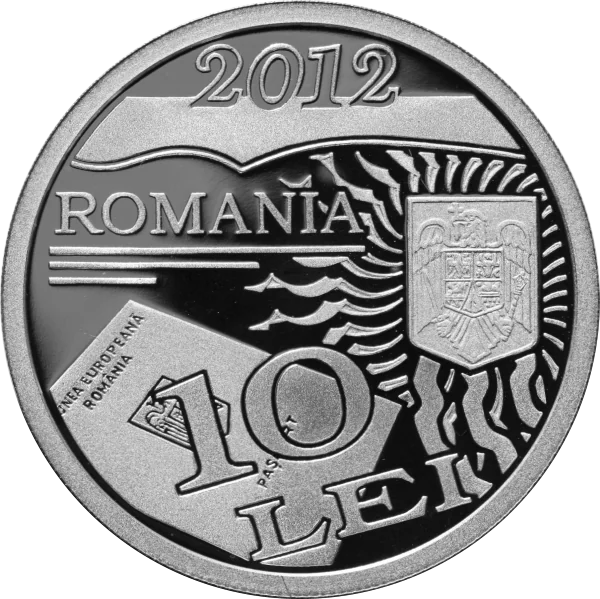
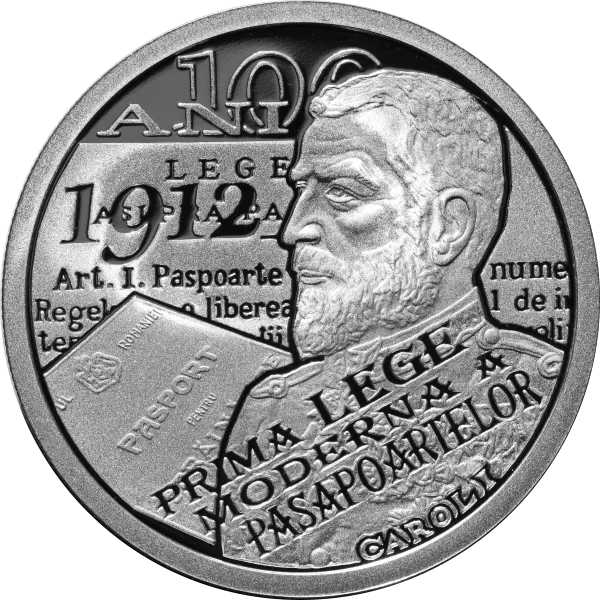
10 Lei (First Roman Passport) – Romania
Non-circulating coins
Commemoration: 100th Anniversary of the First Roman Passport
Romania
Context

Material
Diameter: 37 mm
Weight: 31.1 g
Silver weight: 28.77 g
Shape: Round
Composition: 92.5% Silver
Standard: Silver ounce
Magnetic: No
Technique: Milled
Alignment: Coin alignment
flip
References
KM: #Click to copy to clipboard309
Numista: #67952
Value
Exchange value: 10 RON = $2.32
Bullion value: $83.10
Inflation-adjusted value: 16.65 RON
Obverse
Reverse
Description:
Portrait of King Carol I, featuring a passport and legal excerpt in the background.
Inscription:
100 ANI 1912
PRIMA LEGE MODERNA A PASAPOARTELOR
CAROL I
PRIMA LEGE MODERNA A PASAPOARTELOR
CAROL I
Script: Latin
Edge
Mintings
| Year | Mint Mark | Mintage | Quality | Collection |
|---|---|---|---|---|
| 2012 | — | 500 | Proof |
Historical background
In 2012, Romania was navigating a fragile recovery from the severe recession induced by the 2008 global financial crisis and subsequent Eurozone debt crisis. The country was under a precautionary standby agreement with the International Monetary Fund (IMF) and the European Union, which provided a financial safety net and imposed strict austerity measures. These measures, including a controversial VAT hike to 24% and public sector wage cuts, aimed to reduce the budget deficit but also suppressed domestic demand and economic growth, creating a challenging environment for the national currency, the leu (RON).
The leu itself exhibited relative stability against the euro during this period, but this was largely artificial and maintained under significant pressure. The National Bank of Romania (NBR) prioritized exchange rate stability as a key anchor to control inflation and maintain economic confidence. It actively intervened in the foreign exchange market and kept interest rates high—the key rate was 5.25% for most of the year—to defend the leu and attract capital inflows. This stability, however, came at a cost, constraining monetary policy tools needed to stimulate the weak economy.
Underneath this controlled stability, underlying vulnerabilities persisted. Political instability, including a change in government mid-year, raised concerns about the country's commitment to its IMF-led reform program. Furthermore, the economy remained heavily dependent on external financing, and the banking sector was predominantly foreign-owned, making it sensitive to regional financial stress. Consequently, while the leu did not experience a dramatic crash in 2012, it operated in a state of fragile equilibrium, with its value upheld by high interest rates and central bank intervention rather than robust economic fundamentals.
The leu itself exhibited relative stability against the euro during this period, but this was largely artificial and maintained under significant pressure. The National Bank of Romania (NBR) prioritized exchange rate stability as a key anchor to control inflation and maintain economic confidence. It actively intervened in the foreign exchange market and kept interest rates high—the key rate was 5.25% for most of the year—to defend the leu and attract capital inflows. This stability, however, came at a cost, constraining monetary policy tools needed to stimulate the weak economy.
Underneath this controlled stability, underlying vulnerabilities persisted. Political instability, including a change in government mid-year, raised concerns about the country's commitment to its IMF-led reform program. Furthermore, the economy remained heavily dependent on external financing, and the banking sector was predominantly foreign-owned, making it sensitive to regional financial stress. Consequently, while the leu did not experience a dramatic crash in 2012, it operated in a state of fragile equilibrium, with its value upheld by high interest rates and central bank intervention rather than robust economic fundamentals.
✨ Legendary