

1 Dollar (founding of Regina, Saskatchewan) – Canada
Non-circulating coins
Commemoration: 100th Anniversary of the city of founding of the city of Regina, Saskatchewan
Canada
Context

Material

References
KM: #Click to copy to clipboard133
Numista: #6786
Value
Exchange value: 1 CAD = $0.73
Bullion value: $33.65
Inflation-adjusted value: 3.27 CAD
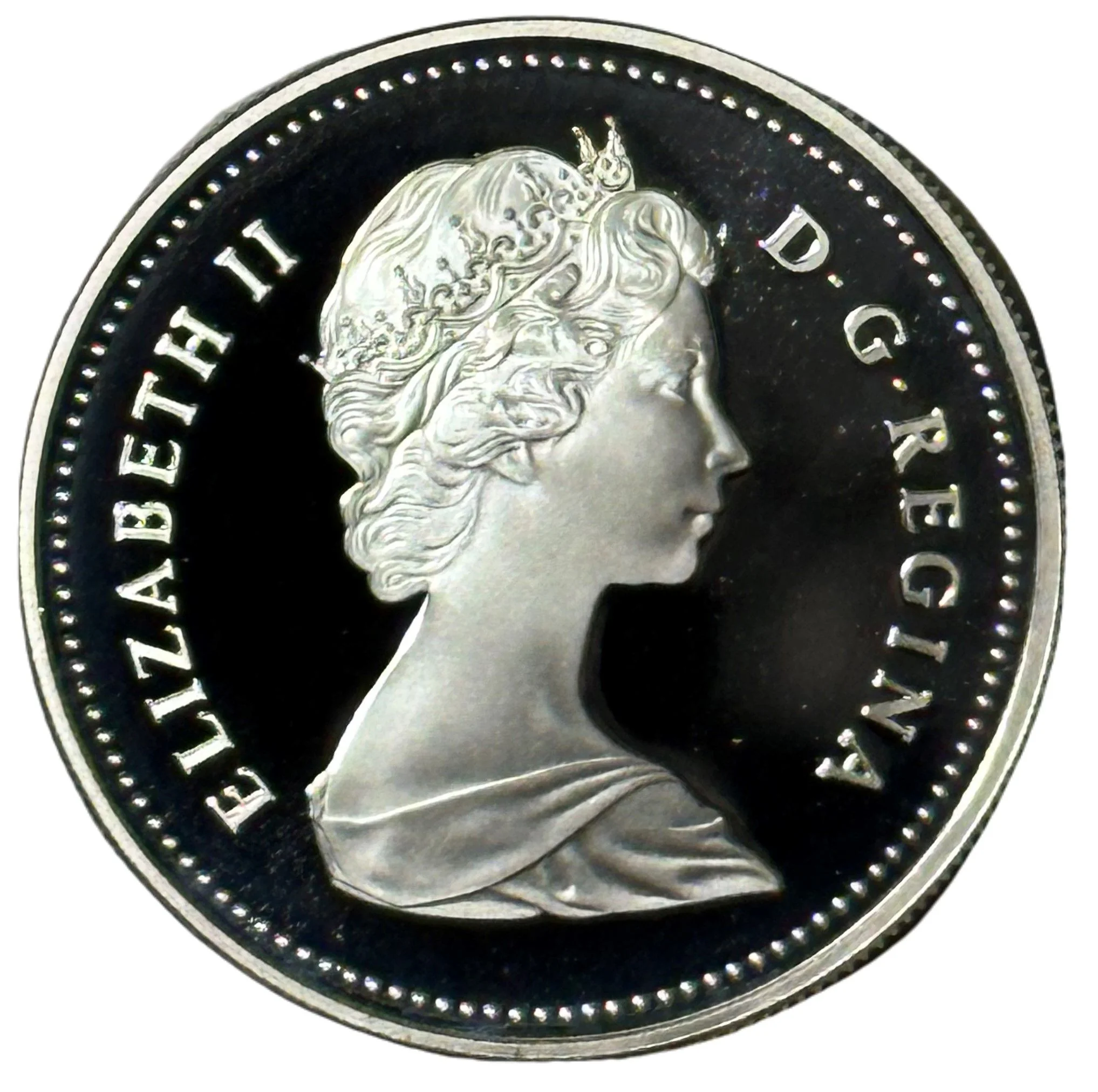
Obverse
Description:
Bust of Queen Elizabeth II at age 37, wearing a tiara and facing right.
Inscription:
ELIZABETH II D·G·REGINA
Translation:
Elizabeth II, by the Grace of God, Queen
Script: Latin
Language: Latin
Designer: Arnold Machin
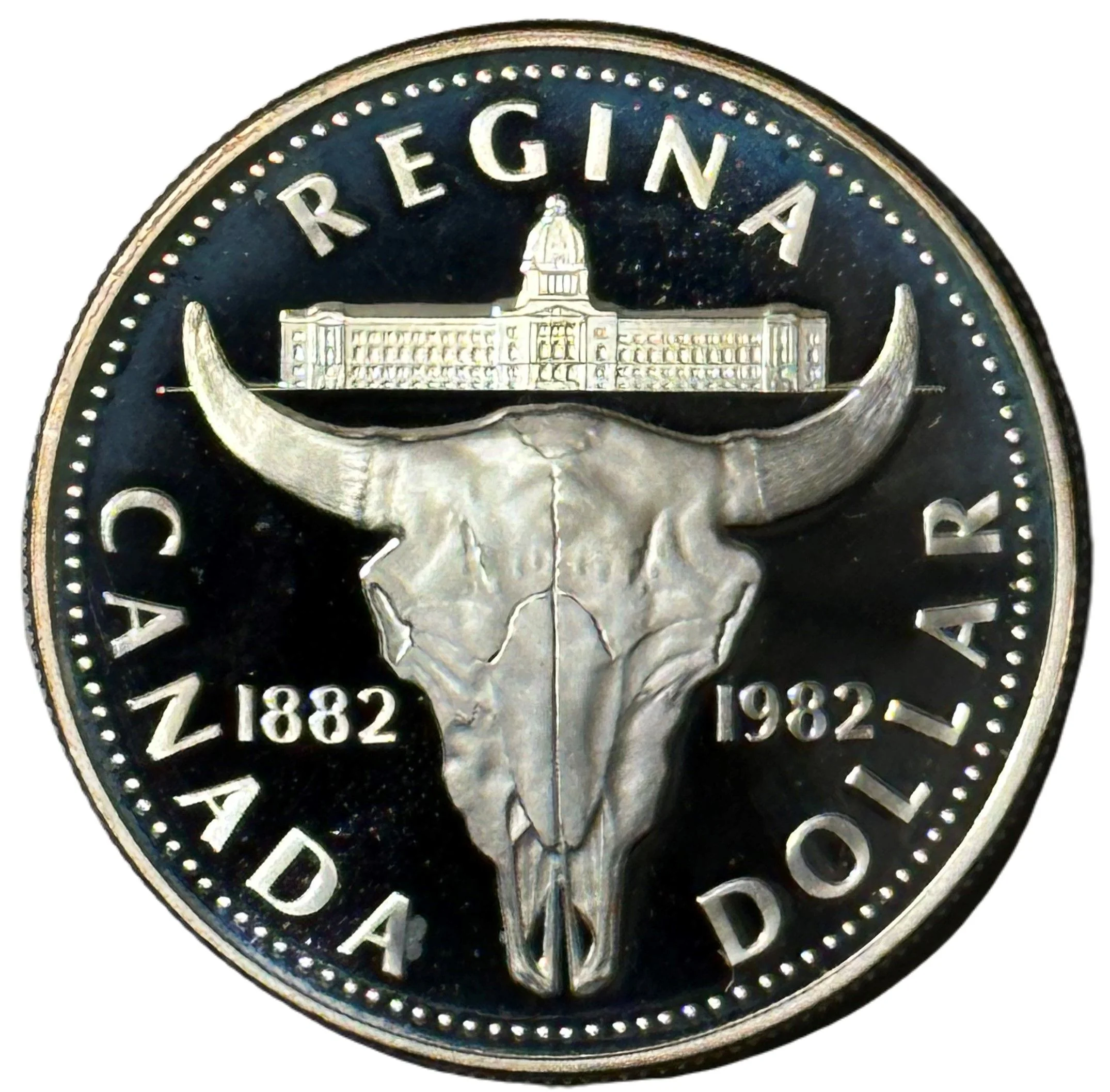
Reverse
Description:
Skull divides date and denomination.
Inscription:
REGINA
1882 1982
CANADA DOLLAR
1882 1982
CANADA DOLLAR
Script: Latin
Engraver: Walter Ott
Designer: Huntley Brown
Edge
Reeded
Mints
| Name | Mark |
|---|---|
| Royal Canadian Mint of Ottawa | — |
Mintings
| Year | Mint Mark | Mintage | Quality | Collection |
|---|---|---|---|---|
| 1982 | — | 144,989 | ||
| 1982 | — | 577,959 | Proof |
Historical background
In 1982, Canada's currency situation was dominated by the severe economic recession that gripped the nation, the deepest since the Great Depression. The Bank of Canada, under Governor Gerald Bouey, maintained a tight monetary policy focused squarely on crushing the double-digit inflation inherited from the late 1970s. This involved keeping interest rates at historically high levels, with the bank rate peaking at an astonishing 16.75% in the summer. While this policy aimed to stabilize the Canadian dollar's long-term value, it dramatically increased the cost of borrowing, exacerbating the recession and contributing to an unemployment rate soaring above 12%.
The value of the Canadian dollar itself was under significant pressure during this period, influenced by both domestic weakness and global factors. It traded within a range of approximately 77 to 82 cents U.S., a notable depreciation from the near-parity seen in the mid-1970s. This decline was driven by the recession's impact on commodity exports, falling global oil prices which hurt Alberta's oil sector, and a strong U.S. dollar fueled by the aggressive interest rate policies of the U.S. Federal Reserve. The weak currency had a dual effect: it made imports more expensive, contributing to the cost-of-living crisis, but also provided some relief to export-oriented industries.
Ultimately, 1982 represented a painful transitional year where the short-term costs of disinflation were acutely felt. The high-interest-rate environment successfully began to break the back of inflation, which fell from over 12% at the start of the year to around 8% by its end. This set the stage for a gradual economic recovery later in the decade, but the immediate legacy was one of severe hardship, with business failures, high unemployment, and social strain defining the national experience alongside the complex dynamics of the Canadian dollar.
The value of the Canadian dollar itself was under significant pressure during this period, influenced by both domestic weakness and global factors. It traded within a range of approximately 77 to 82 cents U.S., a notable depreciation from the near-parity seen in the mid-1970s. This decline was driven by the recession's impact on commodity exports, falling global oil prices which hurt Alberta's oil sector, and a strong U.S. dollar fueled by the aggressive interest rate policies of the U.S. Federal Reserve. The weak currency had a dual effect: it made imports more expensive, contributing to the cost-of-living crisis, but also provided some relief to export-oriented industries.
Ultimately, 1982 represented a painful transitional year where the short-term costs of disinflation were acutely felt. The high-interest-rate environment successfully began to break the back of inflation, which fell from over 12% at the start of the year to around 8% by its end. This set the stage for a gradual economic recovery later in the decade, but the immediate legacy was one of severe hardship, with business failures, high unemployment, and social strain defining the national experience alongside the complex dynamics of the Canadian dollar.

🌱 Common