

10 Dinars (Independence) – Tunisia
Non-circulating coins
Commemoration: 20th Anniversary of Independence (20 March 1956-1976)
Tunisia
Context
Material
References
KM: #Click to copy to clipboard324
Numista: #112095
Value
Exchange value: 10 TND
Bullion value: $2813.32
Obverse
Description:
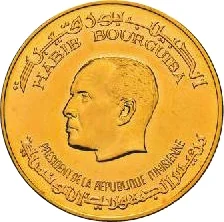
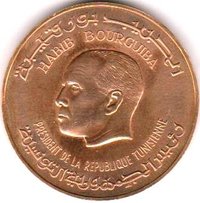
Head of Bourguiba facing left. French and Arabic text encircling.
Inscription:
الحبيب بورقيبة
HABIB BOURGUIBA
PRÉSIDENT DE LA RÉPUBLIQUE TUNISIENNE
رئيس الجمهورية التونسية
HABIB BOURGUIBA
PRÉSIDENT DE LA RÉPUBLIQUE TUNISIENNE
رئيس الجمهورية التونسية
Translation:
Habib Bourguiba
President of the Tunisian Republic
President of the Tunisian Republic
President of the Tunisian Republic
President of the Tunisian Republic
Reverse
Description:
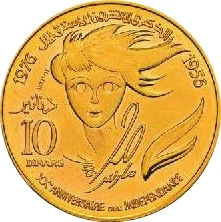
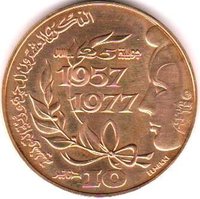
French & Arabic. Design & value.
Inscription:
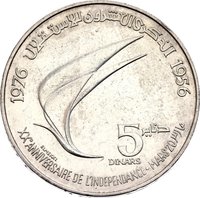
الذكرى العشرون للإستقلال
1976 1956
دنانير
10
DINARS
20
Mars مارس
XX° ANNIVERSAIRE DE L'INDEPENDANCE
1976 1956
دنانير
10
DINARS
20
Mars مارس
XX° ANNIVERSAIRE DE L'INDEPENDANCE
Translation:
Twentieth Anniversary of Independence
1976 1956
Dinars
10
DINARS
20
March مارس
XX° ANNIVERSAIRE DE L'INDEPENDANCE
1976 1956
Dinars
10
DINARS
20
March مارس
XX° ANNIVERSAIRE DE L'INDEPENDANCE
Edge
Mints
| Name | Mark |
|---|---|
| Royal Mint | — |
Mintings
| Year | Mint Mark | Mintage | Quality | Collection |
|---|---|---|---|---|
| 1976 | — | 2,000 |
Historical background
In 1976, Tunisia's currency situation was characterized by stability under a managed exchange rate regime, with the Tunisian dinar (TND) pegged to a basket of currencies. This system, overseen by the Central Bank of Tunisia, provided a predictable environment for trade and investment, which was crucial for the country's development strategy. The dinar's value was maintained through conservative fiscal and monetary policies, supported by revenues from key exports like phosphates, olive oil, and a growing tourism sector. This relative strength reflected the broader economic planning of the era, which emphasized state-led industrialization and social development.
However, underlying pressures were beginning to emerge. The global economic shocks of the 1970s, including the 1973 oil crisis, had a mixed impact; while Tunisia was a modest oil exporter, it also faced higher import costs for machinery and manufactured goods. Furthermore, the ambitious public investment programs of the 1970s, funded partly by external borrowing, started to contribute to a widening trade deficit and growing external debt. These factors subtly strained the managed currency regime, foreshadowing the balance of payments challenges that would become more pronounced in the following decade.
Consequently, 1976 represents a point of relative calm before a period of adjustment. The currency's stability was a point of pride and a tool for economic planning, yet the model was increasingly vulnerable to external imbalances. The government's response in the late 1970s and early 1980s would shift toward economic liberalization and seek structural adjustment loans, setting the stage for eventual devaluations of the dinar to improve competitiveness and address the mounting economic pressures that were quietly building during this time.
However, underlying pressures were beginning to emerge. The global economic shocks of the 1970s, including the 1973 oil crisis, had a mixed impact; while Tunisia was a modest oil exporter, it also faced higher import costs for machinery and manufactured goods. Furthermore, the ambitious public investment programs of the 1970s, funded partly by external borrowing, started to contribute to a widening trade deficit and growing external debt. These factors subtly strained the managed currency regime, foreshadowing the balance of payments challenges that would become more pronounced in the following decade.
Consequently, 1976 represents a point of relative calm before a period of adjustment. The currency's stability was a point of pride and a tool for economic planning, yet the model was increasingly vulnerable to external imbalances. The government's response in the late 1970s and early 1980s would shift toward economic liberalization and seek structural adjustment loans, setting the stage for eventual devaluations of the dinar to improve competitiveness and address the mounting economic pressures that were quietly building during this time.
✨ Legendary