

20 Centimes – France
France
Context
Years: 1945–1946
Issuer: France 
Period:
(1944—1946)
Currency:
(1795—1959)
Demonetization: 20 March 1947
Total mintage: 8,586,337
Material
Diameter: 24 mm
Weight: 3 g
Shape: Round with a round hole
Composition: Zinc
Magnetic: No
Technique: Milled
Alignment: Coin alignment
flip
References
KM: #Click to copy to clipboard907
Numista: #675
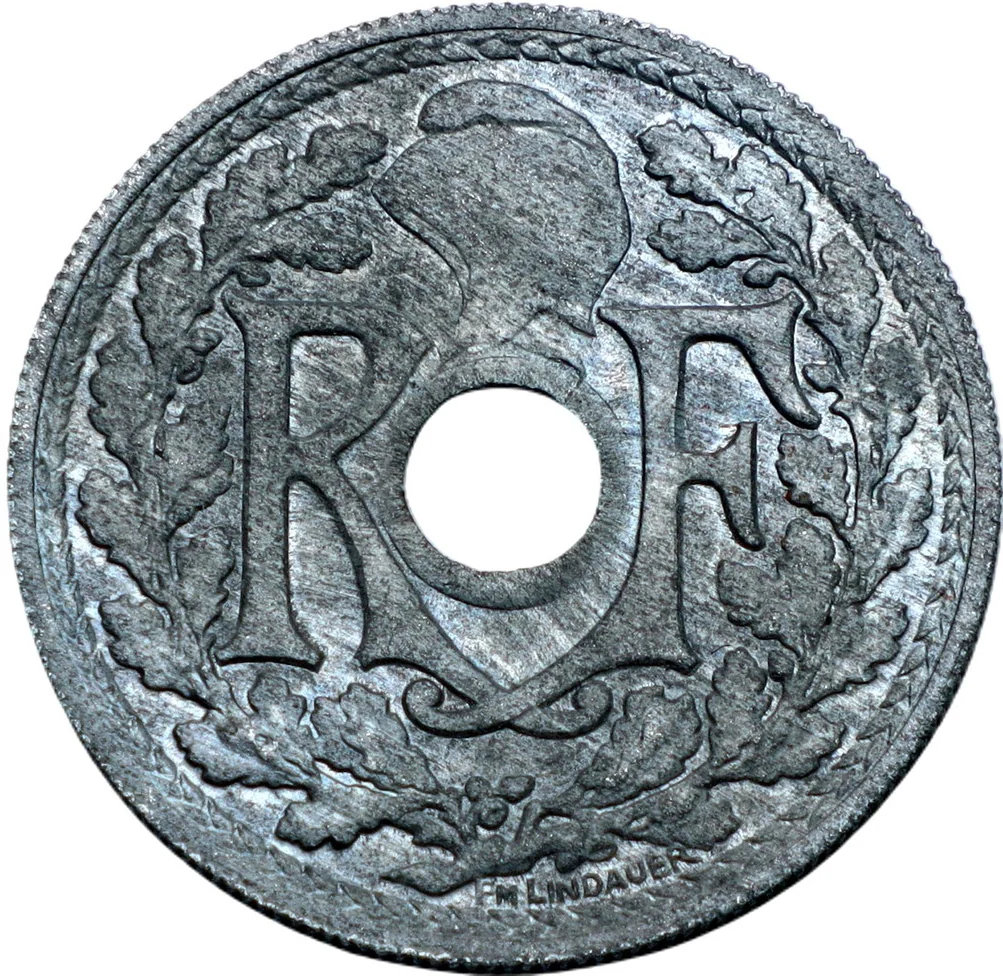
Obverse
Description:
KM differences depend solely on the shop letter. The design—two oak branches encircling the hole, with "RF" and a Phrygian cap above—is otherwise identical.
Inscription:
R F
EM LINDAUER
EM LINDAUER
Translation:
R(es) F(ublica) Lindauer
Script: Latin
Language: Latin
Engraver: Edmond-Émile Lindauer
Reverse
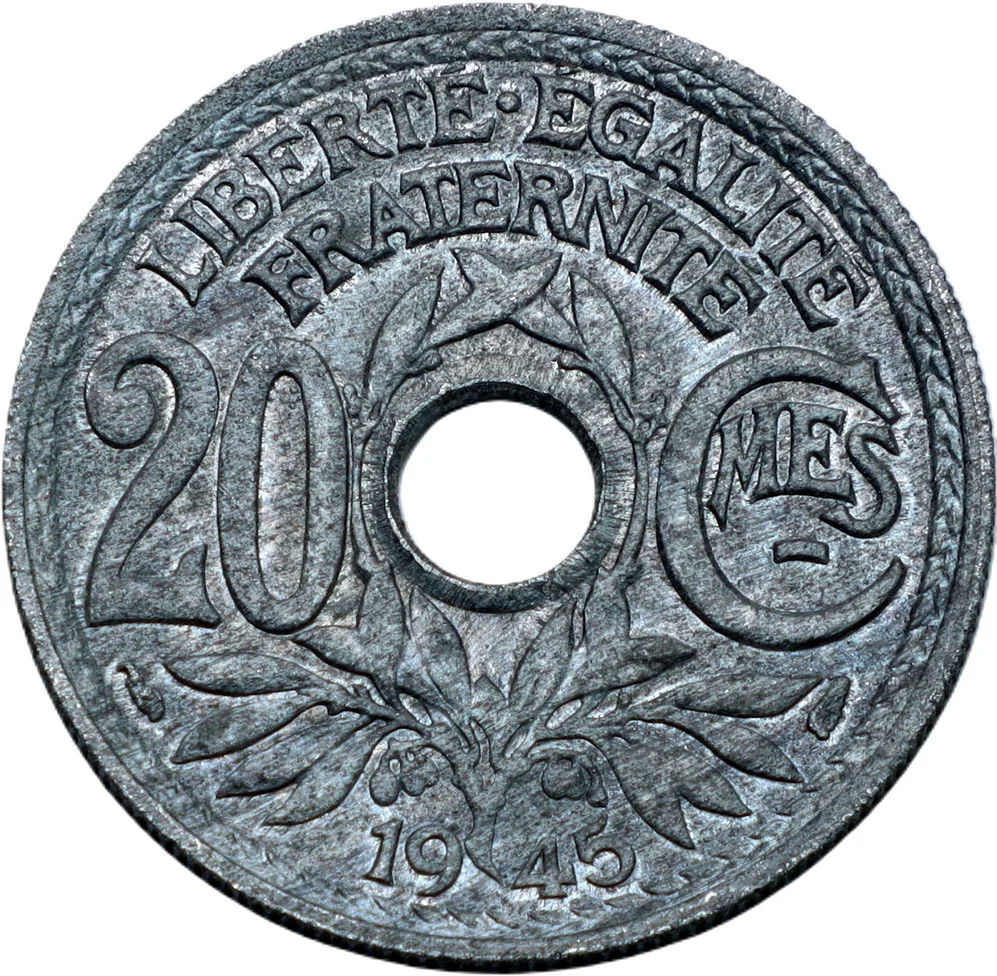
Description:
Value/hole, date below.
Inscription:
LIBERTE·EGALITE
FRATERNITE
20 CMES
1945
FRATERNITE
20 CMES
1945
Script: Latin
Engraver: Edmond-Émile Lindauer
Edge
Milled
Mints
| Name | Mark |
|---|---|
| Monnaie de Paris | — |
| Beaumont-le-Roger | B |
| Castelsarrasin | C |
Mintings
Historical background
In 1945, France emerged from World War II with its economy and monetary system in a state of profound crisis. The wartime Occupation and Vichy regime had financed themselves through massive borrowing from the Banque de France, leading to runaway inflation and a vast expansion of the money supply. The currency in circulation, the franc, had lost much of its value and public confidence, while a thriving black market operated with different, higher exchange rates. Furthermore, the country was burdened by enormous reconstruction costs, severe shortages of basic goods, and a complex web of foreign debts, including obligations to the United States for Lend-Lease aid.
The immediate post-liberation period was characterized by a provisional government under Charles de Gaulle grappling with this monetary chaos. A key, yet controversial, early measure was the "confiscatory exchange" of banknotes in June 1945, which aimed to flush out black market profits and reduce the money supply by forcing citizens to declare and exchange their cash. While partially successful, this operation was socially divisive and did not fully curb inflation. The government also maintained strict price controls and rationing to manage scarcity, but these measures often distorted the official economy and failed to eliminate the parallel market.
This precarious situation set the stage for a more comprehensive overhaul. The instability of the franc hindered reconstruction and trade, creating an urgent need for a new monetary foundation. Consequently, the primary focus of 1945 was on stopgap measures and planning for a major reform. This groundwork would culminate just after the close of the year, with the pivotal Monnet Plan for modernization and, crucially, the currency reform of December 1945, which created the "Franc Germinal" and established a new central bank, the Caisse des Dépôts et Consignations, laying the institutional groundwork for France's post-war financial reconstruction.
The immediate post-liberation period was characterized by a provisional government under Charles de Gaulle grappling with this monetary chaos. A key, yet controversial, early measure was the "confiscatory exchange" of banknotes in June 1945, which aimed to flush out black market profits and reduce the money supply by forcing citizens to declare and exchange their cash. While partially successful, this operation was socially divisive and did not fully curb inflation. The government also maintained strict price controls and rationing to manage scarcity, but these measures often distorted the official economy and failed to eliminate the parallel market.
This precarious situation set the stage for a more comprehensive overhaul. The instability of the franc hindered reconstruction and trade, creating an urgent need for a new monetary foundation. Consequently, the primary focus of 1945 was on stopgap measures and planning for a major reform. This groundwork would culminate just after the close of the year, with the pivotal Monnet Plan for modernization and, crucially, the currency reform of December 1945, which created the "Franc Germinal" and established a new central bank, the Caisse des Dépôts et Consignations, laying the institutional groundwork for France's post-war financial reconstruction.
🌱 Common