

50 qindarka (Albania's Liberation) – Albania
Add to wishlist
Circulating commemorative coins
Commemoration: 25th Anniversary of Albania's Liberation
Albania
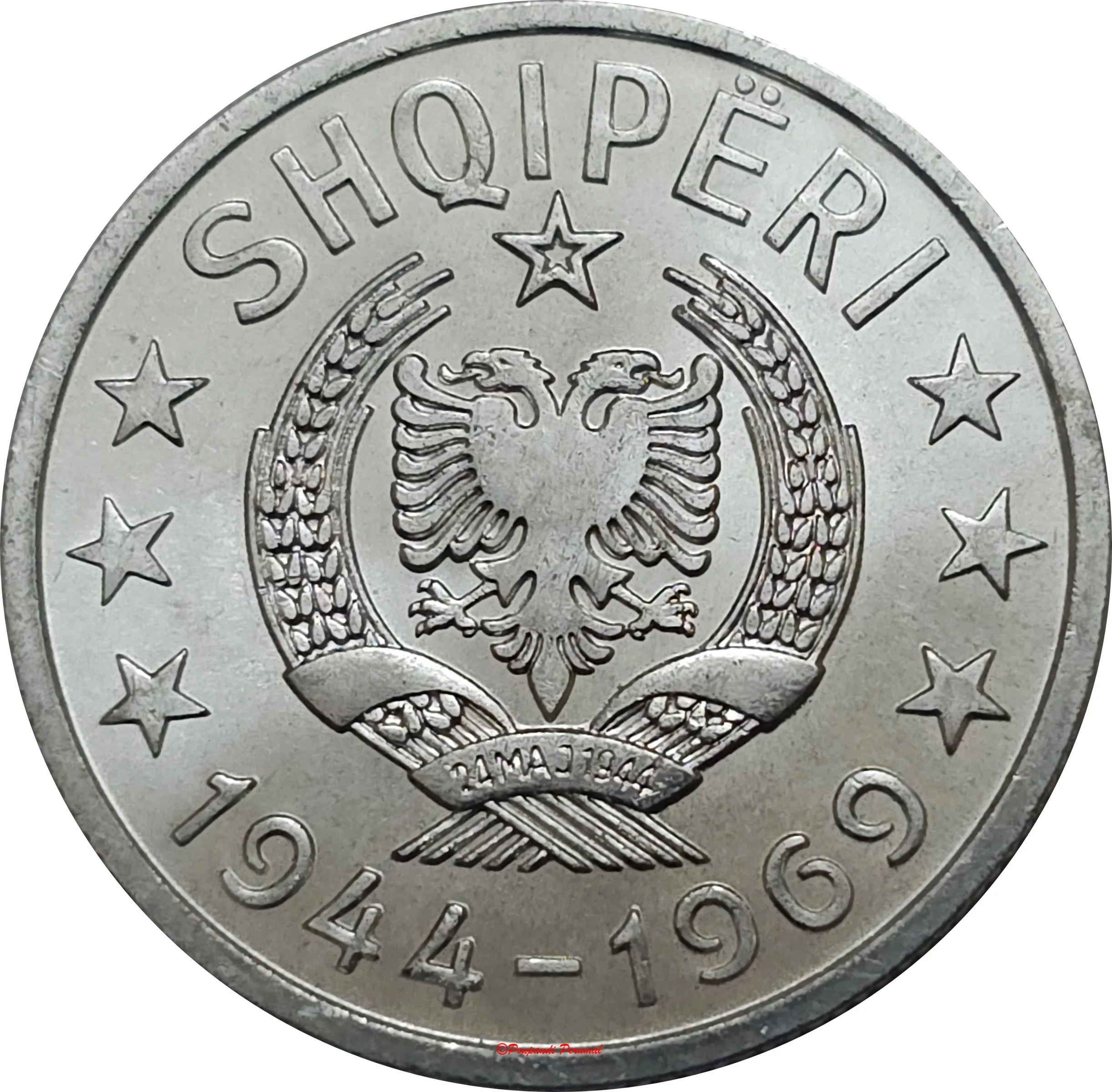
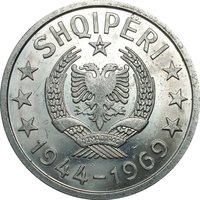
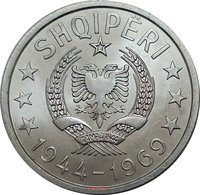
Obverse
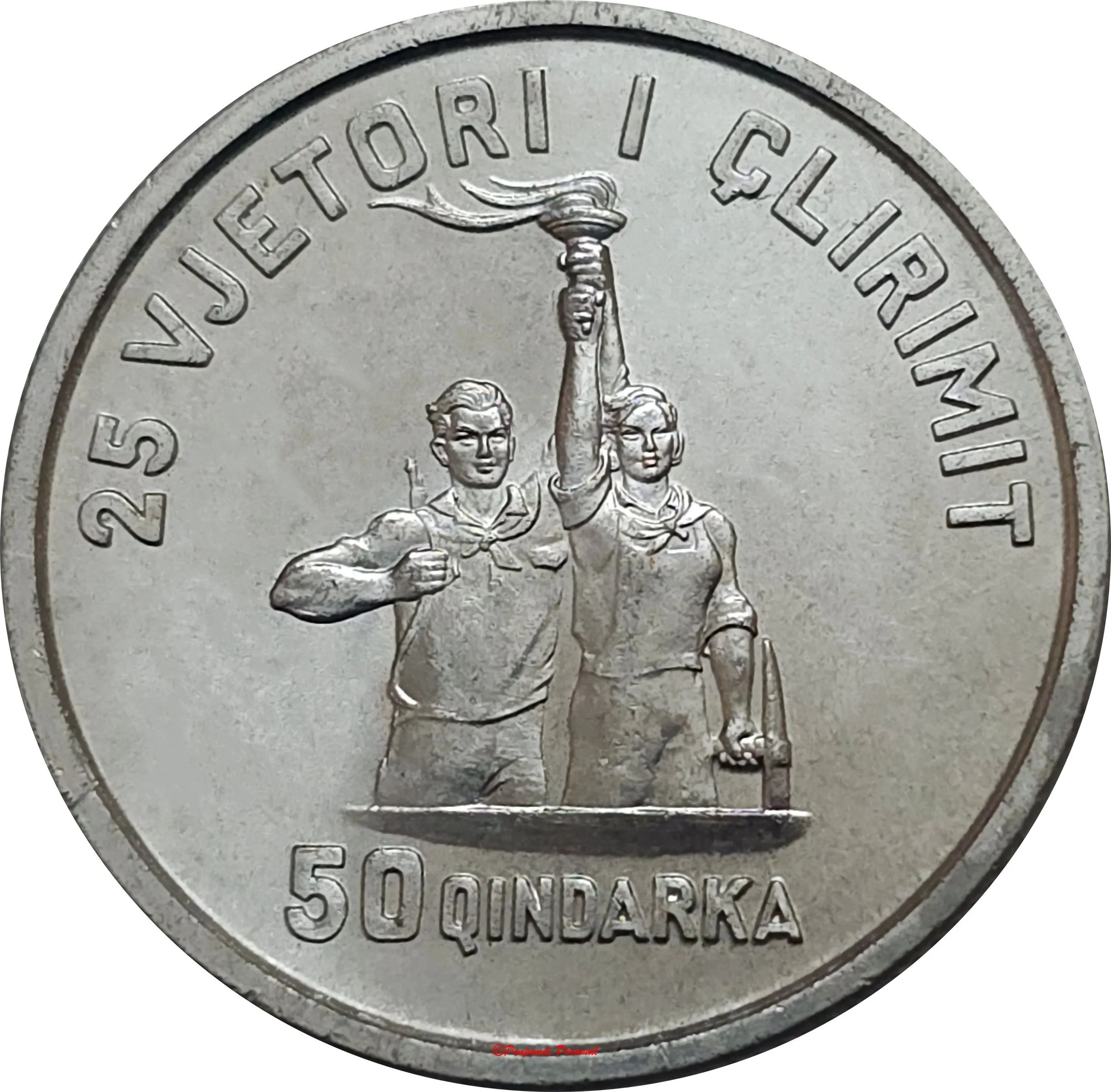
Reverse
Description:
Two half-figures raising a torch, value beneath.
Inscription:
25 VJETORI I ÇLIRIMIT
50 QINDARKA
50 QINDARKA
Translation:
Twenty-fifth Anniversary of Liberation
50 Qindarka
50 Qindarka
Script: Latin
Language: Albanian
Engraver: Odhise Paskali
Edge
Reeded
Categories
| Animal> Bird |
| Symbols> Coat of Arms |
| Symbol> Double-headed eagle |
Mintings
| Year | Mint Mark | Mintage | Quality | Collection |
|---|---|---|---|---|
| 1969 | — | — |
Historical background
In 1969, Albania's currency situation was defined by its extreme political and economic isolation under Enver Hoxha's Stalinist regime. Having severed ties with the Soviet Union in 1961 and with China deteriorating by the end of the decade, Albania operated as a closed, command economy with a state-controlled monetary system. The national currency, the Albanian lek, was a non-convertible currency, meaning it could not be legally exchanged for foreign currencies on international markets. Its value was administratively set by the state with no relation to market forces, primarily functioning as an accounting unit within the planned economy.
Internally, the currency's role was heavily constrained. While used for wages and limited consumer transactions, the actual purchasing power of the lek was secondary to the state allocation of goods. Severe shortages of consumer products were common, rendering savings largely meaningless as there was little of value to buy. The state banking monopoly, the State Bank of Albania, controlled all financial flows, with no private commerce or foreign investment. Black markets for scarce goods or foreign currency existed but were dangerous and limited, operating under the constant threat of severe punishment for "economic sabotage."
Externally, Albania's currency was virtually absent from global finance. The country adhered to a doctrine of total self-reliance (vetëmbështetje), rejecting foreign credits and loans. This resulted in no external debt, but also meant no integration into international monetary systems. Any essential foreign trade was conducted through bilateral, barter-like agreements, carefully managed to avoid trade deficits. Thus, in 1969, the Albanian lek symbolized the regime's ideological purity and economic isolation, functioning as a sealed instrument of control in one of Europe's most closed and impoverished economies.
Internally, the currency's role was heavily constrained. While used for wages and limited consumer transactions, the actual purchasing power of the lek was secondary to the state allocation of goods. Severe shortages of consumer products were common, rendering savings largely meaningless as there was little of value to buy. The state banking monopoly, the State Bank of Albania, controlled all financial flows, with no private commerce or foreign investment. Black markets for scarce goods or foreign currency existed but were dangerous and limited, operating under the constant threat of severe punishment for "economic sabotage."
Externally, Albania's currency was virtually absent from global finance. The country adhered to a doctrine of total self-reliance (vetëmbështetje), rejecting foreign credits and loans. This resulted in no external debt, but also meant no integration into international monetary systems. Any essential foreign trade was conducted through bilateral, barter-like agreements, carefully managed to avoid trade deficits. Thus, in 1969, the Albanian lek symbolized the regime's ideological purity and economic isolation, functioning as a sealed instrument of control in one of Europe's most closed and impoverished economies.
🌱 Common