

3 Pence – Rhodesia and Nyasaland
Zimbabwe
Context
Year: 1955
Country: Zimbabwe 
Issuer: Rhodesia and Nyasaland
Ruler: Elizabeth II
Currency:
(1955—1964)
Demonetization: 1 June 1965
Total mintage: 2,000
Material
References
KM: #Click to copy to clipboard3a
Numista: #67379
Value
Bullion value: $2.00
Obverse
Description:
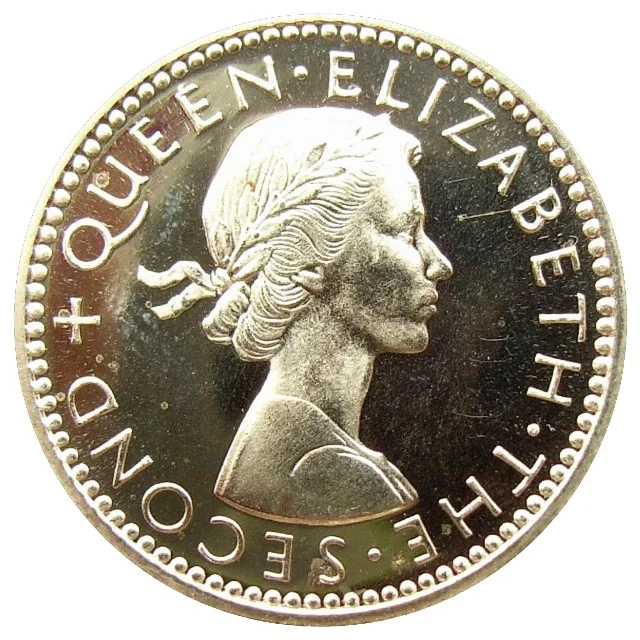
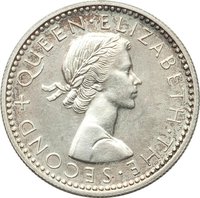
Young Queen Elizabeth II laureate bust right, legend surrounding.
Inscription:
+ QUEEN · ELIZABETH · THE · SECOND
Script: Latin
Engraver: Mary Gillick
Reverse
Description:
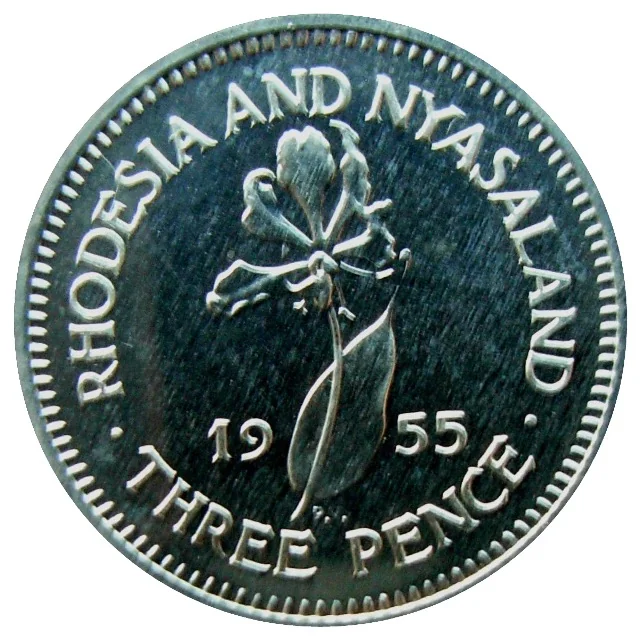
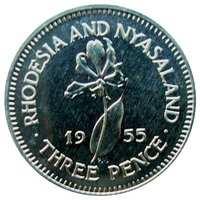
Flame Lily, date divides legend above, denomination below.
Inscription:
RHODESIA AND NYASALAND
19 55
P.V.
· THREE PENCE ·
19 55
P.V.
· THREE PENCE ·
Script: Latin
Engraver: Paul Vincze
Edge
Reeded
Mints
| Name | Mark |
|---|---|
| Royal Mint (Tower Hill) | — |
Mintings
| Year | Mint Mark | Mintage | Quality | Collection |
|---|---|---|---|---|
| 1955 | — | 2,000 | Proof |
Historical background
In 1955, the currency situation in the Federation of Rhodesia and Nyasaland was defined by the operations of the Central African Currency Board, established in London in 1954. This board issued the distinctive Rhodesia and Nyasaland pound (£), which was pegged at par with and fully convertible to the British pound sterling. The currency, featuring local imagery, circulated across all three territories—Southern Rhodesia, Northern Rhodesia, and Nyasaland—replacing the previous Southern Rhodesian pound and facilitating trade and administration within the Federation's unified economic framework.
Economically, the currency's stability was underpinned by the Federation's burgeoning prosperity, heavily reliant on the copper boom from Northern Rhodesia's mines and agricultural exports from Southern Rhodesia. This peg to sterling provided credibility for international investment and trade, which the federal government actively encouraged. However, this monetary integration also symbolised and reinforced the centralised economic control favoured by the federal structure, despite the differing economic interests and development levels of the constituent territories.
Beneath this surface stability, the currency arrangement contained inherent tensions. It was managed from London, reflecting continued colonial financial oversight, while its circulation across three distinct territories papered over growing political discontent. The system primarily served the interests of the settler-dominated federal government and European business, with critics in Nyasaland and Northern Rhodesia beginning to question the economic benefits of federation. These monetary ties would later become a point of contention as nationalist movements gained momentum and the Federation moved towards dissolution in the early 1960s.
Economically, the currency's stability was underpinned by the Federation's burgeoning prosperity, heavily reliant on the copper boom from Northern Rhodesia's mines and agricultural exports from Southern Rhodesia. This peg to sterling provided credibility for international investment and trade, which the federal government actively encouraged. However, this monetary integration also symbolised and reinforced the centralised economic control favoured by the federal structure, despite the differing economic interests and development levels of the constituent territories.
Beneath this surface stability, the currency arrangement contained inherent tensions. It was managed from London, reflecting continued colonial financial oversight, while its circulation across three distinct territories papered over growing political discontent. The system primarily served the interests of the settler-dominated federal government and European business, with critics in Nyasaland and Northern Rhodesia beginning to question the economic benefits of federation. These monetary ties would later become a point of contention as nationalist movements gained momentum and the Federation moved towards dissolution in the early 1960s.
💎 Extremely Rare