

10 euro (Diplomatic Relations Netherlands Turkey) – Netherlands
Add to wishlist
Non-circulating coins
Commemoration: Ulip - 400 Years of Diplomatic Relations Netherlands - Turkey
Netherlands
Context
Material
References
KM: #
Numista: #67191
Value
Exchange value: 10 EUR
Bullion value: $926.70
Inflation-adjusted value: 13.78 EUR
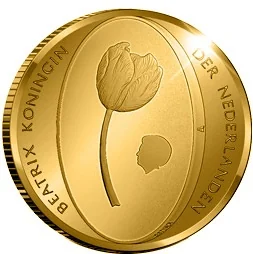
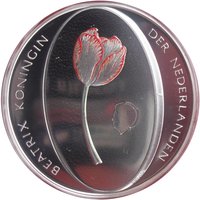
Obverse
Description:
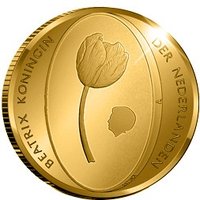
A tulip with Queen Beatrix's effigy.
Inscription:
BEATRIX KONINGIN
DER NEDERLANDEN
DER NEDERLANDEN
Translation:
BEATRIX QUEEN OF THE NETHERLANDS
Script: Latin
Language: Dutch
Engraver: Deniz Seyda Tunca
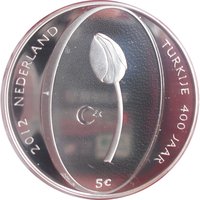
Reverse
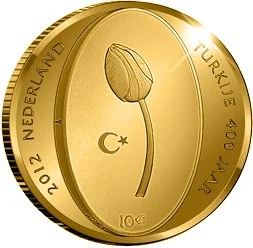
Description:
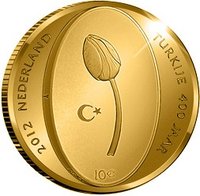
A tulip with Turkey's star and crescent symbol.
Inscription:
2012 NEDERLAND
TURKIJE 400 JAAR
10 €
TURKIJE 400 JAAR
10 €
Translation:
2012 NETHERLANDS
TURKEY 400 YEARS
10 €
TURKEY 400 YEARS
10 €
Script: Latin
Engraver: Deniz Seyda Tunca
Edge
Mintings
| Year | Mint Mark | Mintage | Quality | Collection |
|---|---|---|---|---|
| 2012 | — | 2,000 | Proof |
Historical background
In 2012, the Netherlands was a core member of the Eurozone, having adopted the euro in 1999 (with physical notes and coins introduced in 2002). The country's currency situation was therefore intrinsically tied to the stability and crises of the single currency. Domestically, the Dutch guilder was a distant memory, and the euro was fully embedded in the financial system. However, the year was dominated not by domestic currency policy but by the severe European sovereign debt crisis, which posed an existential threat to the euro itself.
The Dutch government, led by Prime Minister Mark Rutte, was a staunch advocate for strict fiscal discipline within the Eurozone, aligning closely with Germany in pushing for austerity measures for crisis-hit countries like Greece, Portugal, and Ireland. This position was driven by a desire to protect the stability of the euro, which was crucial for the Netherlands' export-oriented economy, and to safeguard Dutch taxpayers from bearing excessive costs for bailouts. Domestically, the Netherlands faced its own economic challenges, entering a brief recession in 2012, which fueled debate about the austerity-focused European approach.
Despite its pro-euro stance, 2012 also saw the rise of public skepticism. The ongoing crises sparked discussions about the potential exit of struggling nations from the euro and, in more fringe debates, even a hypothetical return to the guilder. While never a mainstream political position, this reflected underlying concerns about the costs of European solidarity. Ultimately, the year culminated in the European Central Bank's pivotal announcement of the Outright Monetary Transactions (OMT) program in September, a "whatever it takes" move that calmed markets and solidified the euro's future, thereby resolving the immediate existential currency uncertainty for the Netherlands.
The Dutch government, led by Prime Minister Mark Rutte, was a staunch advocate for strict fiscal discipline within the Eurozone, aligning closely with Germany in pushing for austerity measures for crisis-hit countries like Greece, Portugal, and Ireland. This position was driven by a desire to protect the stability of the euro, which was crucial for the Netherlands' export-oriented economy, and to safeguard Dutch taxpayers from bearing excessive costs for bailouts. Domestically, the Netherlands faced its own economic challenges, entering a brief recession in 2012, which fueled debate about the austerity-focused European approach.
Despite its pro-euro stance, 2012 also saw the rise of public skepticism. The ongoing crises sparked discussions about the potential exit of struggling nations from the euro and, in more fringe debates, even a hypothetical return to the guilder. While never a mainstream political position, this reflected underlying concerns about the costs of European solidarity. Ultimately, the year culminated in the European Central Bank's pivotal announcement of the Outright Monetary Transactions (OMT) program in September, a "whatever it takes" move that calmed markets and solidified the euro's future, thereby resolving the immediate existential currency uncertainty for the Netherlands.

✨ Legendary