

5 euro – Latvia
Add to wishlist
Non-circulating coins
Commemoration: The seasons.
Latvia
Context
Material
References
KM: #
Numista: #67014
Value
Exchange value: 5 EUR
Bullion value: $50.79
Inflation-adjusted value: 7.38 EUR
Obverse
Description:
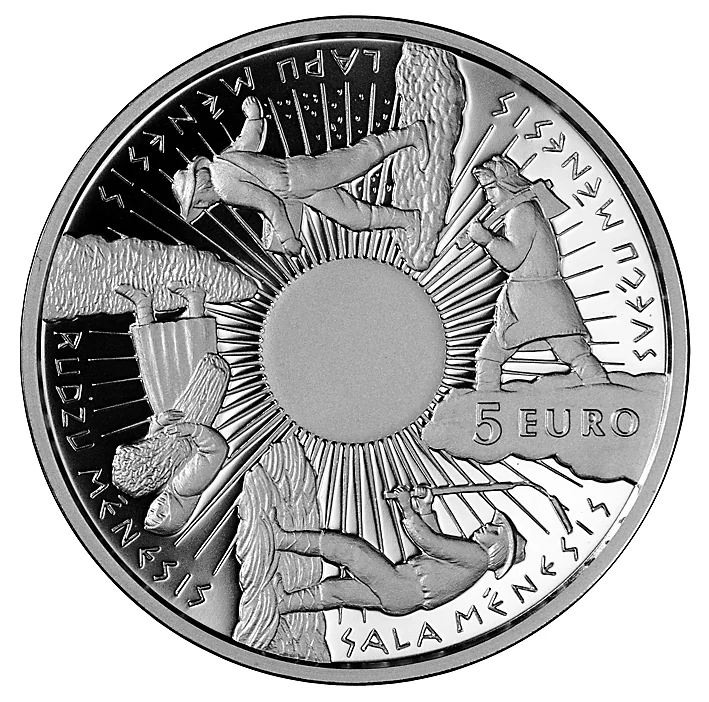
The obverse center shows the Sun encircled by four laborers representing the seasons: a woodcutter (winter), a sower (spring), a harvester (summer), and a thresher (autumn). Around the outer ring are the ancient names of the season-ending months: the Candle, Leaf, Rye, and Frost Months. "5 EURO" appears to the right of center.
Inscription:
5 EURO
SVEČU MĒNESIS
LAPU MĒNESIS
RUDZU MĒNESIS
SALA MĒNESIS
SVEČU MĒNESIS
LAPU MĒNESIS
RUDZU MĒNESIS
SALA MĒNESIS
Translation:
Festivity Month
Leaf Month
Rye Month
Island Month
Leaf Month
Rye Month
Island Month
Language: Latvian
Engraver: Ligita Franckeviča
Designer: Arvīds Priedīte
Reverse
Description:
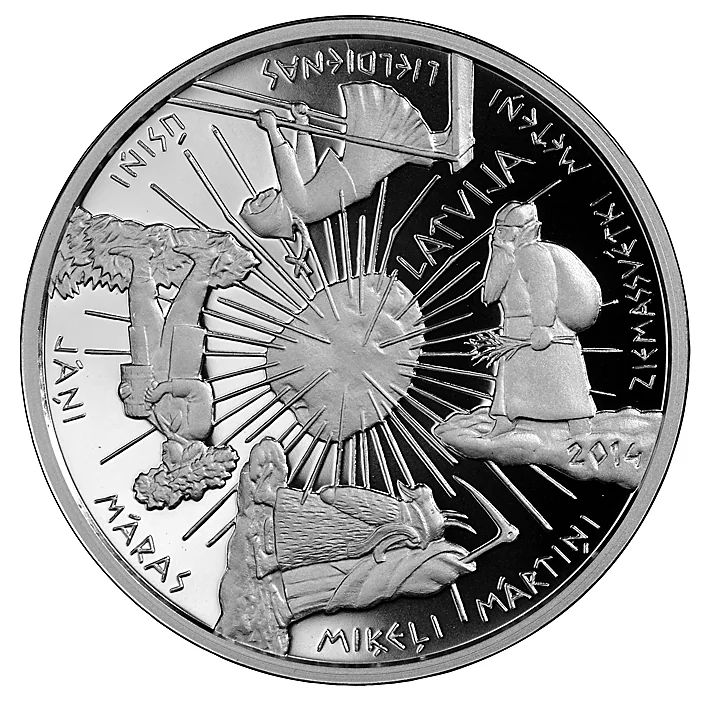
The reverse depicts a potato with straws, a traditional Latvian decoration, surrounded by seasonal symbols: Father Christmas, an Easter girl swinging, a Midsummer celebrant, and mummers. The outer ring lists the celebrations: CHRISTMAS, SHROVETIDE, EASTER, ŪSIŅI, JĀŅI, MĀRAS, and MARTINMAS. "LATVIJA" is inscribed slantwise to the upper right, with the year 2014 on the right side.
Inscription:
LATVIJA
2014
ZIEMASSVĒTKI
METEŅI
LIELDIENAS
ŪSIŅI
JĀŅI
MĀRAS
MIĶEĻI
MĀRTIŅI
2014
ZIEMASSVĒTKI
METEŅI
LIELDIENAS
ŪSIŅI
JĀŅI
MĀRAS
MIĶEĻI
MĀRTIŅI
Translation:
LATVIA
2014
CHRISTMAS
SHROVETIDE
EASTER
USIŅI (St. Ursula's Day)
JĀņI (St. John's Day / Midsummer)
MĀRAS (Māra's Day / St. Mary's Day)
MIĶEĒLI (St. Michael's Day)
MĀRTIŅI (St. Martin's Day)
2014
CHRISTMAS
SHROVETIDE
EASTER
USIŅI (St. Ursula's Day)
JĀņI (St. John's Day / Midsummer)
MĀRAS (Māra's Day / St. Mary's Day)
MIĶEĒLI (St. Michael's Day)
MĀRTIŅI (St. Martin's Day)
Language: Latvian
Engraver: Ligita Franckeviča
Designer: Arvīds Priedīte
Edge
There are the inscriptions LATVIJAS BANKA and LATVIJAS REPUBLIKA, separated by rhombic dots.
Legend:
LATVIJAS BANKA ◊ LATVIJAS REPUBLIKA ◊
Translation:
LATVIJAS BANKA ◊ LATVIJAS REPUBLIKA ◊
Language: Latvian
Mints
| Name | Mark |
|---|---|
| Royal Dutch Mint | — |
Mintings
| Year | Mint Mark | Mintage | Quality | Collection |
|---|---|---|---|---|
| 2014 | — | 10,000 | Proof |
Historical background
In 2014, Latvia was in a unique and transitional currency situation, having just adopted the euro on January 1st of that year. This marked the culmination of a long-stated strategic goal following its accession to the European Union in 2004 and recovery from a severe financial crisis in 2008-2009. The country replaced its previous currency, the Latvian lats (LVL), which had been a strong symbol of national identity since its reintroduction after independence from the Soviet Union. The switch was driven by a desire for deeper economic integration with the Eurozone core, aiming to secure greater financial stability, attract foreign investment, and lower borrowing costs for the state and businesses.
The transition itself was technically smooth, with a two-week dual-circulation period. However, it was met with significant public ambivalence. Polls consistently showed a majority of Latvians opposed the change, driven by concerns over a loss of sovereignty, fears of hidden price increases (despite strict conversion rules), and sentimental attachment to the lats. The political elite, however, remained overwhelmingly in favor, viewing euro adoption as a final step in Latvia's "return to Europe" and a strategic move to distance itself from the economic and political influence of Russia—a consideration that gained immense urgency later in 2014 with the annexation of Crimea.
Thus, Latvia's 2014 currency situation was defined by its first full year operating within the Eurozone. The macroeconomic rationale was clear: it locked in the fiscal discipline of the post-crisis years and provided a stable currency platform. Yet, the year also highlighted the complex blend of economic pragmatism and geopolitical calculation behind the move, set against a backdrop of lingering public skepticism. The timing proved historically significant, as the geopolitical shocks later that year underscored the importance of Latvia's anchored position within the core European monetary and political bloc.
The transition itself was technically smooth, with a two-week dual-circulation period. However, it was met with significant public ambivalence. Polls consistently showed a majority of Latvians opposed the change, driven by concerns over a loss of sovereignty, fears of hidden price increases (despite strict conversion rules), and sentimental attachment to the lats. The political elite, however, remained overwhelmingly in favor, viewing euro adoption as a final step in Latvia's "return to Europe" and a strategic move to distance itself from the economic and political influence of Russia—a consideration that gained immense urgency later in 2014 with the annexation of Crimea.
Thus, Latvia's 2014 currency situation was defined by its first full year operating within the Eurozone. The macroeconomic rationale was clear: it locked in the fiscal discipline of the post-crisis years and provided a stable currency platform. Yet, the year also highlighted the complex blend of economic pragmatism and geopolitical calculation behind the move, set against a backdrop of lingering public skepticism. The timing proved historically significant, as the geopolitical shocks later that year underscored the importance of Latvia's anchored position within the core European monetary and political bloc.

💎 Very Rare