


Obverse
Description:
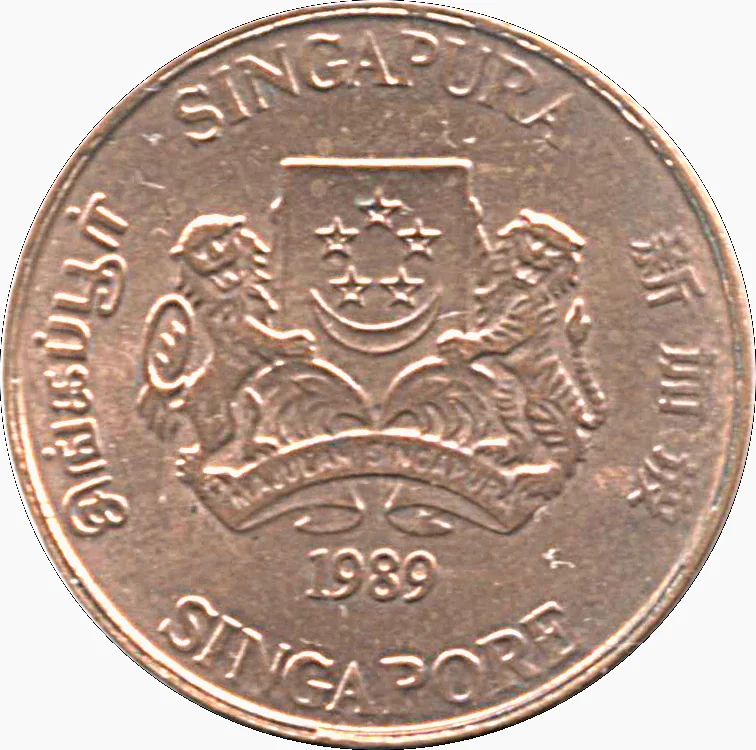
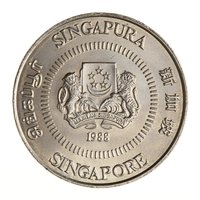
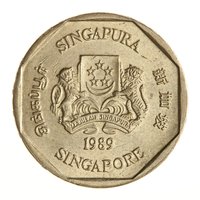
Emblem with date; 'Singapore' encircles it in English, Tamil, Chinese, and Malay.
Inscription:
SINGAPURA
சிங்கப்பூர் 新加坡
1989
SINGAPORE
சிங்கப்பூர் 新加坡
1989
SINGAPORE
Translation:
Singapore
Singapore Singapore
1989
Singapore
Singapore Singapore
1989
Singapore
Engraver: Christopher Ironside
Reverse
Description:
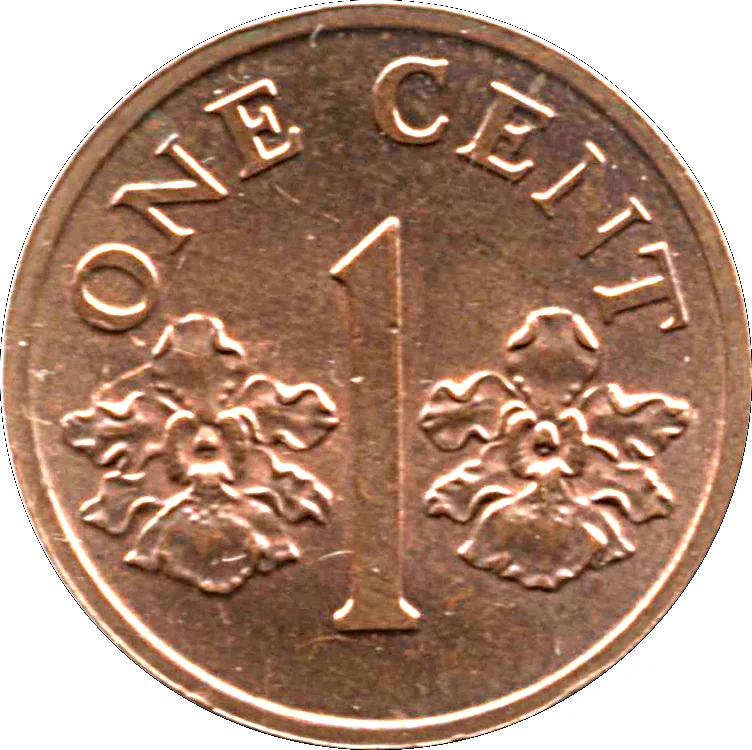
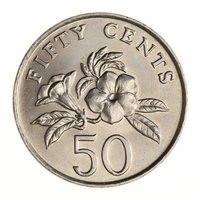
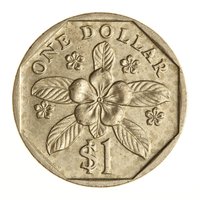
Denomination distinguishes orchid types.
Inscription:
ONE CENT
1
1
Engraver: Christopher Ironside
Edge
Plain
Mints
| Name | Mark |
|---|---|
| Singapore Mint | — |
Mintings
| Year | Mint Mark | Mintage | Quality | Collection |
|---|---|---|---|---|
| 1986 | — | 20,000,000 | ||
| 1987 | — | 120,000 | ||
| 1988 | — | 120,000 | ||
| 1989 | — | 20,080,000 | ||
| 1990 | — | 10,000,000 |
Historical background
In 1986, Singapore’s currency situation was defined by a managed float regime overseen by the Monetary Authority of Singapore (MAS). Unlike typical central banks, the MAS did not target interest rates but instead managed the Singapore dollar’s nominal effective exchange rate (S$NEER) against a secret basket of currencies of its major trading partners. This unique policy, established in the early 1980s, aimed explicitly at controlling imported inflation and ensuring medium-term price stability, which was crucial for a small, open economy heavily reliant on trade and foreign investment.
The mid-1980s context was challenging, as Singapore was experiencing its most severe recession since independence. The economic downturn, triggered by a collapse in global demand for electronics and ship repair, high domestic costs, and a loss of competitiveness, put pressure on the currency framework. There was a delicate balance to strike: the MAS needed to avoid an excessively strong currency that would hurt exports further, while also preventing a loss of confidence through sharp depreciation. Consequently, the MAS allowed for a modest and gradual depreciation of the S$NEER policy band throughout 1985 and into 1986 to support the struggling export sector.
This calibrated monetary easing, combined with broader fiscal and wage reforms, helped Singapore navigate out of recession by late 1986. The period solidified the credibility and effectiveness of the exchange-rate-centered monetary policy, demonstrating its utility as a shock absorber. The successful management in 1986 reinforced the MAS's commitment to this framework, which has remained the cornerstone of Singapore's monetary policy ever since, prioritizing exchange rate stability over domestic interest rate controls.
The mid-1980s context was challenging, as Singapore was experiencing its most severe recession since independence. The economic downturn, triggered by a collapse in global demand for electronics and ship repair, high domestic costs, and a loss of competitiveness, put pressure on the currency framework. There was a delicate balance to strike: the MAS needed to avoid an excessively strong currency that would hurt exports further, while also preventing a loss of confidence through sharp depreciation. Consequently, the MAS allowed for a modest and gradual depreciation of the S$NEER policy band throughout 1985 and into 1986 to support the struggling export sector.
This calibrated monetary easing, combined with broader fiscal and wage reforms, helped Singapore navigate out of recession by late 1986. The period solidified the credibility and effectiveness of the exchange-rate-centered monetary policy, demonstrating its utility as a shock absorber. The successful management in 1986 reinforced the MAS's commitment to this framework, which has remained the cornerstone of Singapore's monetary policy ever since, prioritizing exchange rate stability over domestic interest rate controls.
🌱 Very Common