

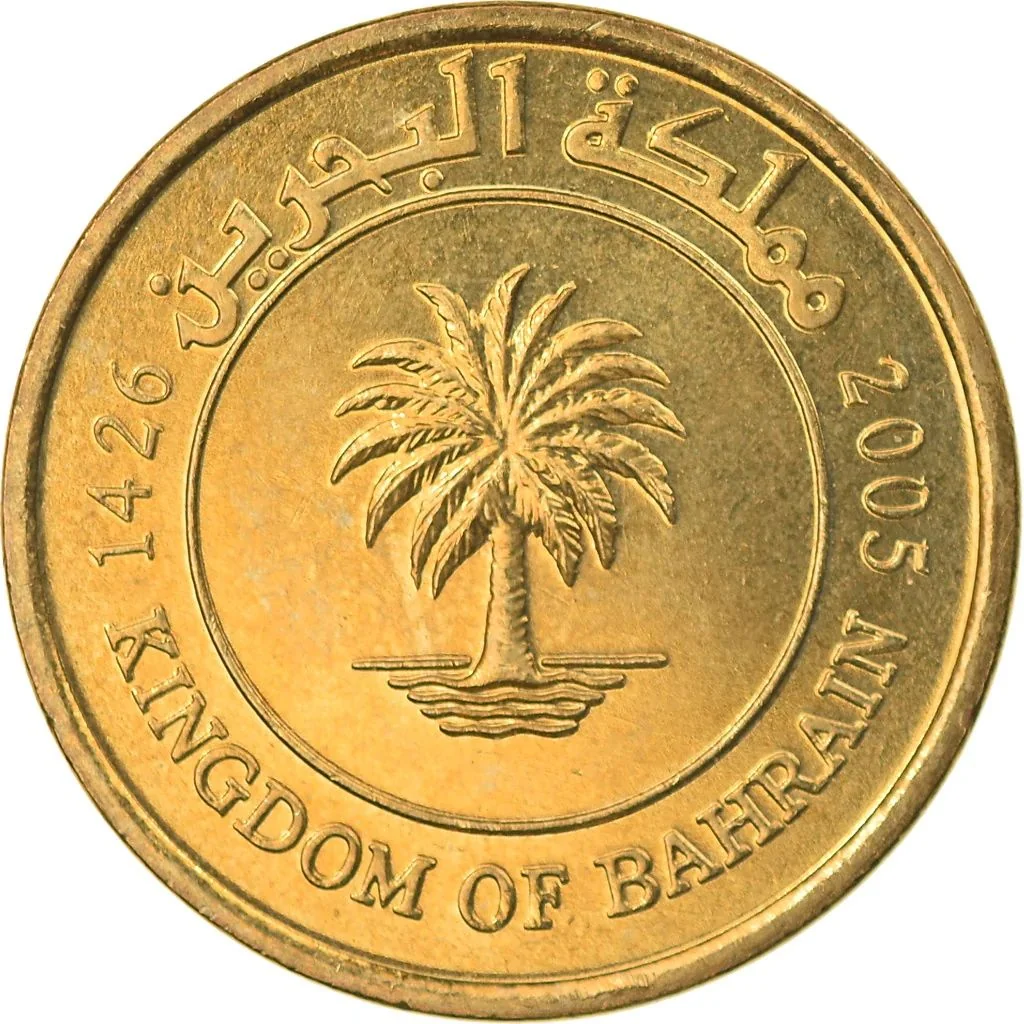
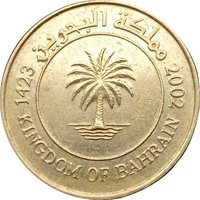
Obverse
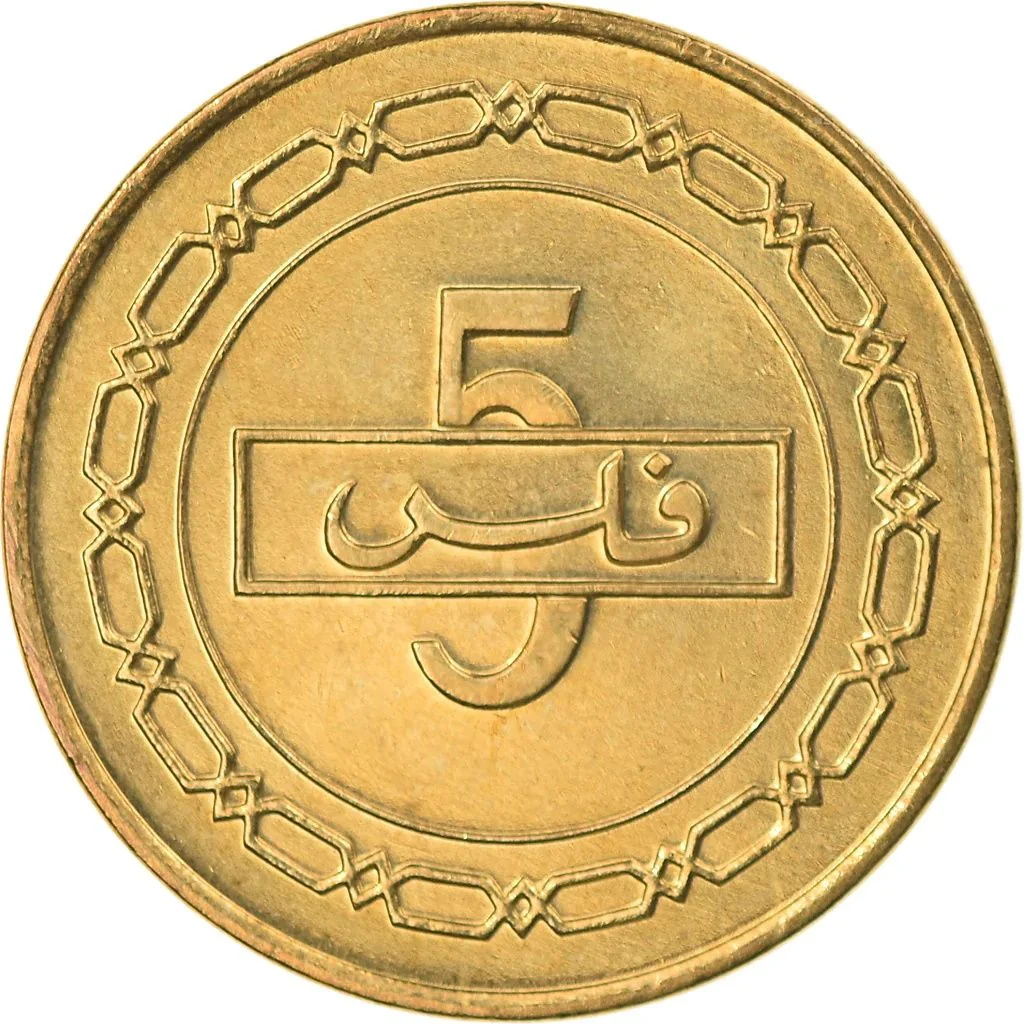
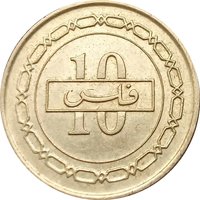
Reverse
Edge
Plain
Mints
| Name | Mark |
|---|---|
| Royal Mint | — |
Mintings
| Year | Mint Mark | Mintage | Quality | Collection |
|---|---|---|---|---|
| 2005 | — | — | ||
| 2007 | — | — |
Historical background
In 2005, Bahrain's currency situation was defined by its long-standing and stable peg to the US dollar, a policy formally adopted in 1980. The Bahraini dinar (BHD) was fixed at a rate of 1 USD = 0.376 BHD (or approximately 1 BHD = $2.65), a cornerstone of the kingdom's financial and monetary policy. This peg, managed by the Bahrain Monetary Agency (which was transformed into the Central Bank of Bahrain later that year), provided critical stability for trade, investment, and price expectations in an economy heavily reliant on hydrocarbons and regional banking services.
The dollar peg served Bahrain well, anchoring inflation and facilitating its role as a financial hub for the Gulf. However, 2005 also presented emerging challenges. With the US Federal Reserve raising interest rates to combat inflation, Bahrain was compelled to follow suit to maintain the currency peg's credibility, despite differing domestic economic conditions. Furthermore, the global surge in oil prices, which benefited Bahrain's fiscal position, also contributed to rising regional liquidity and inflationary pressures, leading to quiet discussions about the long-term suitability of the peg alongside other GCC states that were also dollar-pegged.
Overall, the currency regime in 2005 was not in crisis but at a point of strategic evaluation. The stability of the peg was unquestioned, but within financial circles, there was growing debate about the potential benefits of a revaluation or a shift to a basket of currencies to better manage imported inflation and align with the planned Gulf Monetary Union. For that year, however, maintaining the dollar peg remained the unequivocal policy, providing a predictable foundation for the economy amid regional economic boom and shifting global monetary conditions.
The dollar peg served Bahrain well, anchoring inflation and facilitating its role as a financial hub for the Gulf. However, 2005 also presented emerging challenges. With the US Federal Reserve raising interest rates to combat inflation, Bahrain was compelled to follow suit to maintain the currency peg's credibility, despite differing domestic economic conditions. Furthermore, the global surge in oil prices, which benefited Bahrain's fiscal position, also contributed to rising regional liquidity and inflationary pressures, leading to quiet discussions about the long-term suitability of the peg alongside other GCC states that were also dollar-pegged.
Overall, the currency regime in 2005 was not in crisis but at a point of strategic evaluation. The stability of the peg was unquestioned, but within financial circles, there was growing debate about the potential benefits of a revaluation or a shift to a basket of currencies to better manage imported inflation and align with the planned Gulf Monetary Union. For that year, however, maintaining the dollar peg remained the unequivocal policy, providing a predictable foundation for the economy amid regional economic boom and shifting global monetary conditions.
🌱 Common