

50 Dollars – Barbados
Non-circulating coins
Commemoration: Sir Clyde Walcott, Sir Everton Weekes and Sir Frank Worrell.
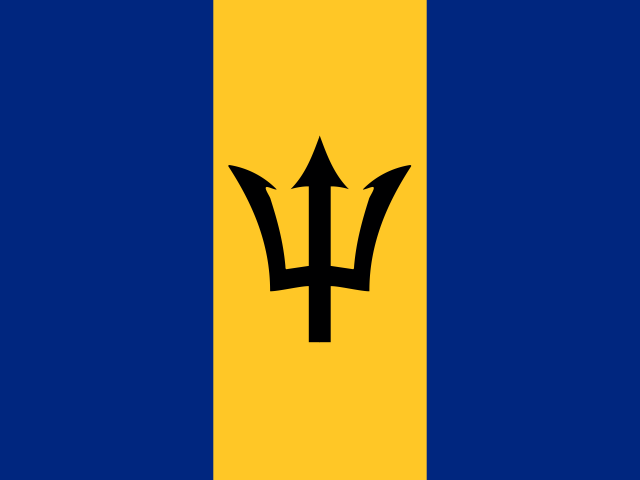
Barbados
Context
Material

References
KM: #Click to copy to clipboard77
Numista: #103532
Value
Exchange value: 50 BBD
Bullion value: $2436.18
Obverse
Description:
National coat of arms
Inscription:
BARBADOS
2007
2007
Reverse
Description:
The Three Ws: Sirs Clyde Walcott, Everton Weekes, and Frank Worrell.
Inscription:
BARBADOS - HOME OF THE MASTERS
3W's
FIFTY DOLLARS
3W's
FIFTY DOLLARS
Edge
Categories
| Symbols> Coat of Arms |
| Sport> Cricket |
Mints
| Name | Mark |
|---|---|
| Royal Mint | — |
Mintings
| Year | Mint Mark | Mintage | Quality | Collection |
|---|---|---|---|---|
| 2007 | — | 50 | Proof |
Historical background
In 2007, Barbados operated under a fixed exchange rate regime, pegging the Barbadian dollar (BBD) at a rate of 2:1 to the United States dollar (USD). This system, established in 1975, was a cornerstone of the country's economic policy, managed by the Central Bank of Barbados. The primary objective was to ensure monetary stability, control inflation, and foster confidence for both domestic businesses and foreign investors, particularly in the crucial tourism sector. By 2007, this peg was deeply institutionalized and widely regarded as a symbol of national economic prudence and stability.
The context of 2007, however, was one of growing external pressures. The global economy was on the brink of the financial crisis, and Barbados faced significant challenges including high and rising public debt, persistent fiscal deficits, and increasing import costs—especially for food and fuel. These factors placed sustained pressure on the country's foreign exchange reserves, which were essential for defending the fixed peg. While the peg itself remained firmly in place and publicly unquestioned by officials, economists and international institutions like the IMF began to voice concerns about the long-term sustainability of the fiscal path, noting that it could eventually threaten the very reserves that backed the currency.
Consequently, the currency situation in 2007 was characterized by a stark contrast between surface stability and underlying vulnerability. The Barbadian dollar itself was stable and fully convertible, with no immediate crisis. However, the macroeconomic imbalances fueling the drain on foreign reserves represented a slow-burning threat to the system. The government of the day maintained a strong rhetorical and policy commitment to the peg, but the year ended with the nation at a crossroads, needing to address its fiscal fundamentals to preserve the currency regime that had defined its economy for over three decades.
The context of 2007, however, was one of growing external pressures. The global economy was on the brink of the financial crisis, and Barbados faced significant challenges including high and rising public debt, persistent fiscal deficits, and increasing import costs—especially for food and fuel. These factors placed sustained pressure on the country's foreign exchange reserves, which were essential for defending the fixed peg. While the peg itself remained firmly in place and publicly unquestioned by officials, economists and international institutions like the IMF began to voice concerns about the long-term sustainability of the fiscal path, noting that it could eventually threaten the very reserves that backed the currency.
Consequently, the currency situation in 2007 was characterized by a stark contrast between surface stability and underlying vulnerability. The Barbadian dollar itself was stable and fully convertible, with no immediate crisis. However, the macroeconomic imbalances fueling the drain on foreign reserves represented a slow-burning threat to the system. The government of the day maintained a strong rhetorical and policy commitment to the peg, but the year ended with the nation at a crossroads, needing to address its fiscal fundamentals to preserve the currency regime that had defined its economy for over three decades.

✨ Legendary