

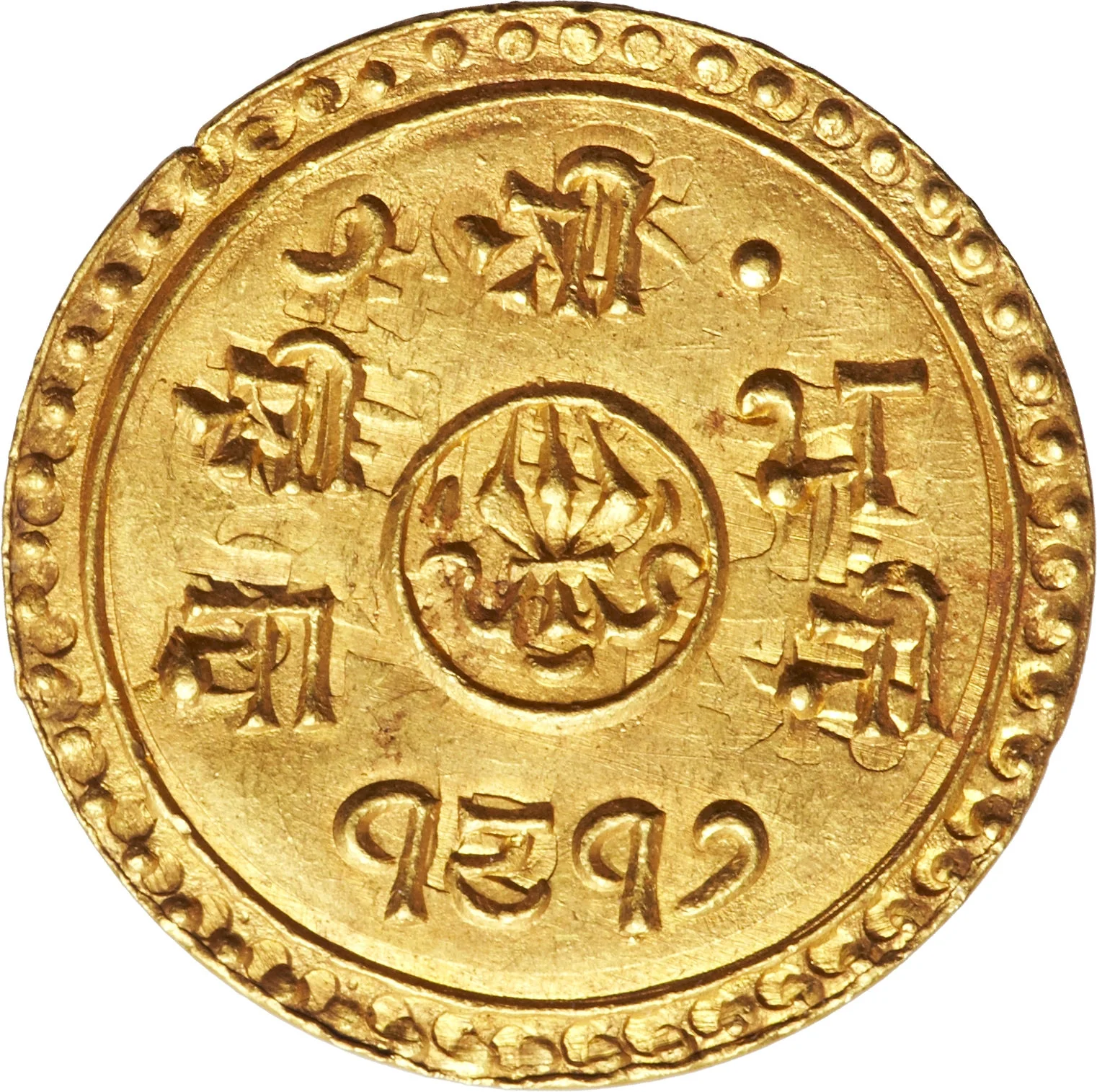
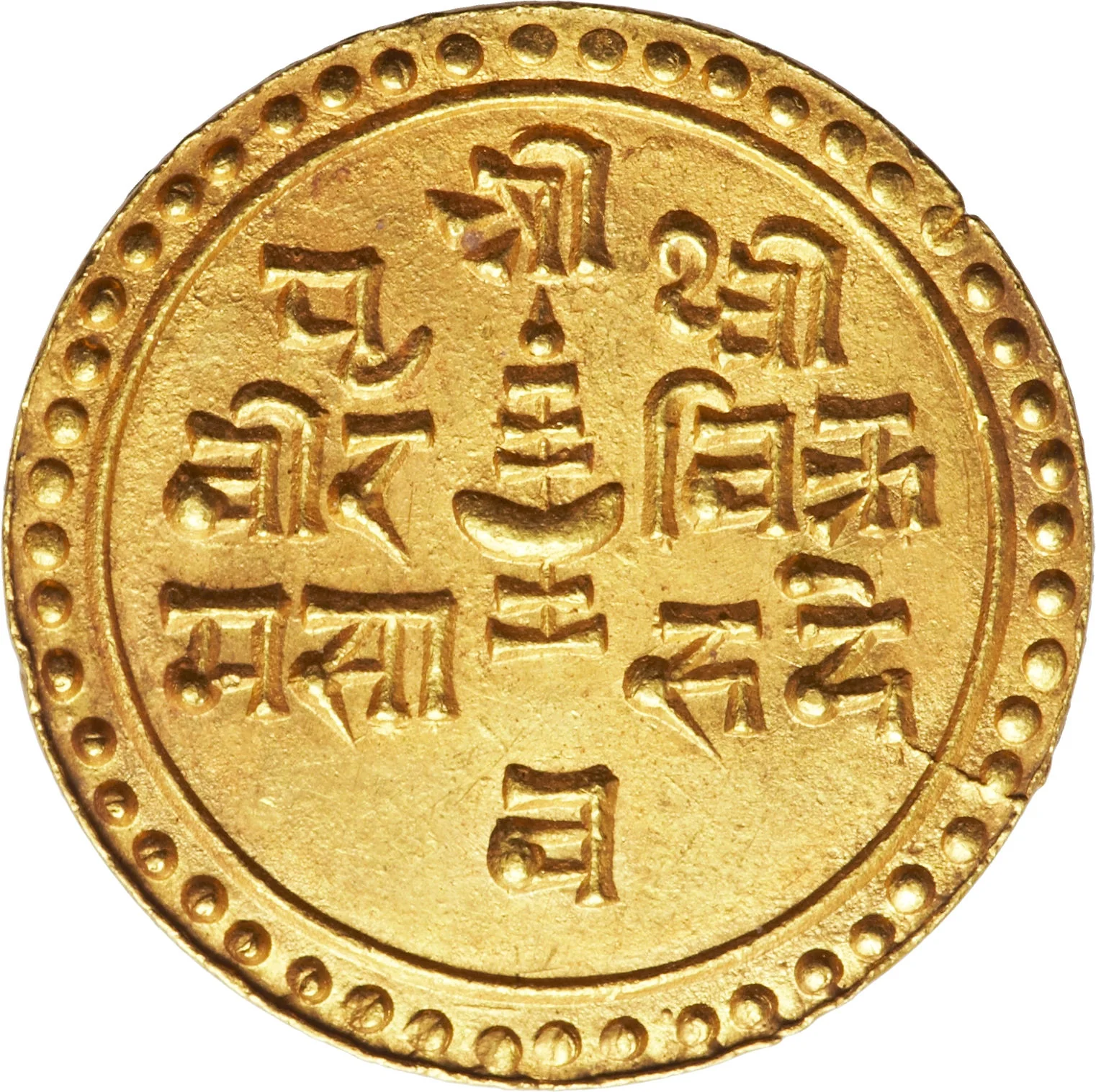
½ Mohar – Nepal
Nepal
Context
Year: 1883
Nepal - Saka era Year: 1805
Issuer: Nepal 
Ruler: Prithvi Bir Bikram Shah
Currency:
(1546—1932)
Demonetized: Yes
Material
References
KM: #Click to copy to clipboard672.1
Numista: #66158
Value
Bullion value: $466.14
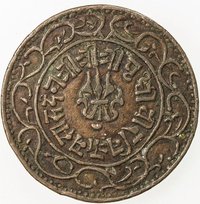
Obverse
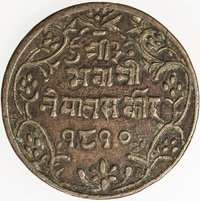
Reverse
Edge
Mintings
| Year | Mint Mark | Mintage | Quality | Collection |
|---|---|---|---|---|
| 1883 | — | — |
Historical background
In 1883, Nepal’s currency system was a complex and transitional one, caught between its own ancient traditions and the economic dominance of British India. The primary circulating medium was the Mohar, a silver coin minted by the state, but its value and purity were not uniform. More significantly, the economy was effectively dominated by the Indian Rupee, which circulated widely, especially in the Tarai plains and for larger trade transactions. This dual-currency reality created practical challenges for commerce and state finance, as exchange rates between the two coins fluctuated.
This monetary duality was a direct reflection of Nepal’s political and economic relationship with the British Raj. Following the 1816 Sugauli Treaty, Nepal was increasingly drawn into the British Indian economic sphere. The fixed exchange rate established earlier (1 Indian Rupee = 1.5 Nepali Mohars) was often unstable in practice, leading to confusion and arbitrage. Furthermore, the silver content of the Nepali mohar had been debased over time, eroding public confidence and driving a preference for the more stable and widely accepted Indian rupee, particularly for external trade.
Recognizing the inefficiencies, the Rana Prime Minister, Bir Shumsher Jang Bahadur Rana, was in the early stages of planning a major currency reform in 1883. This would culminate just a few years later, in 1887, with the introduction of a new decimal system: the Nepali Rupee (NRs), divided into 100 paisa, and the minting of modern, machine-struck silver coins. Thus, the situation in 1883 was one of lingering disorder immediately preceding a pivotal standardization, as the state sought to assert greater monetary sovereignty while aligning its system more closely with that of its powerful southern neighbor for practical trade purposes.
This monetary duality was a direct reflection of Nepal’s political and economic relationship with the British Raj. Following the 1816 Sugauli Treaty, Nepal was increasingly drawn into the British Indian economic sphere. The fixed exchange rate established earlier (1 Indian Rupee = 1.5 Nepali Mohars) was often unstable in practice, leading to confusion and arbitrage. Furthermore, the silver content of the Nepali mohar had been debased over time, eroding public confidence and driving a preference for the more stable and widely accepted Indian rupee, particularly for external trade.
Recognizing the inefficiencies, the Rana Prime Minister, Bir Shumsher Jang Bahadur Rana, was in the early stages of planning a major currency reform in 1883. This would culminate just a few years later, in 1887, with the introduction of a new decimal system: the Nepali Rupee (NRs), divided into 100 paisa, and the minting of modern, machine-struck silver coins. Thus, the situation in 1883 was one of lingering disorder immediately preceding a pivotal standardization, as the state sought to assert greater monetary sovereignty while aligning its system more closely with that of its powerful southern neighbor for practical trade purposes.
✨ Legendary