

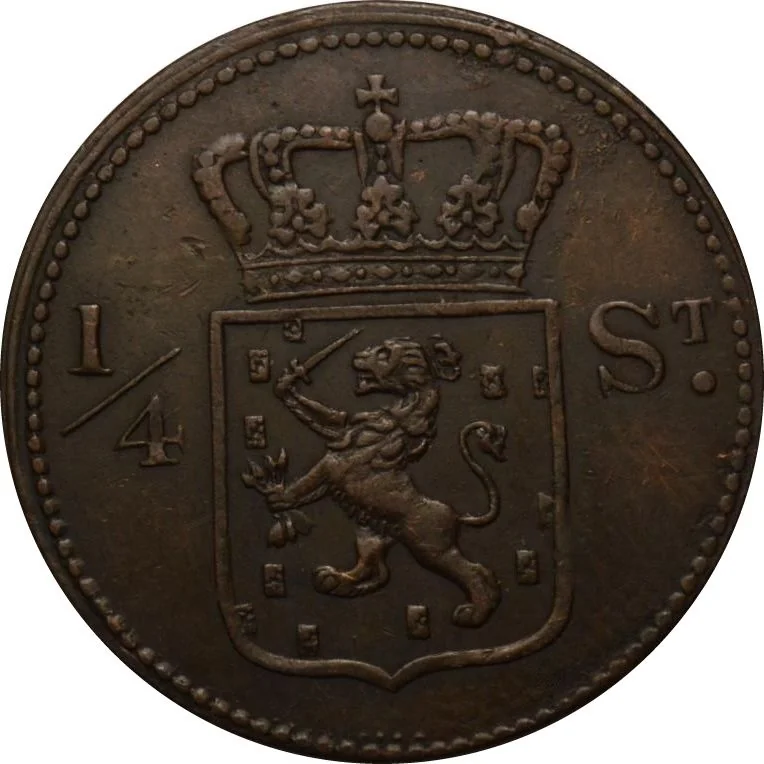
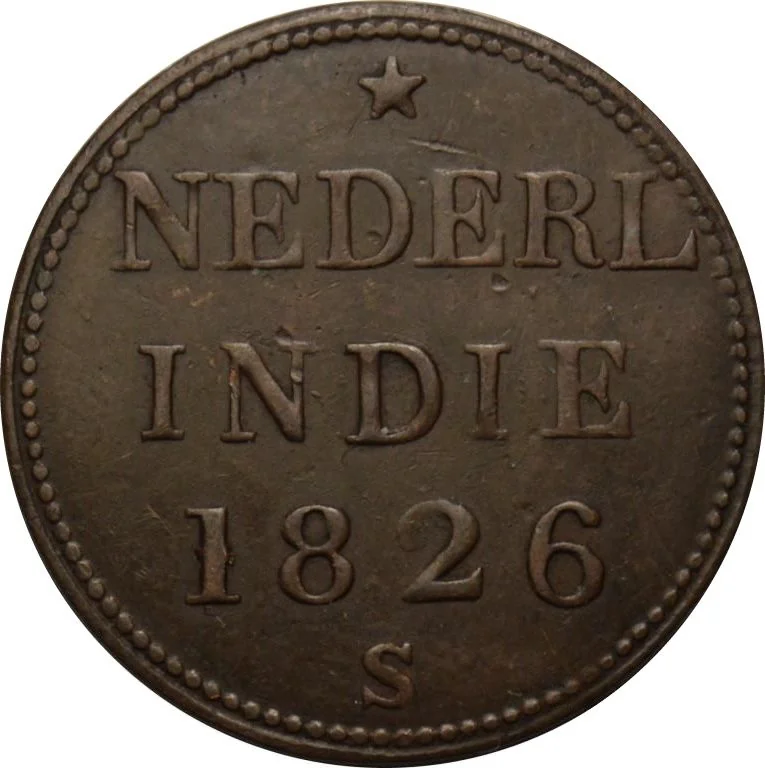
¼ stuiver – Netherlands East Indies
Add to wishlist
Indonesia
Context
Years: 1822–1836
Country: Indonesia
Issuer: Netherlands East Indies
Ruler: William I
Currency:
(1726—1854)
Demonetized: Yes
Total mintage: 451,453,000
Material
References
KM: #
Numista: #6605
Obverse
Reverse
Edge
Plain
Mints
| Name | Mark |
|---|---|
| Royal Dutch Mint | — |
Mintings
| Year | Mint Mark | Mintage | Quality | Collection |
|---|---|---|---|---|
| 1822 | S | 30,000,000 | ||
| 1823 | S | 29,000,000 | ||
| 1824 | S | 26,000,000 | ||
| 1825 | S | 125,000,000 | ||
| 1826 | S | 208,000,000 | ||
| 1836 | S | 33,453,000 |
Historical background
In 1822, the currency situation in the Netherlands East Indies (NEI) was characterized by a complex and unstable monetary duality. The official system was based on the Dutch guilder, but the colony suffered from a severe shortage of acceptable metallic coinage. This scarcity was a legacy of the Napoleonic Wars and the British interregnum (1811-1816), which had disrupted trade and drained silver from the archipelago. Consequently, the authorities struggled to enforce a single, reliable currency for official transactions and tax payments.
The vacuum was filled by a proliferation of foreign coins, creating a de facto multi-currency environment. Spanish American silver dollars (Mexican reales) and other silver coins circulated widely alongside smaller copper duit coins. Most critically, the Javanese economy relied heavily on the Japanese copper kepeng coins, which were imported in large quantities and used for everyday market transactions and wage payments. This created a disconnect between the high-value silver used in international trade and government finance and the low-value copper that fueled the local bazaar economy, with fluctuating exchange rates between them.
Recognizing this chaos as an impediment to colonial control and economic exploitation, the Dutch administration was actively seeking solutions. The year 1822 fell within a period of monetary experimentation following the return of Dutch rule. Authorities were attempting to assert greater control by regulating the value of foreign coins and promoting the use of Dutch currency, setting the stage for more decisive reforms. These would culminate just a few years later, in 1826, with the introduction of the gulden as the official unit of account and the establishment of the Java Bank, aiming to impose a unified and colonial-controlled monetary system.
The vacuum was filled by a proliferation of foreign coins, creating a de facto multi-currency environment. Spanish American silver dollars (Mexican reales) and other silver coins circulated widely alongside smaller copper duit coins. Most critically, the Javanese economy relied heavily on the Japanese copper kepeng coins, which were imported in large quantities and used for everyday market transactions and wage payments. This created a disconnect between the high-value silver used in international trade and government finance and the low-value copper that fueled the local bazaar economy, with fluctuating exchange rates between them.
Recognizing this chaos as an impediment to colonial control and economic exploitation, the Dutch administration was actively seeking solutions. The year 1822 fell within a period of monetary experimentation following the return of Dutch rule. Authorities were attempting to assert greater control by regulating the value of foreign coins and promoting the use of Dutch currency, setting the stage for more decisive reforms. These would culminate just a few years later, in 1826, with the introduction of the gulden as the official unit of account and the establishment of the Java Bank, aiming to impose a unified and colonial-controlled monetary system.
🌱 Common