

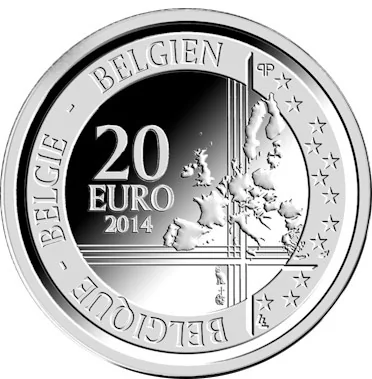
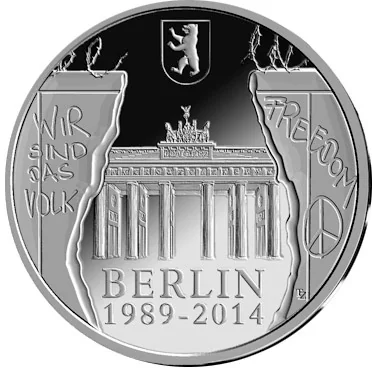
20 Euro (Fall of the Berlin Wall) – Belgium
Non-circulating coins
Commemoration: 25th Anniversary of the Fall of the Berlin Wall
Belgium
Context

Material
References
KM: #Click to copy to clipboard342
Numista: #65765
Value
Exchange value: 20 EUR = $23.63
Bullion value: $59.65
Inflation-adjusted value: 26.06 EUR
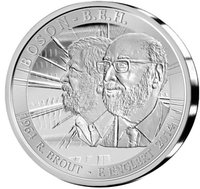
Obverse
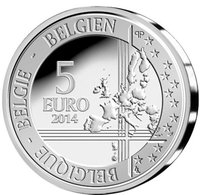
Reverse
Edge
Plain
Mintings
| Year | Mint Mark | Mintage | Quality | Collection |
|---|---|---|---|---|
| 2014 | — | 15,000 | Proof |
Historical background
In 2014, Belgium, as a founding member of the Eurozone, had fully integrated the euro as its national currency for over a decade, having adopted it for cash transactions in 2002. The currency situation was therefore stable and defined by its participation in the single currency, governed by the European Central Bank (ECB). The primary monetary policy focus, both for Belgium and the Eurozone as a whole, was combating persistently low inflation, which had fallen to a "danger zone" below 1%, raising concerns about deflationary risks that could stifle economic growth and increase debt burdens.
Domestically, the Belgian economy and its currency stability were influenced by the country's high public debt, which remained above 100% of GDP. This necessitated careful fiscal management to maintain market confidence and avoid any sovereign debt pressures that could indirectly affect perceptions of the euro's strength. However, Belgium's strong institutional framework and its role as the host to key EU institutions provided a stabilizing effect, ensuring its voice was heard in broader ECB policy debates aimed at stimulating the Eurozone economy.
The year was also marked by significant preparatory discussions at the Eurozone level, which would directly impact Belgium. The ECB, under President Mario Draghi, was moving towards unprecedented monetary stimulus, culminating in the announcement of a large-scale quantitative easing (QE) program in early 2015. Throughout 2014, Belgium, as part of the Eurosystem, was involved in these critical negotiations, balancing the need for economic stimulus with national concerns, all within the secure framework of a shared and stable currency.
Domestically, the Belgian economy and its currency stability were influenced by the country's high public debt, which remained above 100% of GDP. This necessitated careful fiscal management to maintain market confidence and avoid any sovereign debt pressures that could indirectly affect perceptions of the euro's strength. However, Belgium's strong institutional framework and its role as the host to key EU institutions provided a stabilizing effect, ensuring its voice was heard in broader ECB policy debates aimed at stimulating the Eurozone economy.
The year was also marked by significant preparatory discussions at the Eurozone level, which would directly impact Belgium. The ECB, under President Mario Draghi, was moving towards unprecedented monetary stimulus, culminating in the announcement of a large-scale quantitative easing (QE) program in early 2015. Throughout 2014, Belgium, as part of the Eurosystem, was involved in these critical negotiations, balancing the need for economic stimulus with national concerns, all within the secure framework of a shared and stable currency.

💎 Extremely Rare