

200 Kronor (Nobel Prize foundation) – Sweden
Non-circulating coins
Commemoration: 100th Anniversary of the foundation of the Nobel Prize
Sweden
Context

Material
References
KM: #Click to copy to clipboard919
Numista: #65506
Value
Exchange value: 200 SEK = $22.07
Bullion value: $70.23
Inflation-adjusted value: 322.61 SEK
Obverse
Description:
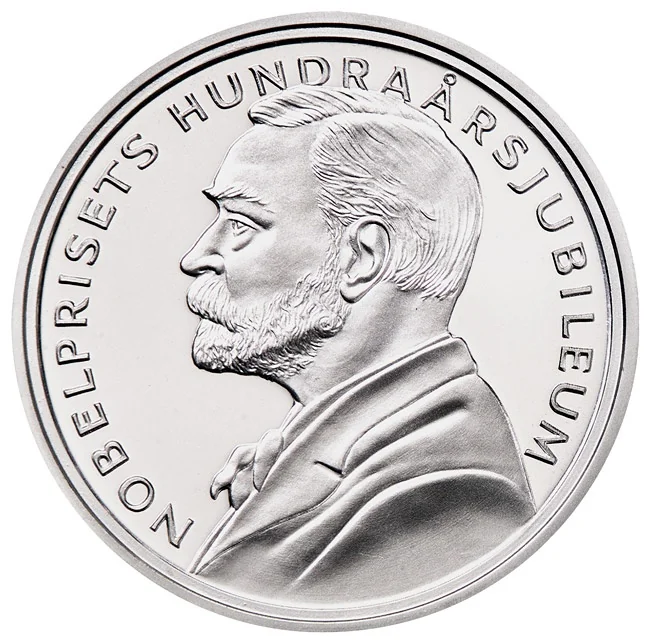
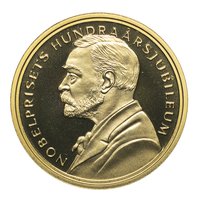
Erik Lindberg's left-facing portrait of Alfred Nobel, used on the first Nobel medals (1901/02).
Inscription:
NOBELPRISETS HUNDRAÅRS JUBILEUM
Translation:
The Nobel Prize's Centenary Jubilee
Script: Latin
Language: Swedish
Engraver: Philip Nathan
Reverse
Description:
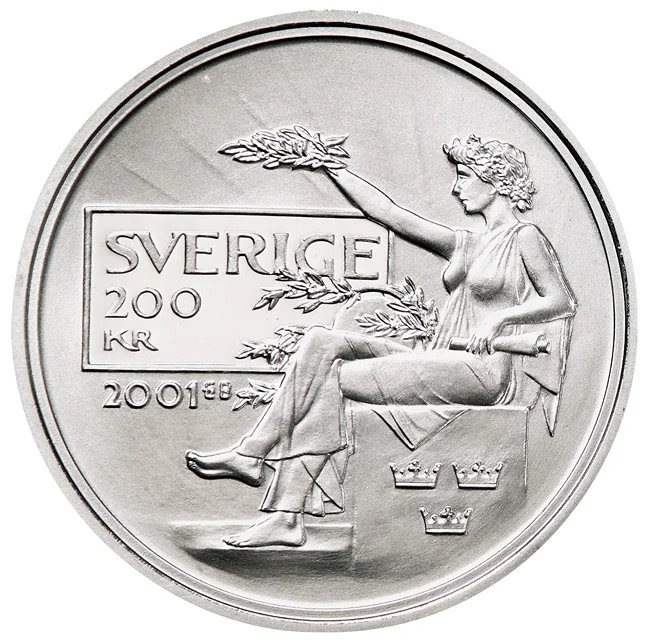
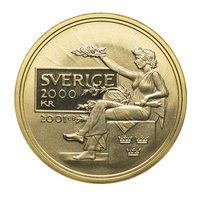
An antiquated female figure representing humanity sits on a podium with the Swedish coat of arms. She holds Nobel's will in one hand and raises a laurel wreath in salute with the other. The left side shows the value, date, mintmark 'E' for Eskilstuna, and 'B' for the Riksbank Governor's initial.
Inscription:
SVERIGE
200
KR
2001 E B
200
KR
2001 E B
Script: Latin
Engraver: Philip Nathan
Edge
Plain
Mints
| Name | Mark |
|---|---|
| Myntverket | — |
Mintings
| Year | Mint Mark | Mintage | Quality | Collection |
|---|---|---|---|---|
| 2001 | — | 29,856 |
Historical background
In 2001, Sweden was in the midst of a sustained and deliberate experiment with monetary policy, having unilaterally adopted an inflation-targeting framework after the collapse of the European Exchange Rate Mechanism (ERM) in 1992. The Riksbank, Sweden's central bank, had set a clear target of 2% annual inflation (with a tolerance band of ±1%), and by 2001, this framework was widely credited with delivering price stability and credibility. The Swedish krona was a freely floating currency, with its value determined by market forces rather than being pegged to another currency or basket. This independence allowed the Riksbank to set interest rates solely based on domestic economic conditions, primarily to steer inflation towards its target.
The year itself was characterized by a relatively strong krona and concerns about economic slowdown, following the burst of the global dot-com bubble. The Riksbank's main policy rate, the repo rate, was at 4.0% at the start of the year, but facing weaker global demand and subdued inflationary pressures, the bank embarked on an easing cycle. It cut the repo rate four times during 2001, bringing it down to 3.5% by December, in an effort to stimulate the domestic economy. A significant backdrop was Sweden's ongoing political debate about potential future adoption of the euro, following its entry into the European Union in 1995. The 2003 referendum on euro membership was already on the horizon, adding a layer of political uncertainty to long-term currency expectations.
Despite the domestic easing, the krona remained firm for much of the year, partly due to Sweden's sound public finances and strong current account surplus. However, the currency was not immune to global volatility, experiencing pressure following the terrorist attacks on September 11, 2001, which caused a flight to safety and strengthened traditional havens like the US dollar and Swiss franc. Overall, the currency situation in 2001 was one of stability under a transparent inflation-targeting regime, with proactive central bank management to counter external shocks, all set against the looming political question of European Monetary Union integration.
The year itself was characterized by a relatively strong krona and concerns about economic slowdown, following the burst of the global dot-com bubble. The Riksbank's main policy rate, the repo rate, was at 4.0% at the start of the year, but facing weaker global demand and subdued inflationary pressures, the bank embarked on an easing cycle. It cut the repo rate four times during 2001, bringing it down to 3.5% by December, in an effort to stimulate the domestic economy. A significant backdrop was Sweden's ongoing political debate about potential future adoption of the euro, following its entry into the European Union in 1995. The 2003 referendum on euro membership was already on the horizon, adding a layer of political uncertainty to long-term currency expectations.
Despite the domestic easing, the krona remained firm for much of the year, partly due to Sweden's sound public finances and strong current account surplus. However, the currency was not immune to global volatility, experiencing pressure following the terrorist attacks on September 11, 2001, which caused a flight to safety and strengthened traditional havens like the US dollar and Swiss franc. Overall, the currency situation in 2001 was one of stability under a transparent inflation-targeting regime, with proactive central bank management to counter external shocks, all set against the looming political question of European Monetary Union integration.
⭐ Rare