

10 escudos – Angola
Add to wishlist
Angola
Obverse
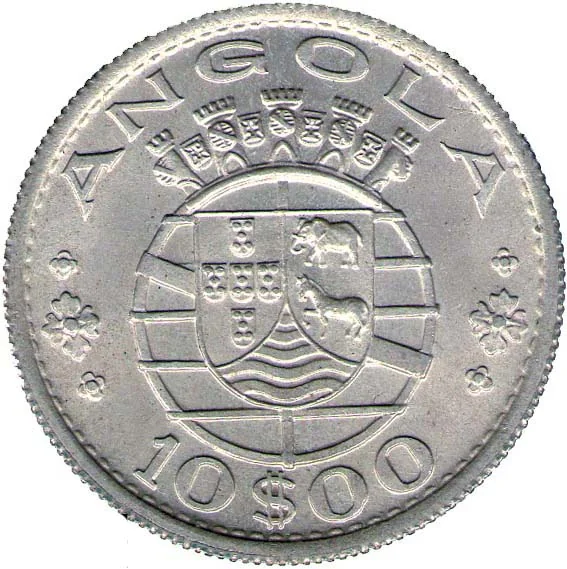
Description:
Five crowns, value below.
Inscription:
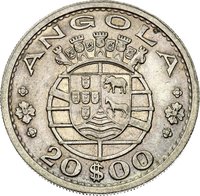
ANGOLA
10$00
10$00
Translation:
ANGOLA
10 dollars 00 cents
10 dollars 00 cents
Script: Latin
Language: Portuguese
Reverse
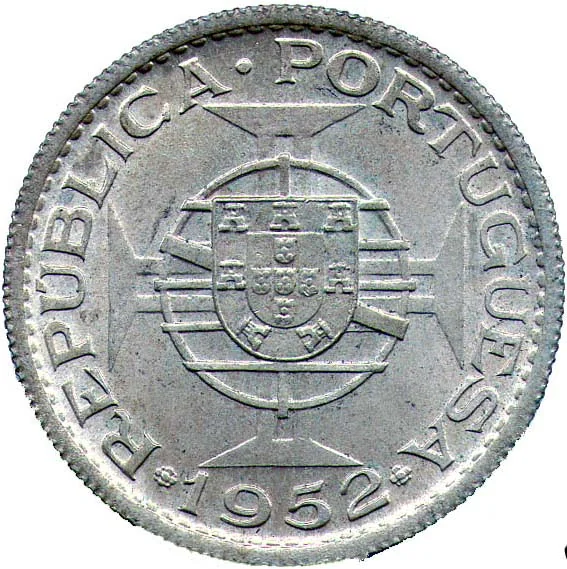
Description:
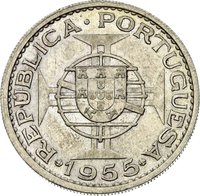
Arms, date beneath.
Inscription:
REPÚBLICA·PORTUGUESA
1952
1952
Translation:
PORTUGUESE REPUBLIC
1952
1952
Script: Latin
Language: Portuguese
Edge
Milled
Categories
| Animal> Elephant |
| Animal> Horse |
| Building> Castle or fortification |
| Symbols> Coat of Arms |
| Symbol> Cross |
Mintings
| Year | Mint Mark | Mintage | Quality | Collection |
|---|---|---|---|---|
| 1952 | — | 2,023,000 | ||
| 1955 | — | 1,977,000 |
Historical background
In 1952, Angola's currency situation was fundamentally defined by its status as a Portuguese colony, integrated into Portugal's metropolitan financial system. The official currency was the Angolan escudo (AOE), which had replaced the angolar just a year earlier, in 1951. This change was not merely a renaming but a symbolic and economic realignment, coinciding with Portugal's constitutional revision that redesignated its colonies as "overseas provinces." The Angolan escudo was pegged at par with the Portuguese escudo (PTE), creating a unified monetary zone controlled entirely from Lisbon. This meant Angola had no independent central bank or monetary policy; its currency supply, interest rates, and financial regulations were dictated by Portugal's Banco Nacional Ultramarino (National Overseas Bank), which served as the central banking authority for the colony.
Economically, this system facilitated the extraction of resources and the financing of colonial infrastructure. The fixed parity ensured stable exchange rates for Portuguese businesses and settlers, simplifying the repatriation of profits from Angola's booming coffee, diamond, and nascent oil industries. However, it also tightly bound Angola's economy to Portugal's often-weaker financial position, limiting its ability to respond to local economic conditions. Currency circulation primarily served the commercial interests of the Portuguese administration and settler community, with the broader Angolan population largely engaged in subsistence agriculture or low-wage labor, having limited interaction with the formal monetary economy.
Thus, the currency situation in 1952 reflected the core dynamics of late colonial rule: political control, economic integration for the benefit of the metropole, and the suppression of financial autonomy. The escudo was a tool of colonial management, ensuring that Angola's growing export wealth was seamlessly convertible into Portugal's currency. This arrangement would remain largely unchallenged until the winds of decolonization began to blow in the 1960s, eventually leading to profound monetary changes after Angola's independence in 1975.
Economically, this system facilitated the extraction of resources and the financing of colonial infrastructure. The fixed parity ensured stable exchange rates for Portuguese businesses and settlers, simplifying the repatriation of profits from Angola's booming coffee, diamond, and nascent oil industries. However, it also tightly bound Angola's economy to Portugal's often-weaker financial position, limiting its ability to respond to local economic conditions. Currency circulation primarily served the commercial interests of the Portuguese administration and settler community, with the broader Angolan population largely engaged in subsistence agriculture or low-wage labor, having limited interaction with the formal monetary economy.
Thus, the currency situation in 1952 reflected the core dynamics of late colonial rule: political control, economic integration for the benefit of the metropole, and the suppression of financial autonomy. The escudo was a tool of colonial management, ensuring that Angola's growing export wealth was seamlessly convertible into Portugal's currency. This arrangement would remain largely unchallenged until the winds of decolonization began to blow in the 1960s, eventually leading to profound monetary changes after Angola's independence in 1975.
🌱 Common