

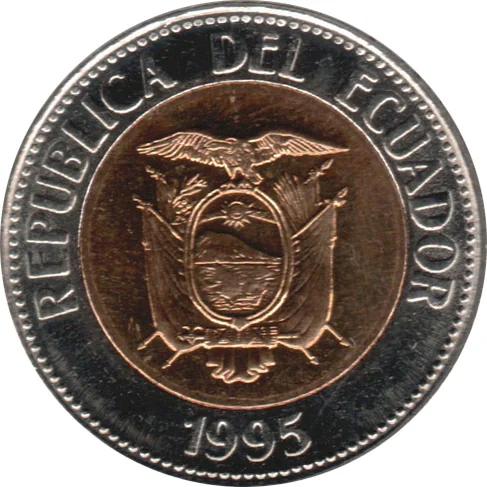
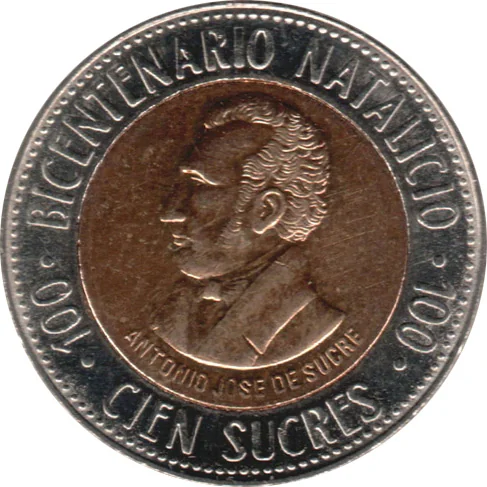
100 sucres – Ecuador
Add to wishlist
Circulating commemorative coins
Commemoration: Bicentennial of Birth of Antonio José de Sucre
Ecuador
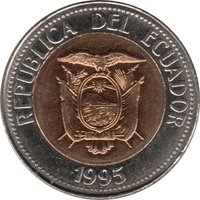
Obverse
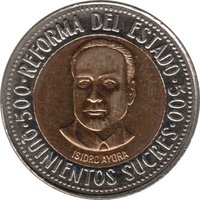
Reverse
Edge
Reeded and plain sections
Categories
| Person> Politician |
Mints
| Name | Mark |
|---|---|
| Sherritt Mint | — |
Mintings
| Year | Mint Mark | Mintage | Quality | Collection |
|---|---|---|---|---|
| 1995 | — | — |
Historical background
In 1995, Ecuador was in the late stages of a prolonged period of macroeconomic instability and currency crisis, directly setting the stage for the dramatic monetary reforms that would follow later in the decade. The national currency, the sucre, was under severe pressure, characterized by chronic devaluation and hyperinflation. This instability was rooted in a combination of external shocks, fiscal deficits financed by the central bank, and a loss of public confidence, leading to a vicious cycle where depreciation fueled inflation, which in turn prompted further depreciation.
The government's response throughout the early 1990s, including under President Sixto Durán Ballén (1992-1996), involved a series of orthodox adjustment programs and attempts at liberalization. However, policies such as a crawling peg exchange rate regime failed to anchor expectations. By 1995, inflation soared to over 22% for the year, and the sucre had depreciated by approximately 21% against the US dollar. This erosion of purchasing power severely impacted living standards, while dollar-denominated foreign debt became increasingly burdensome for both the state and private sector.
Ultimately, the currency situation in 1995 represented the accelerating failure of the sucre as a stable store of value and unit of account. The persistent volatility and loss of confidence crippled investment and economic planning. While full dollarization was still five years away, the crisis of 1995 and its immediate aftermath solidified the consensus among policymakers and the public that radical solutions were necessary, paving the ideological and practical path for the eventual abandonment of the sucre in favor of the US dollar in the year 2000.
The government's response throughout the early 1990s, including under President Sixto Durán Ballén (1992-1996), involved a series of orthodox adjustment programs and attempts at liberalization. However, policies such as a crawling peg exchange rate regime failed to anchor expectations. By 1995, inflation soared to over 22% for the year, and the sucre had depreciated by approximately 21% against the US dollar. This erosion of purchasing power severely impacted living standards, while dollar-denominated foreign debt became increasingly burdensome for both the state and private sector.
Ultimately, the currency situation in 1995 represented the accelerating failure of the sucre as a stable store of value and unit of account. The persistent volatility and loss of confidence crippled investment and economic planning. While full dollarization was still five years away, the crisis of 1995 and its immediate aftermath solidified the consensus among policymakers and the public that radical solutions were necessary, paving the ideological and practical path for the eventual abandonment of the sucre in favor of the US dollar in the year 2000.
🌱 Very Common